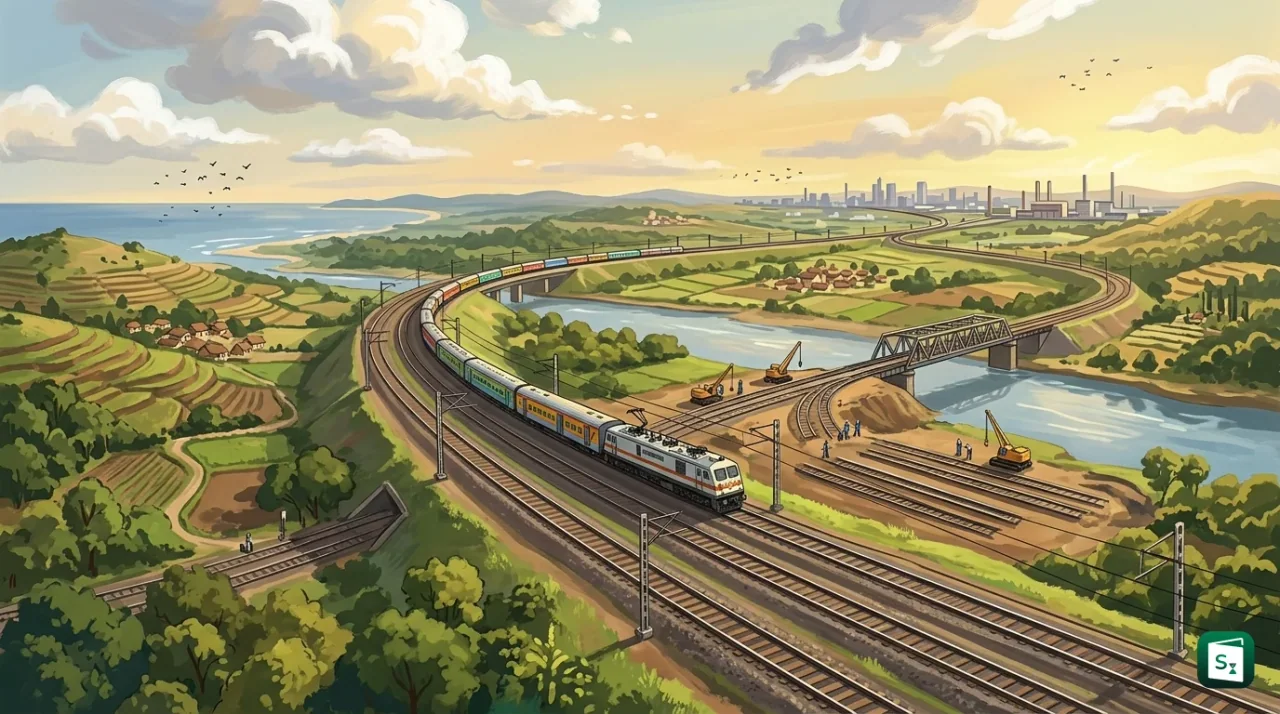
The Cabinet Committee on Economic Affairs (CCEA), chaired by Prime Minister Narendra Modi, has approved eight railway multi-tracking projects worth ₹20,804 crore on 9 September 2026. The projects will add 1,196 km to the Indian Railways network across 31 districts in nine states and are planned for completion by 2029-30. Planned under the PM Gati Shakti National Master Plan, they aim to cut congestion, speed up freight and passenger movement, and lower logistics costs.
What Is Multi-Tracking in Railways?
Multi-tracking means adding one or more extra railway lines alongside an existing line on the same route. If a single line section gets a second line, it is called doubling. If a double line section gets a third or fourth line, it is called tripling or quadrupling. In official approvals, these works are often named as third line, fourth line or third and fourth line projects.
Extra lines matter because many busy routes in India run beyond their capacity. When only one or two lines carry both slow goods trains and fast passenger trains, trains have to wait for clearance and average speed falls. Additional lines allow freight and passenger trains to run on separate paths. This reduces detention, improves punctuality and lets more trains run each day without building an entirely new route.
Eight Railway Projects Approved by the Cabinet
The Cabinet Committee on Economic Affairs (CCEA) is the apex government body that approves large infrastructure and economic proposals. Cabinet approval means the projects have received financial sanction and can move to tendering and construction by the Ministry of Railways and its agencies. In this decision, the eight projects form two bundles with a combined length of 1,196 km.
The first bundle has three projects with an outlay of ₹10,783 crore. It will add about 656 km across 14 districts in West Bengal, Jharkhand, Odisha, Madhya Pradesh and Chhattisgarh. The second bundle has five projects with an outlay of ₹10,021 crore. It will add about 540 km across 17 districts in Tamil Nadu, Andhra Pradesh, Karnataka and Telangana. Together, they cover 31 districts in nine states and are scheduled for completion by FY30, which is the financial year ending March 2030.
| Bundle | Projects | Length | Cost | Coverage |
|---|---|---|---|---|
| Eastern and central India | Kharagpur to Jharsuguda (Bagdehi) fourth line, Katni to Pendra Road fourth line, Bilaspur (Uslapur) to Pendra Road third line | About 656 km | ₹10,783 crore | 14 districts in 5 states |
| Southern India | Arakkonam to Renigunta third and fourth line (77 km), Whitefield to Bangarapet third and fourth line (47 km), Hosur to Omalur doubling (147 km), Salem to Karur to Dindigul doubling (159 km), Secunderabad (Ghatkesar) to Kazipet multi-tracking (110 km) | About 540 km | ₹10,021 crore | 17 districts in 4 states |
| Total | 8 projects | 1,196 km | ₹20,804 crore | 31 districts in 9 states |
What Is the PM Gati Shakti National Master Plan?
The PM Gati Shakti National Master Plan (NMP) is a digital planning platform that brings maps and data from different ministries onto one system to plan infrastructure together. It was launched by Prime Minister Narendra Modi on 13 October 2021. The Cabinet Committee on Economic Affairs approved its implementation on 21 October 2021.
The nodal agency for the plan is the Department for Promotion of Industry and Internal Trade (DPIIT), which functions under the Ministry of Commerce and Industry. DPIIT maintains the central geospatial portal built with GIS data, satellite imagery and data layers on economic zones, rail lines, roads, ports and social infrastructure. More than 44 central ministries and 36 states and Union Territories have joined the platform.
For railways, the plan works through integrated planning and stakeholder consultation. The Network Planning Group (NPG) checks large projects for multi-modal links and last mile connectivity before approval. Inside the Railway Board, a dedicated Gati Shakti Directorate coordinates this planning. The eight multi-tracking projects were planned through this process so that new rail lines connect smoothly with ports, industrial clusters, coal fields and road networks instead of being built in isolation.
Why These Corridors Matter for Freight and Connectivity
The three eastern and central projects lie on high density coal and steel routes. The Kharagpur to Jharsuguda, Katni to Pendra Road and Bilaspur to Pendra Road sections connect mines, steel plants, cement units and power houses across Odisha, Jharkhand, Chhattisgarh and Madhya Pradesh to ports and consumption centres in West Bengal and beyond. These sections carry heavy bulk loads of coal, iron and steel, and cement. Capacity addition of 27 million tonnes per annum (MTPA) is expected on these three lines. This means the railways can move 27 million tonnes more goods each year than at present.
The five southern projects serve a different mix of industry, cities and pilgrim centres. The Arakkonam to Renigunta, Whitefield to Bangarapet, Hosur to Omalur, Salem to Karur to Dindigul and Secunderabad to Kazipet sections link Chennai, Bengaluru, Hyderabad and Coimbatore industrial belts with ports on the east coast. They are important for coal, cement, containers, automobiles, foodgrains, petroleum products and fertilisers. Capacity addition of 47 MTPA is expected on these five lines. Together, all eight projects will create space for about 74 MTPA of extra freight.
Direct village level connectivity will also improve. The three eastern and central projects are expected to improve rail access for about 4,790 villages with a population of around 56 lakh. The five southern projects are expected to benefit about 2,121 villages with a population of around 52 lakh. Better line capacity will mean more passenger trains, fewer delays and easier access to jobs, markets and schools.
Tourism and pilgrimage access is another gain. In the east, improved connectivity will help visitors reach the Bandhavgarh Tiger Reserve, Amarkantak, Achanakmar Tiger Reserve and Taratarini Temple. In the south, access will improve to Tirupati, the Subramaniya Swamy Temple at Tiruttani, the Sri Padmavati Temple at Tiruchanur, Kolar Gold Fields, Hogenakkal Falls, Hosur Fort, Mettur Dam, Kodaikanal Hills, Sathyamangalam Wildlife Sanctuary, Yadagirigutta Temple and Bhongir Fort.
Lower Costs and Cleaner Transport
Rail transport uses less fuel per tonne of goods than road transport. When freight shifts from trucks to trains, diesel use falls and carbon dioxide emissions come down. The three eastern and central projects are estimated to save about 12 crore litres of oil imports and cut about 62 crore kg of carbon dioxide. This cut is described as equal to planting about 2.48 crore trees.
The five southern projects are estimated to save about 8 crore litres of oil and cut about 42 crore kg of carbon dioxide, equal to planting about 2 crore trees. Together, the eight projects are expected to save about 20 crore litres of oil imports and reduce carbon dioxide by about 104 crore kg. For Indian Railways, which is working to raise its share in national freight, such savings support climate goals and help keep the cost of moving goods lower for industry and consumers.
The Way Forward
The projects are now set for detailed execution by the Ministry of Railways, with completion targeted by 2029-30. The next steps include land related formalities where needed, bidding for construction contracts, and phased commissioning of sections. Progress will be tracked through the PM Gati Shakti platform so that road, port and industrial linkages grow along with the rail lines.
Once completed, the added lines will ease pressure on seven high density corridors and other busy routes that are expected to carry more traffic in the future. For passengers, this should mean more train options and better punctuality. For industry, it should mean faster and more reliable supply of coal, steel, cement and essential goods. The steady expansion of such multi-tracking works shows a shift from building isolated lines to adding capacity where demand is already high.
Key Takeaways
- The Cabinet Committee on Economic Affairs approved 8 railway multi-tracking projects worth ₹20,804 crore on 9 September 2026.
- The projects will add 1,196 km across 31 districts in 9 states, with completion targeted by 2029-30.
- The PM Gati Shakti National Master Plan, launched on 13 October 2021, is coordinated by DPIIT under the Ministry of Commerce and Industry.
- The eight lines will create capacity for about 74 MTPA of additional freight, with 27 MTPA from eastern and central routes and 47 MTPA from southern routes.
- The expansion is expected to save about 20 crore litres of oil imports and cut about 104 crore kg of carbon dioxide emissions.