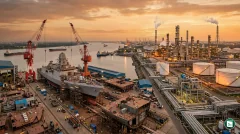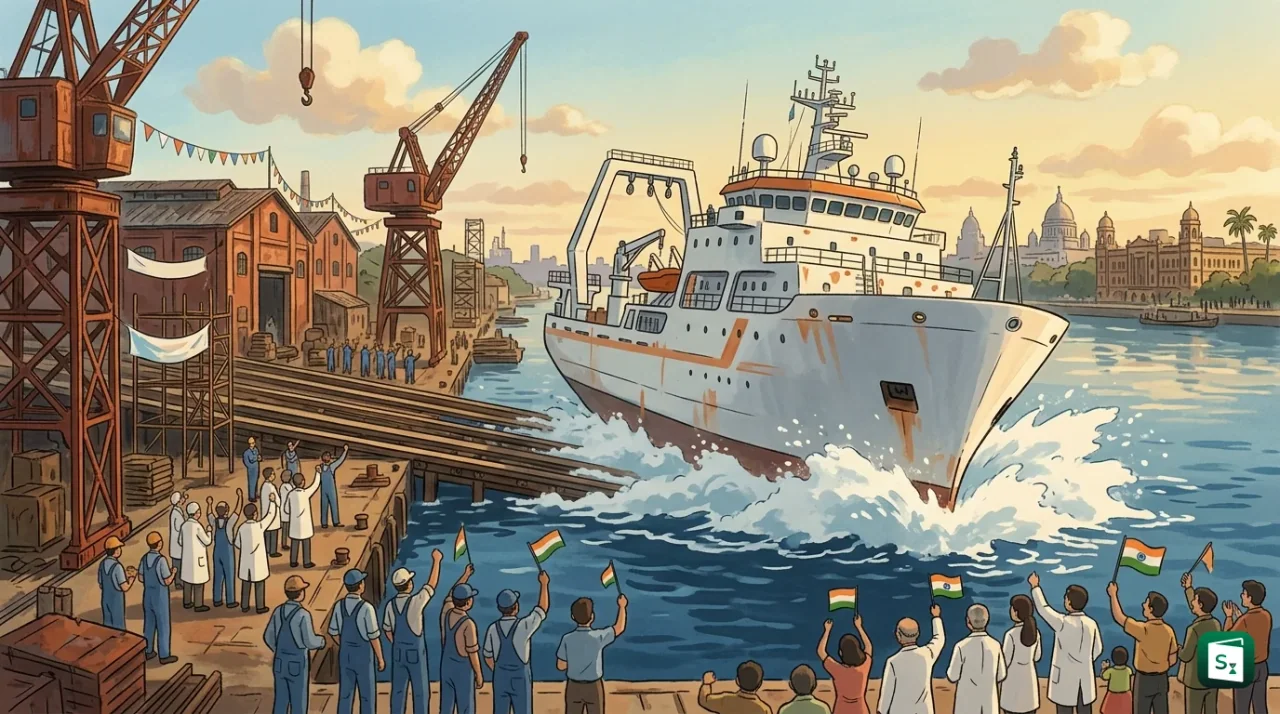
Garden Reach Shipbuilders and Engineers launched Sagar Manthan, India’s first indigenous advanced Ocean Research Vessel (ORV), on 9 September 2026 at the Rishi Bankim Shipyard in Kolkata. Built for the National Centre for Polar and Ocean Research (NCPOR) under the Ministry of Earth Sciences at a cost of around ₹840 crore, the ship will carry out deep sea surveys up to 6 km depth. It is expected to enter full service by early 2028 and take over from the ageing ORV Sagar Kanya, which India bought from Germany in 1983.
What Is Sagar Manthan?
Sagar Manthan is India’s first advanced ocean research vessel designed, engineered and built fully in India. A research vessel is a special ship that works as a floating laboratory. It carries scientists, laboratories and survey tools to study the sea water, sea floor, weather above the sea and life inside the sea.
The ship is listed as Yard 3041 in the build records of Garden Reach Shipbuilders and Engineers. Union Minister for Earth Sciences Jitendra Singh joined the launch through video link, and Manju Singh formally named the ship as per sea tradition. Ministry of Earth Sciences Secretary T. Srinivasa Kumar attended the ceremony in Kolkata along with senior officers of the shipyard, the Deep Ocean Mission and NCPOR.
The name connects to the idea of churning the ocean to gain knowledge and resources. In practical terms, the ship is an all weather, multidisciplinary platform with a planned service life of about 30 years. It is built to sail in tough conditions, including the Southern Ocean around Antarctica, and to support long research trips far from the coast.
Key Features and Technical Capabilities of the Vessel
Sagar Manthan measures 89.5 metres in length and 18.8 metres in width, with a gross tonnage of 5,900 tonnes. Gross tonnage is a measure of the total closed in space inside a ship, and it shows the size of the vessel. The ship can sail at a maximum speed of 14 knots at 90 percent maximum continuous rating. Maximum continuous rating is the highest power at which the main engine can run safely for a long time. One knot equals 1.852 km per hour, so 14 knots is about 26 km per hour.
The ship has space to carry 34 scientists at a time, along with crew members. It has modern laboratories on board, so samples can be tested and data can be studied during the voyage itself. It follows the latest pollution control rules of the International Maritime Organisation (IMO), which is the United Nations body for ship safety and pollution control, under the MARPOL convention. MARPOL is the global rulebook to stop pollution from ships. The ship is built under dual class certification from the Indian Register of Shipping (IRS) and the American Bureau of Shipping (ABS). Class certification means independent agencies have checked the design, construction and safety systems.
| Feature | Detail |
|---|---|
| Length | 89.5 metres |
| Width | 18.8 metres |
| Gross tonnage | 5,900 tonnes |
| Maximum speed | 14 knots at 90 percent maximum continuous rating |
| Maximum survey depth | Up to 6 km |
| Scientist capacity | 34 scientists |
| Service life | Around 30 years |
| Class | Dual class by IRS and ABS |
How the Vessel Will Conduct Ocean Research
Once delivered, Sagar Manthan will carry out underway swath multibeam surveys and geophysical seismic surveys in coastal seas and deep waters. A multibeam survey uses sound waves to make a detailed map of the sea floor. A seismic survey sends sound pulses into the layers below the sea floor to study rocks and structures that may hold minerals.
The ship will also conduct conductivity, temperature and depth profiling, which is called CTD profiling. This test measures how salty, warm and deep the sea water is at different levels. It will collect water samples and living samples using vertical and horizontal nets. It will place and recover moorings and data buoys on the surface and in the deep sea, take sea floor samples using corers and grabs, and collect rock pieces using chain bag dredges.
For advanced study, the vessel carries dynamic positioning, multibeam bathymetry systems, multichannel seismic systems, sub bottom profilers, weather radar and drop keels. Dynamic positioning is a computer controlled system that holds the ship at an exact spot in the sea without anchoring. The ship has a DP2 dynamic positioning system, which has backup controls for very exact work. It is designed to Silent A standards, which means it produces very low underwater noise so that sound based survey tools give clear results. It can also launch and recover Remotely Operated Vehicles (ROVs) and Autonomous Underwater Vehicles (AUVs). ROVs are underwater robots controlled by cable from the ship, while AUVs swim on their own on a set path. The vessel will also record surface weather, ocean currents and upper air data, and it will train scientists and technicians at sea.
Who Built It and For Whom?
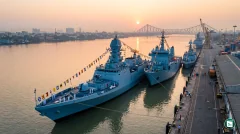
Garden Reach Shipbuilders and Engineers (GRSE) designed, engineered and built the ship. GRSE is a defence public sector company under the Ministry of Defence, based in Kolkata in West Bengal. It started as a small workshop to repair river vessels in 1884, was taken over by the Government of India in 1960, and built independent India’s first warship, INS Ajay, in 1961. It has delivered more than 800 platforms, including 118 warships for the Navy, Coast Guard and friendly foreign countries. In June 2026, GRSE received Navratna status, which gives large public companies greater freedom to invest and take business decisions.
The ship was built for the National Centre for Polar and Ocean Research (NCPOR). NCPOR is an autonomous research body under the Ministry of Earth Sciences. It was set up on 25 May 1998 and is located at Vasco da Gama in Goa. It was first called the National Centre for Antarctic and Ocean Research and was later renamed. NCPOR is the nodal agency for India’s polar and Southern Ocean work. Nodal agency means it plans, coordinates and carries out the full programme. It maintains India’s two research stations in Antarctica, Maitri (set up in 1989) and Bharati (set up in 2011), and manages the Arctic station Himadri. The present Director of NCPOR is Thamban Meloth.
The Ministry of Earth Sciences (MoES) is the administrative ministry for this project. It handles ocean science, weather, climate and polar research through bodies such as NCPOR, the National Institute of Ocean Technology (NIOT) in Chennai and the Indian National Centre for Ocean Information Services (INCOIS) in Hyderabad. The contract for the ship was signed in July 2024 at a value of ₹839.55 crore. Steel cutting took place on 29 November 2024, and the keel was laid on 8 April 2026. Keel laying is the formal start of joining the main body of the ship. The launch took place barely five months after keel laying, which the shipyard presented as faster than the planned schedule.
Sagar Manthan and India’s Deep Ocean Mission
Sagar Manthan is being built under Vertical 4, which covers Deep Ocean Survey and Exploration, of the Deep Ocean Mission. The Deep Ocean Mission is the central government’s flagship plan to study the deep ocean and use its living and non living resources in a safe and sustainable way. The Ministry of Earth Sciences is the nodal ministry for the Mission. The Cabinet Committee on Economic Affairs approved the Mission in 2021 at a total cost of ₹4,077 crore for five years. It supports the Blue Economy idea, which means using ocean resources such as shipping, fishing, minerals, energy and tourism to create jobs and growth while protecting the sea.
The Mission has six verticals, which are six work areas with separate goals and budgets.
| Vertical | Focus Area |
|---|---|
| Vertical 1 | Technologies for deep sea mining, manned submersible and underwater robotics |
| Vertical 2 | Ocean climate change advisory services |
| Vertical 3 | Search and protection of deep sea biodiversity |
| Vertical 4 | Deep ocean survey and exploration, including research ships such as Sagar Manthan |
| Vertical 5 | Energy and fresh water from the ocean, including ocean thermal energy conversion |
| Vertical 6 | Advanced marine station for ocean biology at Nemmeli in Chennai |
Sagar Manthan directly supports Vertical 4. Its surveys will help find polymetallic nodules and polymetallic sulphides along the mid ocean ridges in the Indian Ocean. Polymetallic nodules are potato sized lumps on the deep sea floor that contain metals such as manganese, nickel, cobalt and copper. Polymetallic sulphides are mineral deposits near hot underwater vents that contain copper, zinc, gold and silver. India holds exploration rights from the International Seabed Authority, the United Nations linked body that controls mineral activity in international sea bed areas, for about 75,000 sq km in the Central Indian Ocean.
The vessel also links with Samudrayaan, India’s manned ocean mission under the Deep Ocean Mission. Samudrayaan aims to send three people to 6,000 metres depth in the manned submersible Matsya 6000. Matsya 6000 is being developed by NIOT Chennai. It has completed harbour trials in shallow water, and work is on for deeper trials in stages. Sagar Manthan can work as a support and research platform for such deep sea technology tests, surveys and sampling.
Why Sagar Manthan Matters for India
For more than four decades, India depended on ORV Sagar Kanya for major ocean voyages. That ship is now 43 years old, so maintenance costs are high and modern tools cannot be fitted easily. Sagar Manthan will slowly take over its role with new sensors, quiet operation and on board laboratories. This will cut dependence on foreign shipyards and foreign research ships.
The ship also strengthens self reliance in specialised shipbuilding. Warships and research ships need very exact design, low noise and heavy deck machines. GRSE has shown it can build such complex platforms in India with high local content. This supports the Make in India effort and keeps design skills, jobs and supply chains inside the country.
For resources and climate, the gains are direct. Detailed maps of the sea floor will guide the search for deep sea minerals, gas hydrates and biodiversity with commercial and scientific value. Gas hydrates are ice like solids that trap natural gas in sea floor sediments. Regular CTD data, current data and weather data will improve ocean models, monsoon understanding and early warnings for cyclones, storm surges and coastal erosion. Work in the Southern Ocean will also help India’s Antarctic programme, since the same ship can support polar linked ocean studies and long term monitoring of the seas around Maitri and Bharati.
The Way Forward
Launch means the ship has entered water for the first time, but it is not ready for research yet. The next steps are construction of the superstructure, which is the upper part of the ship above the main deck, fitting of scientific systems, wiring and integration, harbour checks and then sea trials. Sea trials test speed, stability, noise, positioning and scientific tools in real sea conditions.
Final delivery to NCPOR and the Ministry of Earth Sciences is planned for 2028, with full operations expected by early 2028. The Ministry has also stated plans to add more research capability, including additional oceanographic vessels and a dedicated Polar Research Vessel for ice region work. Once Sagar Manthan joins service, India will have its largest home built research vessel for deep sea exploration, and a stable platform for the next 30 years of ocean, climate and mineral research.
Key Takeaways
- Sagar Manthan (Yard 3041) was launched on 9 September 2026 at GRSE’s Rishi Bankim Shipyard in Kolkata.
- The vessel is India’s first indigenous advanced Ocean Research Vessel, built by GRSE for NCPOR under the Ministry of Earth Sciences.
- It is built under Vertical 4 of the Deep Ocean Mission at a cost of around ₹840 crore and will be fully operational by early 2028.
- The ship measures 89.5 metres in length, has a gross tonnage of 5,900 tonnes, a speed of 14 knots and can survey up to 6 km depth.
- NCPOR was established on 25 May 1998 at Vasco da Gama, Goa, and maintains India’s Antarctic stations Maitri and Bharati.
- The Deep Ocean Mission was approved in 2021 with an outlay of ₹4,077 crore, and Samudrayaan’s Matsya 6000 aims to carry three persons to 6,000 metres depth.