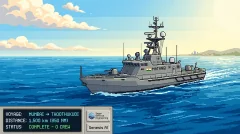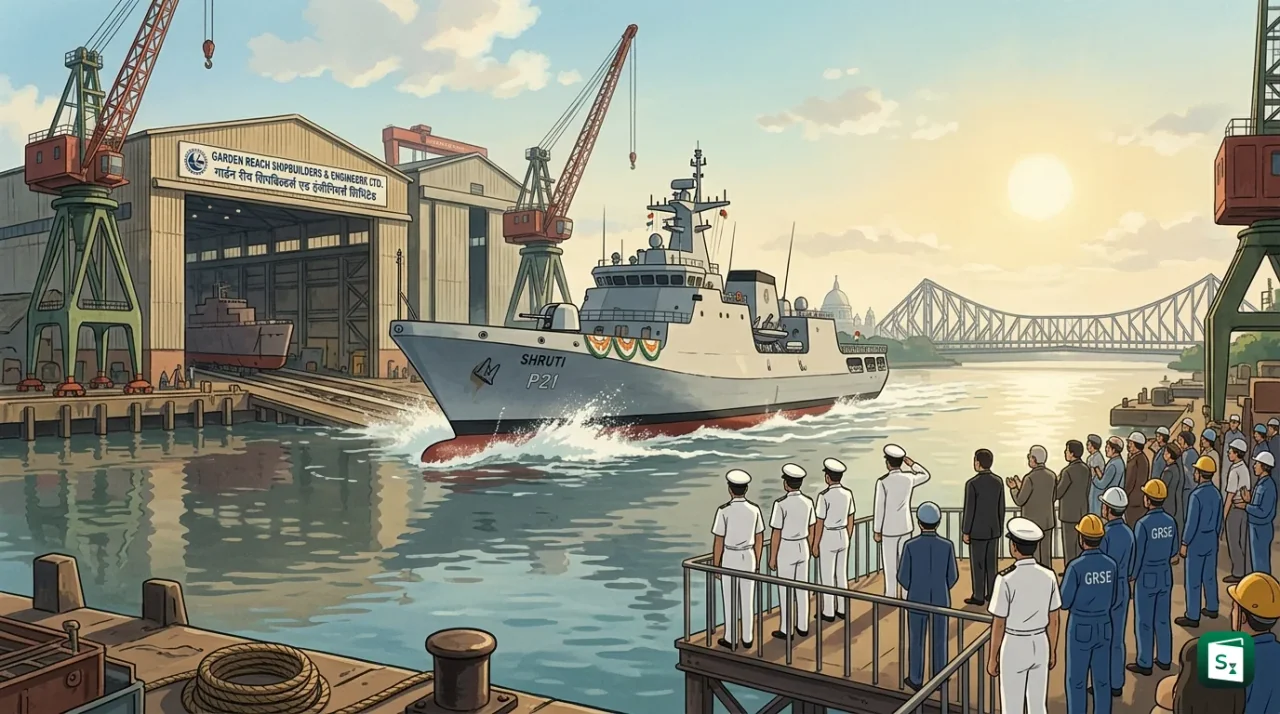
The Indian Navy launched Shruti (Yard 3037), a Next-Generation Offshore Patrol Vessel, at Garden Reach Shipbuilders and Engineers (GRSE) in Kolkata on 11 August 2026. The vessel was ceremonially launched by Mrs Manika Sadhu in the presence of Vice Admiral Sanjay Sadhu, Controller of Warship Production and Acquisition. Shruti is the second of four NGOPVs being built by GRSE as part of a wider 11-ship programme contracted by the Ministry of Defence at a total value of ₹9,781 crore.
What Is the NGOPV Programme?
The Next Generation Offshore Patrol Vessel (NGOPV) programme is India’s largest indigenous patrol vessel initiative, designed to replace and upgrade the Indian Navy’s ageing fleet of conventional Offshore Patrol Vessels (OPVs) and Near Offshore Patrol Vessels (NOPVs). The programme was formalised on 30 March 2023, when the Ministry of Defence signed contracts with two Defence Public Sector Undertakings under the Buy (Indian-IDDM) category, the highest preference tier under India’s Defence Acquisition Procedure that mandates platforms be indigenously designed, developed, and manufactured.
Under the contract, Goa Shipyard Limited (GSL) serves as the lead shipyard and is constructing 7 vessels, while GRSE is building the remaining 4 vessels. The total contract value of ₹9,781 crore translates to roughly ₹889 crore per vessel at FY2023 prices. In December 2023, Bharat Electronics Limited (BEL) secured a separate order worth ₹2,673 crore to supply 14 categories of sensors for installation across all 11 NGOPVs, ensuring that even the electronic warfare and sensor suites are domestically produced.
The programme was conceived to give the Indian Navy a versatile, modern platform capable of operating across multiple mission profiles, from anti-piracy patrols in the Arabian Sea to humanitarian relief operations in the Indian Ocean neighbourhood. Unlike older OPVs, which were primarily basic patrol platforms, the NGOPVs are designed as multi-role combatant vessels with significantly greater endurance, firepower, and operational flexibility.
Shruti: Name and Design
The name Shruti carries deep cultural resonance. In Indian tradition, Shruti refers to “that which is heard” and is closely associated with the four Vedas, the oldest scriptures of Hinduism, which were preserved through oral transmission across generations. The naming convention follows the Indian Navy’s tradition of deriving vessel names from India’s rich heritage. The first NGOPV launched at GRSE, Sanghmitra (Yard 3039), launched on 20 May 2026, was named after the daughter of Emperor Ashoka who carried Buddhism to Sri Lanka.
The crest of Shruti depicts the Ursa Major constellation and a red-and-white lighthouse, symbols that connect the vessel to India’s maritime navigation tradition. The ship was launched with traditional naval ceremonies, including Vedic chanting and rituals, reflecting the Navy’s blend of modern capability and cultural continuity.
Shruti’s launch marks the second NGOPV to enter the water at GRSE and the third overall in the 11-ship programme. The first NGOPV in the entire programme, INS Shachi (Yard 1280), was launched at GSL, Goa, on 31 March 2026. GRSE’s first, Sanghmitra, followed on 20 May 2026. With Shruti now in the water, GRSE has launched two of its four assigned vessels within a span of less than three months, demonstrating the shipyard’s accelerated construction tempo.
Technical Specifications
The NGOPVs are significantly larger and more capable than the Sukanya-class and Saryu-class OPVs they are designed to replace. The vessels measure approximately 113 metres in length and 14.6 metres in beam, with a displacement of around 3,000 tonnes. They have a structural draught of just 4 metres, which allows them to operate in shallow coastal waters, a critical requirement for protecting India’s offshore oil rigs, fishing fleets, and island territories.
| Parameter | Specification |
|---|---|
| Length | ~113 metres |
| Beam (Width) | ~14.6 metres |
| Displacement | ~3,000 tonnes |
| Maximum Speed | 23 knots |
| Cruising Speed | 14 knots |
| Range | 8,500 nautical miles |
| Draught | 4 metres (shallow) |
| Sea Endurance | Minimum 60 days |
| Crew | 24 officers (incl. 4 women) + 130 sailors |
The vessels can remain at sea for a minimum of 60 days without replenishment, giving the Indian Navy the ability to sustain prolonged patrols across the vast Indian Ocean Region. Their range of 8,500 nautical miles at a cruising speed of 14 knots allows them to operate far beyond India’s immediate coastline, reaching the choke points of the Strait of Malacca, the Gulf of Aden, or the Mozambique Channel.
The sensor and weapons fit is being supplied by Bharat Electronics Limited (BEL) under its ₹2,673 crore contract. This includes the Lynx-U2 fire control system and EON-51 Close-In Weapon Systems (CIWS), providing the vessels with both offensive and defensive capabilities against surface and aerial threats.
Operational Roles and Capabilities
The NGOPVs are designed as multi-role platforms, meaning a single vessel can perform a wide variety of missions depending on the operational requirement. Their primary roles include:
- Coastal and offshore asset protection: Safeguarding India’s oil rigs, fishing fleets, and Exclusive Economic Zone (EEZ) across a 7,516-kilometre coastline.
- Maritime surveillance: Domain awareness across India’s coastal zones, the Andaman and Nicobar Islands, and Lakshadweep.
- Anti-piracy operations: Continuous patrols in the Arabian Sea and Gulf of Aden, where the Indian Navy has operated since 2008.
- Visit, Board, Search and Seizure (VBSS): Maritime interdiction against smugglers, traffickers, and illegal vessels.
- Search and Rescue (SAR) and Humanitarian Assistance and Disaster Relief (HADR): Critical for India’s role as a first responder in the Indian Ocean neighbourhood.
- Special operations: Insertion and extraction of special operations forces.
- Mine warfare support and counter-infiltration operations along India’s coastline.
- Non-combatant evacuation operations (NEO): Evacuating Indian citizens from conflict zones abroad.
- Fleet support: Hospital facilities, communications intelligence (COMINT), and maintenance support for other naval units.
The shallow draught of 4 metres is a deliberate design choice. It enables the NGOPVs to operate close to shore and in littoral waters where larger combat frigates and destroyers cannot venture. This makes them ideal for protecting India’s island territories in the Andaman and Nicobar chain, the Lakshadweep archipelago, and the numerous offshore development areas along the western and eastern coasts.
GRSE: The Shipyard Behind the Build
Garden Reach Shipbuilders and Engineers (GRSE) Ltd is a Defence Public Sector Undertaking (DPSU) under the Ministry of Defence, headquartered in Kolkata on the banks of the Hooghly River. The shipyard traces its origins to 1884 and was taken over by the Government of India in 1960. Just a year later, it delivered INS Ajay, which was among the first indigenously built warships delivered to the Indian Navy.
Over its 65-year history, GRSE has delivered a record 118 warships to the Indian Navy and Indian Coast Guard, with 80 of those going to the Navy. It has built over 800 ships and platforms in total, serving the Navy, Coast Guard, export customers, and friendly foreign nations. In June 2026, GRSE was accorded Navratna status by the Department of Public Enterprises, making it the 29th Navratna central public sector enterprise in India. The Navratna designation provides greater financial and operational autonomy, allowing the shipyard to undertake larger investments and expansion projects without requiring extensive government approvals.
GRSE’s recent performance has been striking. In FY 2025-26, the shipyard delivered eight warships, including three on a single day, 30 March 2026: the guided-missile frigate INS Dunagiri, the survey vessel INS Sanshodhak, and the anti-submarine warfare shallow water craft INS Agray. Revenue from operations surged from ₹1,754 crore in FY 2021-22 to ₹7,002 crore in FY 2025-26, a jump of nearly 300 per cent. Profit after tax rose from ₹190 crore to ₹748 crore over the same period.
For the current year, GRSE has set a target to deliver five warships and launch four vessels. The shipyard currently has capacity for the concurrent construction of up to 28 ships and aims to raise this to 32 over the next few years. GRSE is also making inroads into the global shipbuilding market, constructing 12 multi-purpose vessels for a German company, and has delivered India’s largest zero-emission electric ferry to the Government of West Bengal.
Strategic Significance
The NGOPV programme is embedded in India’s broader strategic reorientation towards indigenous defence production. The Buy (Indian-IDDM) procurement category mandates a minimum of 50 per cent indigenous content, though GRSE has historically achieved over 90 per cent in comparable programmes. The programme is expected to generate employment of 110 lakh man-days over a period of seven and a half years, providing a significant boost to the domestic economy and the MSME sector that supplies components and subsystems.
From a maritime security perspective, the NGOPVs are critical to India’s ability to project power across the Indian Ocean Region (IOR). The Indian Navy operates under the SAGAR doctrine (Security and Growth for All in the Region), which calls for India to serve as the primary security provider in the IOR. With China’s naval presence expanding through bases in Djibouti and Hambantota, and with increasing threats from piracy, illegal fishing, and maritime terrorism, the NGOPVs give India a modern, indigenous platform to maintain a persistent presence across critical sea lanes.
The naming of these vessels also carries diplomatic weight. Names like Sanghmitra and Shruti connect India’s naval capability to its civilisational heritage, reinforcing the idea that India’s maritime power is not merely a modern military construct but an extension of a tradition that stretches back millennia. As GRSE continues to launch and deliver these vessels, the NGOPV programme stands as one of the most visible outcomes of the Aatmanirbhar Bharat initiative in the defence sector.
Key Takeaways
- Shruti (Yard 3037) was launched at GRSE, Kolkata, on 11 August 2026, making it the second of four NGOPVs being built by GRSE for the Indian Navy.
- The NGOPV programme consists of 11 vessels contracted on 30 March 2023 at a total value of ₹9,781 crore under the Buy (Indian-IDDM) category, with GSL building 7 and GRSE building 4.
- Each NGOPV measures approximately 113 metres in length, displaces around 3,000 tonnes, and can remain at sea for a minimum of 60 days with a range of 8,500 nautical miles.
- Bharat Electronics Limited (BEL) secured a ₹2,673 crore contract in December 2023 to supply 14 categories of sensors for all 11 NGOPVs.
- GRSE was accorded Navratna status on 19 June 2026, becoming the 29th Navratna CPSE, and has delivered 118 warships over its 65-year history.
- The NGOPVs are designed for multi-role operations including anti-piracy, maritime surveillance, VBSS, HADR, and special operations, with a shallow 4-metre draught for coastal and littoral missions.