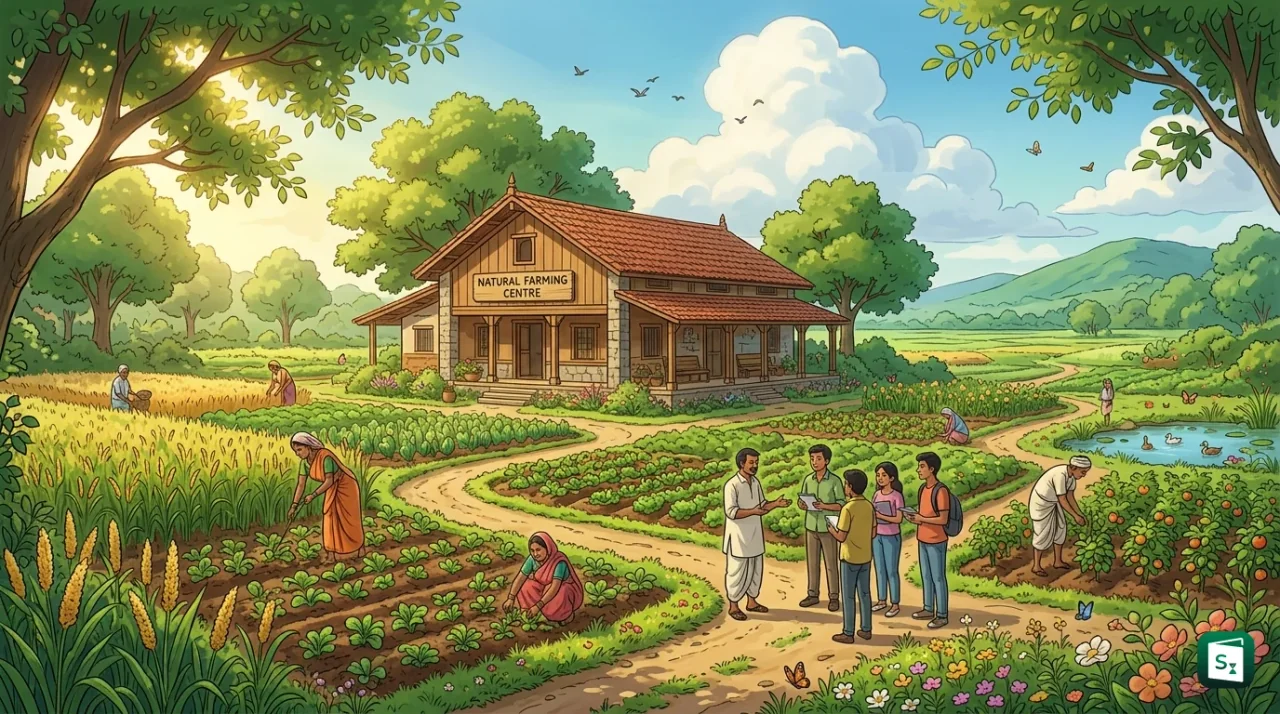
The Gujarat government has approved an allocation of ₹20 crore for the financial year 2026-27 to establish four Centres of Excellence (CoEs) for natural farming across the state. These centres will be set up in Navsari, Morbi, Bhavnagar, and Chhota Udepur districts under the guidance of Governor Acharya Devvrat, a champion of natural farming who has helped nearly 10 lakh farmers in Gujarat transition from chemical-based agriculture to chemical-free practices.
What is Natural Farming and Why It Matters
Natural farming, known as Bharatiya Prakritik Krishi Paddhati (BPKP), is a chemical-free agricultural system rooted in traditional Indian knowledge. It uses locally prepared formulations based on cow dung and cow urine instead of synthetic fertilisers and pesticides. The practice focuses on on-farm biomass recycling, mulching, and use of bio-stimulants to improve soil health and reduce cultivation costs.
The central government has been promoting natural farming through the Paramparagat Krishi Vikas Yojana (PKVY), launched in FY 2015-16. Under this, the Bharatiya Prakritik Krishi Paddhati was implemented as a sub-scheme from 2020-21 to 2022-23. In November 2024, the Union Cabinet approved the National Mission on Natural Farming (NMNF) as a standalone Centrally Sponsored Scheme with a total outlay of ₹2,481 crore. The mission aims to reach one crore farmers, initiate natural farming across 7.5 lakh hectares, and establish 10,000 Bio-Input Resource Centres (BRCs) nationwide.
Gujarat’s Natural Farming Journey
Gujarat has emerged as one of the leading states in promoting natural farming. The state government has made significant financial allocations to support farmers transitioning from chemical-based agriculture. In the Budget 2020-21, special financial assistance was announced for promoting natural farming under the Gujarat Atma Nirbhar package.
On 17 September 2020, two schemes were launched under this package: Sat Pagla Khedut Kalyanna and Pagala for Natural Farming. The first scheme provides ₹900 monthly subsidy for the maintenance cost of one indigenous cow to farming families practising natural farming. The second scheme offers ₹1,248 subsidy to farmers for purchasing a natural farming kit to prepare Jeevamrut, a bio-stimulant made from cow dung, cow urine, jaggery, and pulse flour.
The number of farmers practising natural farming in Gujarat has grown exponentially. From just 35,000 farmers in 2019, the number rose to 8,71,316 in 2023 and further to 9,75,761 by December 2024. This remarkable growth is largely attributed to the sustained efforts of Governor Acharya Devvrat, who has been championing the cause since taking charge in July 2019.
Role of Governor Acharya Devvrat
Acharya Devvrat, born on 18 January 1959, is an Arya Samaj pracharak and former educator who served as the principal of Gurukul Kurukshetra in Haryana for 35 years. He took charge as Governor of Gujarat in July 2019 and is also the Chancellor of Gujarat Vidyapith, founded by Mahatma Gandhi in 1920.
His journey with natural farming began around 2012-13 at Gurukul Kurukshetra when a farm labourer lost consciousness after spraying pesticides. This incident prompted him to explore alternatives, leading him to adopt natural farming on 180 acres of land at the gurukul. After successfully implementing the practice, he carried the movement to Himachal Pradesh during his tenure as Governor from 2015 to 2019, where nearly 50,000 farmers adopted natural farming.
In Gujarat, Devvrat has institutionalised the natural farming movement through several initiatives. He organised a mega event for 10,000 farmers at Mahatma Mandir in Gandhinagar in September 2019, inaugurated Subhash Palekar Prakrutik Krushi Talim Karyashalas, and launched the state’s natural farming website. He has also established a cluster-based model where practising farmers and Krishi Sakhis handhold other farmers in villages. As of 2024, over 9.75 lakh farmers across Gujarat have adopted natural farming under his guidance.
The Four Centres of Excellence: Locations and Functions
The Gujarat government has approved ₹20 crore for establishing four Centres of Excellence (CoEs) in the financial year 2026-27. These centres will be set up under the Gujarat Prakrutik Krishi Vikas Board, the nodal agency responsible for implementing natural farming schemes in the state.
The four CoEs will be established at the following locations:
| District | Village/Town | Taluka |
|---|---|---|
| Navsari | Nani Bhamti | Vansda |
| Morbi | Halvad | Halvad |
| Bhavnagar | Walavad | Sihor |
| Chhota Udepur | Chudel | Jetpur Pavi |
Each centre will be equipped with modern facilities capable of training up to 100 farmers at a time. The centres will serve both farmers already practising natural farming and those interested in adopting the practice. They will not remain limited to training alone but will be developed as model campuses for natural farming.
The selection of these four districts is strategic. Chhota Udepur is a predominantly tribal district where farming is already practised with minimal use of chemical fertilisers due to the economic conditions of small and marginal farmers. Navsari, Morbi, and Bhavnagar represent diverse agro-climatic zones of Gujarat, ensuring the model can be replicated across different agricultural conditions.
What the CoEs Will Offer: Training, Bio-Inputs, and Value Addition
The Centres of Excellence will provide comprehensive support to farmers across multiple dimensions. The training programmes will cover the preparation and use of key bio-inputs, soil testing, quality testing of agricultural products, and assistance with new technologies and primary agricultural materials.
Bio-Input Production
The centres will produce and make available several essential bio-inputs at nominal prices:
-
Jeevamrut: A liquid bio-stimulant made from cow dung, cow urine, jaggery, pulse flour, lime, and uncontaminated soil. It promotes microbial activity in the soil and increases earthworm populations. Farmers apply it every fortnight by spraying directly on crops or mixing with irrigation water.
-
Ghan Jeevamrut: A concentrated, dried form of Jeevamrut that can be stored and used as needed.
-
Beejamrut: A fermented microbial solution used as seed treatment to protect young roots from fungal infections. It is prepared using cow dung, cow urine, lime, and bund soil.
-
Neemastra: A natural pesticide and insect repellent made from neem leaves, cow dung, and cow urine. It controls sucking pests like jassids, aphids, and whiteflies.
Practical Demonstrations
The centres will conduct demonstrations of the five-layer natural farming model, mixed cropping, and intercropping methods. Experts will also visit farmer fields to provide on-site guidance. Training will include standard natural farming practices for various crops.
Value Addition Support
Beyond cultivation, the centres will assist farmers with value addition, processing, storage, and packaging of their produce. This is expected to help farmers get better returns from their agricultural output. The centres will also produce and sell mulching materials, crop seeds, horticultural saplings, cuttings, grafts, and other planting materials.
Linkage with the National Mission on Natural Farming
Gujarat’s initiative to establish Centres of Excellence aligns with the broader national framework for promoting natural farming. The National Mission on Natural Farming (NMNF), approved by the Union Cabinet in November 2024, is a standalone Centrally Sponsored Scheme under the Ministry of Agriculture and Farmers’ Welfare.
The NMNF, with a total outlay of ₹2,481 crore (Centre’s share: ₹1,584 crore; States’ share: ₹897 crore), targets the creation of 15,000 natural farming clusters across willing Gram Panchayats. It aims to initiate natural farming in 7.5 lakh hectares and reach one crore farmers. The mission also envisages setting up 10,000 need-based Bio-Input Resource Centres (BRCs) and approximately 2,000 model demonstration farms at Krishi Vigyan Kendras (KVKs) and agricultural universities.
Gujarat was among the states that had already adopted the Bharatiya Prakritik Krishi Paddhati (BPKP) under the Paramparagat Krishi Vikas Yojana before the NMNF was launched. The state’s decision to invest ₹20 crore in Centres of Excellence demonstrates its continued commitment to expanding natural farming at the grassroots level, complementing the central government’s mission mode approach.
Key Takeaways
- The Gujarat government has approved ₹20 crore for FY 2026-27 to establish four Centres of Excellence for natural farming in Navsari, Morbi, Bhavnagar, and Chhota Udepur districts.
- The centres will be implemented by the Gujarat Prakrutik Krishi Vikas Board under the guidance of Governor Acharya Devvrat.
- Each centre will train up to 100 farmers at a time in bio-input preparation, soil testing, value addition, and the five-layer natural farming model.
- The key bio-inputs taught include Jeevamrut, Ghan Jeevamrut, Beejamrut, and Neemastra, all prepared from indigenous cow dung and urine.
- The number of farmers practising natural farming in Gujarat grew from 35,000 in 2019 to 9,75,761 by December 2024.
- The initiative aligns with the National Mission on Natural Farming (NMNF), approved by the Union Cabinet in November 2024 with an outlay of ₹2,481 crore.