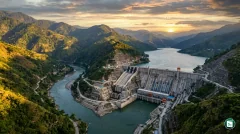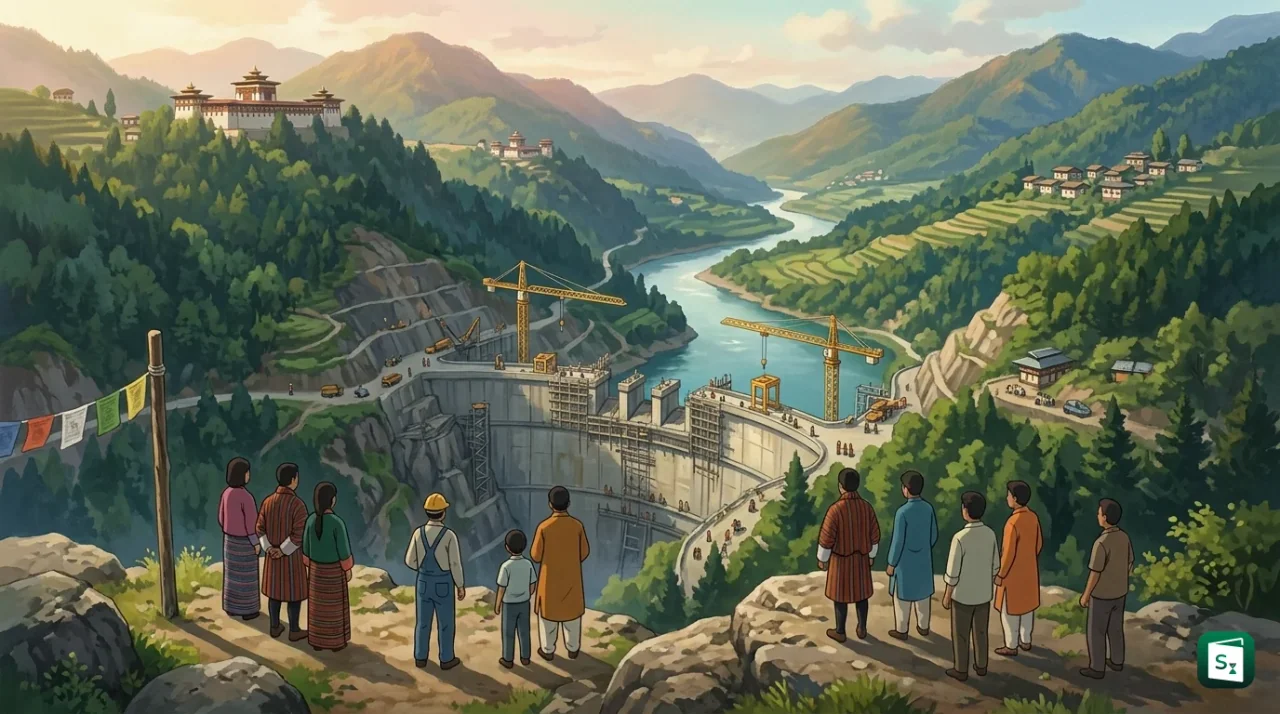
JSW Neo Energy Limited, a wholly owned subsidiary of JSW Energy, has signed a Shareholders\u2019 Agreement with Bhutan\u2019s Druk Green Power Corporation Limited (DGPC) for the joint development of the 920 MW Punatsangchhu-III Hydroelectric Project. The agreement, signed in the presence of the Prime Minister of Bhutan, marks JSW Energy\u2019s first power generation venture outside India. The project will be built on the Punatsangchhu River in Wangdue Phodrang District and developed through a joint venture company on a Build-Own-Operate-Transfer (BOOT) basis.
What Is the Punatsangchhu-III Hydroelectric Project?
The Punatsangchhu-III Hydroelectric Project is a proposed run-of-the-river scheme with an installed capacity of 920 MW, designed as a four-unit facility with each turbine generating 230 MW. The project is located downstream of the already commissioned Punatsangchhu-II (1,020 MW) project on the same river. The dam complex will be situated near Harachhu, and the underground powerhouse will be located approximately 2 km downstream of Relangthang in Wangdue Phodrang District.
At the pre-feasibility study stage, the total project cost is estimated at Nu 78 billion (approximately \u20b96,500 crore), though this figure will be firmed up during the Detailed Project Report (DPR) preparation that is currently underway jointly by DGPC and JSW Neo Energy. The project is planned to generate about 3,400 million units of electricity annually, with winter generation accounting for roughly 20 to 25 percent of total output.
Construction is expected to begin in late 2027, with the total development timeline envisaged at approximately six years. The project is targeted for commissioning by 2032\u20132033.
The Punatsangchhu River, known as the Sunkosh River in India, originates from glacial lakes at an altitude of about 7,000 metres in Gasa District of Bhutan. The Phochhu and Mochhu tributaries merge at Punakha at roughly 1,200 metres to form the Punatsangchhu, which flows southward into the Indian plains of West Bengal before joining the Brahmaputra. Bhutan\u2019s Power System Master Plan (PSMP) of 1993 had identified seventeen hydropower projects in the Punatsangchhu basin with a combined capacity of 8,035 MW, making it one of the most significant river systems for the country\u2019s energy ambitions.
Ownership Structure and the BOOT Model
The project will be developed through a joint venture (JV) company to be incorporated in Bhutan. DGPC will hold a 51 percent stake, ensuring majority ownership remains with Bhutan\u2019s state entity, while JSW Neo Energy will hold the remaining 49 percent. JSW Neo Energy will subscribe to its stake in cash, with an initial contribution of BTN 245 million (approximately \u20b920 crore). Any further capital infusion will depend on the progress of project development.
The agreement was signed by Dasho Chhewang Rinzin, Managing Director of DGPC, and Sharad Mahendra, Joint Managing Director and CEO of JSW Energy. The Investment-cum-Shareholders\u2019 Agreement lays out the ownership and governance structure, funding contributions, roles and responsibilities, share transfer terms, and dispute resolution mechanisms.
What Is a BOOT Model?
The project will be executed on a Build-Own-Operate-Transfer (BOOT) basis. Under this model, the JV company will build the project, own it during the concession period, operate it to generate revenue, and eventually transfer full ownership to the Royal Government of Bhutan after a fixed concession period, typically 30 to 40 years. During the concession, the project authority receives revenue from power sales, and a portion of the generation is often allocated as royalty to the host government.
DGPC plans to meet its equity contribution primarily through operational cash flows, while loans will be raised through a non-recourse project financing arrangement with the support of JSW as the strategic partner. The JV will also require regulatory approvals in Bhutan, including from the Corporate Regulatory Authority and for foreign direct investment clearance.
Why Bhutan Matters for India\u2019s Clean Energy Push
Bhutan is one of the world\u2019s few carbon-negative nations. Its power system is built entirely on clean hydropower, and the country is now expanding into other renewables such as solar. The Himalayan river systems offer substantial untapped hydroelectric potential, and the country has a long-established record of developing and operating large hydro assets.
For India, Bhutanese hydropower plays a critical role in meeting clean energy targets. The electricity trade between the two countries reached approximately 5,600 GWh in 2021. Bhutan\u2019s hydropower generation peaks during the monsoon months, which aligns well with India\u2019s summer demand pattern. This complementarity makes cross-border hydropower trade particularly valuable for grid stability on both sides.
Hydropower\u2019s Role in Bhutan\u2019s Economy
Hydropower is the single largest contributor to Bhutan\u2019s GDP. Power exports to India account for roughly 63 percent of the country\u2019s total exports. Druk Green Power Corporation (DGPC), the sole generation utility in Bhutan, controls all electricity generation plants in the country and is the highest taxpayer in the nation. DGPC was formed on January 1, 2008 through a merger of the Chukha (336 MW), Basochhu (64 MW), and Kurichhu (60 MW) hydropower corporations. The 1,020 MW Tala Hydropower Authority was transferred to DGPC in 2009.
Bhutan has set an ambitious target of reaching 25,000 MW of total generation capacity by 2040. Currently, the country operates about 3,473 MW of hydro capacity, with several large projects under construction and new partnerships being forged with Indian private sector companies to unlock the remaining potential.
India\u2019s Strategic Interest
For India, access to additional renewable power from Bhutan complements its growing clean energy requirements and supports the national target of 500 GW of non-fossil fuel capacity. The Joint Vision on India-Bhutan Energy Partnership (JoIBEP), reaffirmed during Prime Minister Narendra Modi\u2019s visit to Thimphu in March 2024, outlines cooperation not just in hydropower but also in green energy and grid integration. The Government of India has also announced a concessional Line of Credit of \u20b940 billion for Bhutan\u2019s energy projects, signalling strong bilateral support for sustainable infrastructure.
JSW Energy\u2019s Hydropower Expansion
The Punatsangchhu-III project marks a significant milestone for JSW Energy as its first power generation venture outside India. The company is already India\u2019s largest private hydropower generator, with an operating hydro portfolio of 1,781 MW across multiple assets in Himachal Pradesh, including the Karcham Wangtoo and Tidong projects. In June 2026, JSW commissioned the full 150 MW Tidong hydro project in Kinnaur district ahead of schedule, reinforcing its execution capabilities in Himalayan terrain.
JSW Energy\u2019s total locked-in generation capacity stands at approximately 32.1 GW, comprising 13.9 GW of operational capacity and 13.6 GW under construction across thermal, hydro, and renewable energy sources, with a pipeline of 4.6 GW. The company also has 29.6 GWh of locked-in energy storage capacity, including 26.4 GWh of pumped hydro storage and 3.2 GWh of battery energy storage systems.
The company has set a target of reaching 30 GW of generation capacity and 40 GWh of energy storage capacity by 2030, with a broader ambition to achieve carbon neutrality by 2050. Renewables already account for nearly 60 percent of JSW Energy\u2019s operational capacity, reflecting the company\u2019s aggressive green transition.
Significance for JSW\u2019s Portfolio
At 920 MW, the Punatsangchhu-III project will meaningfully strengthen JSW\u2019s hydro portfolio and add clean, dispatchable capacity that complements its growing wind and solar generation. As Sharad Mahendra, Joint MD and CEO of JSW Energy, noted, the partnership brings together two organisations with deep experience in developing and operating large hydroelectric assets in Himalayan terrain, and the project supports stable, predictable cash flows for the company.
India-Bhutan Hydropower Cooperation: A Decades-Old Partnership
India-Bhutan hydropower cooperation dates back to 1961 with the signing of the Jaldhaka Agreement for the Jaldhaka project on the Indian side of the border in West Bengal. The partnership grew significantly with the commissioning of the 336 MW Chukha Hydropower Project in 1987, Bhutan\u2019s first mega power project, fully funded by the Government of India on a 60 percent grant and 40 percent loan basis.
The 10,000 MW Framework
In July 2006, the two countries signed the Agreement on Cooperation in the Field of Hydroelectric Power, laying the framework for future collaboration. In May 2008, during Prime Minister Manmohan Singh\u2019s visit to Bhutan, the two sides signed a Protocol to this agreement and set a target of developing 10,000 MW of hydropower capacity in Bhutan by 2020.
Under this framework, several major projects were built:
| Project | Capacity | Commissioned |
|---|---|---|
| Chukha HEP | 336 MW | 1987 |
| Kurichhu HEP | 60 MW | 2001 |
| Tala HEP | 1,020 MW | 2007 |
| Mangdechhu HEP | 720 MW | 2019 |
| Punatsangchhu-II | 1,020 MW | 2025 |
| Punatsangchhu-I | 1,200 MW | Under construction |
The Kholongchhu (600 MW) project, the first joint venture hydropower project between the two countries, is being developed by Sutlej Jal Vidyut Nigam (SJVN) from India and DGPC from Bhutan under a 50:50 JV model, with a concession agreement signed in June 2020.
A New Era of Private Sector Participation
The Punatsangchhu-III agreement represents a new chapter in this cooperation, with Indian private sector companies playing a leading role. Tata Power has also entered into a major partnership with DGPC, signing an MoU in November 2024 to develop at least 5,000 MW of clean energy capacity in Bhutan. This portfolio includes the 1,125 MW Dorjilung, 600 MW Khorlochhu, 2,540 MW Gongri Reservoir with Jeri Pumped Storage, and 364 MW Chamkharchhu IV projects, along with 500 MW of solar capacity.
The entry of private players like JSW Energy and Tata Power signals a shift from the earlier government-to-government model toward more diversified, commercially driven partnerships. This broadens the investment base, accelerates project timelines, and brings fresh technical expertise to Bhutan\u2019s massive hydropower ambitions.
Key Takeaways
- JSW Neo Energy signed a Shareholders\u2019 Agreement with Bhutan\u2019s Druk Green Power Corporation (DGPC) for the joint development of the 920 MW Punatsangchhu-III Hydroelectric Project on the Punatsangchhu River in Wangdue Phodrang District.
- The project will be developed through a joint venture company on a Build-Own-Operate-Transfer (BOOT) basis, with DGPC holding 51 percent and JSW Neo Energy holding 49 percent equity.
- The estimated project cost at the pre-feasibility stage is Nu 78 billion, and the project is planned to generate about 3,400 million units of electricity annually.
- This marks JSW Energy\u2019s first power generation venture outside India, reinforcing its position as the country\u2019s largest private hydropower generator with an existing operating portfolio of 1,781 MW.
- The agreement was signed in the presence of the Prime Minister of Bhutan, with construction targeted to begin in late 2027 and commissioning by 2032\u20132033.
- Druk Green Power Corporation (DGPC), formed in 2008, is Bhutan\u2019s sole generation utility, operating about 3,473 MW of hydro capacity under the holding company Druk Holding and Investments.