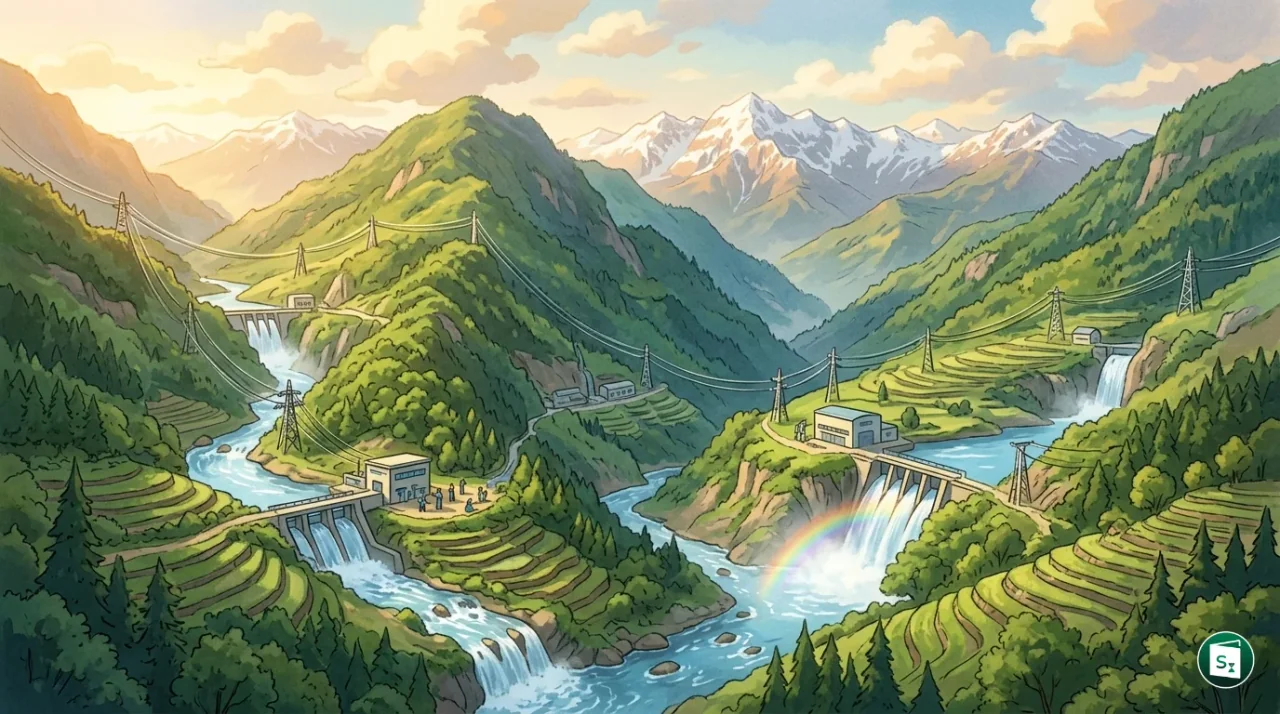
The Himachal Pradesh government has signed implementation agreements for 19 hydropower projects with a combined capacity of 278 MW, attracting an estimated investment of ₹3,336 crore. Chief Minister Sukhvinder Singh Sukhu announced the pacts as part of a broader push to accelerate hydropower development in a state that holds roughly a quarter of India’s total hydroelectric potential. In a parallel move, the state cancelled allotments for 15 non-performing projects and amended its power policy to offer a uniform royalty rate for small projects.
The 19 Projects and the Investment
The 19 projects covered under the implementation agreements span a range of capacities, from 6 MW to 24 MW, and are spread across multiple river basins in the state. Most of these are run-of-river schemes that divert a portion of the river flow through tunnels or channels to generate electricity without large-scale reservoirs.
| Project | Capacity (MW) |
|---|---|
| Bharmour Stage I | 24 |
| Tundah Stage II | 24 |
| Harsar Stage II | 22.5 |
| Bharmour Stage II | 21 |
| Harsar Stage III | 19 |
| Janglik | 18 |
| Toral Kundli | 18 |
| Dunali I and II | 17 |
| Rupin Stage II | 15 |
| Tundan | 15 |
| Jari | 12 |
| Kalal Khol | 11 |
| Umli | 10 |
| Kot Dogri | 10 |
| Soyal Dashal | 9 |
| Gramang | 9 |
| Melan | 9.6 |
| Upper Kurmi | 8 |
| Khauli II | 6 |
The total investment of ₹3,336 crore works out to roughly ₹12 crore per MW, reflecting the capital-intensive nature of hydropower construction in the Himalayan terrain. The projects are scheduled for implementation during the current year and are expected to contribute to the state’s power generation capacity as well as its revenue from electricity sales and royalties.
Himachal Pradesh’s Hydropower Potential
Himachal Pradesh is endowed with the highest hydropower potential among Indian states, estimated at around 24,000 MW of harnessable capacity. This represents nearly a quarter of India’s total hydropower potential. The state’s five snow-fed perennial rivers, the Chenab, Ravi, Beas, Sutlej, and Yamuna, which originate in the Western Himalayas, carry abundant discharge throughout the year, making the terrain ideal for hydroelectric generation.
Of this potential, 12,588 MW has already been developed across 189 completed projects. Another 54 projects with a total capacity of 1,528 MW are currently under construction, while 526 projects aggregating 7,539 MW are at various stages of planning and approval. The fresh agreements for 278 MW add to this pipeline, keeping the state on course to bridge the gap between harnessed and remaining potential.
Hydropower is central to Himachal’s economy. The state earns substantial revenue through the sale of electricity to other states and through royalty payments from project developers. Major projects such as the Nathpa Jhakri Dam (1,500 MW) on the Sutlej and the Bhakra Dam (1,325 MW) on the Sutlej have long been pillars of the northern grid’s power supply.
Policy Reforms and Project Accountability
Alongside the new agreements, the state government has taken two significant steps to reform the hydropower sector.
First, it has amended its power policy and revised royalty rates for hydropower projects up to 25 MW capacity. Under the new framework, a uniform royalty rate of 12 per cent has been fixed for a period of 40 years. This replaces the earlier structure where rates varied across projects, creating uncertainty for developers. The standardized rate is expected to attract more investment while ensuring the state receives a predictable and fair share of revenue from its water resources.
Second, the government has cancelled the allotments of 15 hydropower projects whose developers showed little interest in execution. These projects had remained stalled despite being allocated, locking up valuable river sites without contributing to generation. The state now plans to invite international bids for their speedy implementation, signaling a shift toward greater accountability in project allotment.
Chief Minister Sukhu stated that all agreements are being signed only after ensuring that the interests of Himachal Pradesh are fully protected. The twin approach of signing new projects while cancelling non-performing ones reflects a policy of disciplined development rather than mere project allocation.
Beyond Hydropower: Tidong Completion and Geothermal Exploration
The Chief Minister also announced the completion of the 150 MW Tidong Stage I Hydroelectric Project, located in the Tidong Valley of Kinnaur district. The project, a run-of-river scheme on a tributary of the Sutlej, had been under construction for several years. Its commissioning adds a significant capacity to the state’s operational hydropower base and demonstrates the government’s ability to see large projects through to completion.
In a move toward diversifying its renewable energy portfolio, the state government has signed a Memorandum of Understanding (MoU) with Geo Tropi India Private Limited for the exploration and development of geothermal energy projects in Himachal Pradesh. Geothermal energy, which harnesses heat from beneath the earth’s surface, is an emerging clean energy source in India. The Himalayan region holds considerable geothermal potential due to its tectonic activity, and this MoU marks the state’s first formal step toward tapping that resource.
Key Takeaways
- The Himachal Pradesh government signed implementation agreements for 19 hydropower projects with a combined capacity of 278 MW and an investment of ₹3,336 crore.
- The state cancelled allotments for 15 non-performing projects and will invite international bids for their speedy execution.
- Himachal Pradesh has an estimated harnessable hydropower potential of about 24,000 MW, of which 12,588 MW has been developed across 189 completed projects.
- The government revised royalty rates for projects up to 25 MW, fixing a uniform rate of 12 per cent for 40 years.
- The 150 MW Tidong Stage I hydroelectric project in Kinnaur district has been completed.
- The state signed an MoU with Geo Tropi India Private Limited for the exploration of geothermal energy projects.