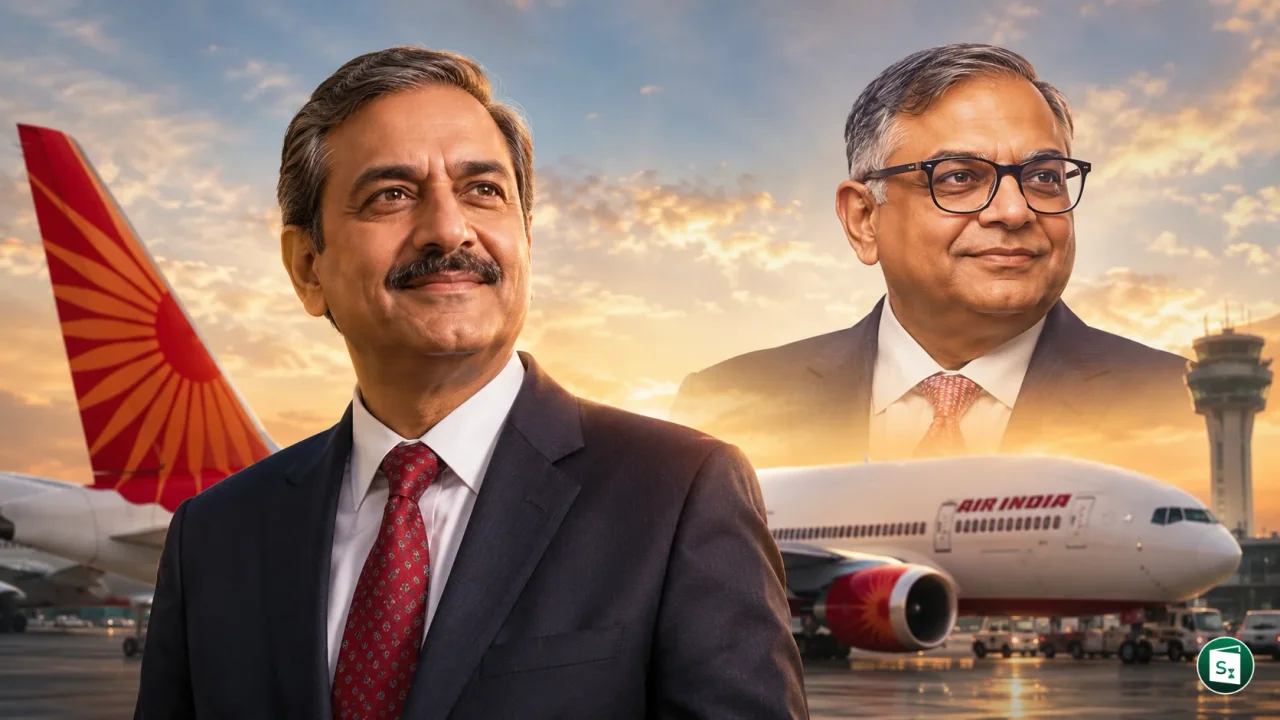
Former Civil Aviation Secretary Pradeep Singh Kharola has returned to Air India as Executive Advisor to Chairman N Chandrasekaran, becoming a full member of the airline’s management committee. Kharola, who served as Air India’s Chairman and Managing Director between 2017 and 2019 when the carrier was under government ownership, comes back at a critical juncture as the airline prepares for a change in leadership. His appointment marks a full circle moment: the same bureaucrat who oversaw Air India’s privatisation that brought the Tata Group back into the cockpit now joins the team tasked with steering its turnaround.
Who Is Pradeep Singh Kharola?
Pradeep Singh Kharola is a 1985-batch IAS officer of the Karnataka cadre. Born in Dehradun, Uttarakhand in 1961, he holds an M.Tech from IIT Delhi. Over a three-decade career in public service, he held several key positions across state and central governments.
Before his aviation assignments, Kharola was the Managing Director of Bangalore Metropolitan Transport Corporation (BMTC) , which he turned profitable for the first time in its history. He also served as the Managing Director of Bangalore Metro Rail Corporation (BMRCL) , overseeing the early phases of the Namma Metro project, and later as Principal Secretary to the Chief Minister of Karnataka.
At the central level, Kharola served as Chairman and Managing Director of India Trade Promotion Organisation (ITPO) and as Director General of the National Testing Agency (NTA) . He also chaired the Airports Authority of India (AAI) before being appointed to lead Air India.
A Return to Familiar Turf
Kharola is no stranger to Air India. He served as its Chairman and Managing Director from November 2017 to February 2019, a period when the airline was still under government ownership and grappling with a massive debt burden. In February 2019, he was appointed Secretary, Ministry of Civil Aviation, a post he held until September 2021.
It was during his tenure as Civil Aviation Secretary that the government pushed through the long-pending privatisation of Air India. Kharola played a central role in designing the disinvestment process, which concluded with the Tata Group winning the bid in October 2021 and taking control of the airline in January 2022. He retired from the IAS in 2023.
His return now as Executive Advisor to Chairman N Chandrasekaran puts him on the other side of the table. Having once represented the seller (the government), he now joins the buyer’s management team.
Why This Appointment Matters Now
The timing of Kharola’s appointment is closely tied to two pressing challenges facing Air India: a leadership vacuum at the top and a deteriorating financial and operational environment.
Leadership Transition at the Top
Air India’s CEO and Managing Director Campbell Wilson, who was appointed in July 2022 to lead the airline’s post-acquisition transformation, announced his departure earlier this year and is set to step down in August 2026. A successor has not yet been named, although Chief Commercial Officer Nipun Aggarwal and former Vistara CEO Vinod Kannan are seen as leading contenders.
In an internal communication announcing Kharola’s appointment, Wilson stated that with his own tenure in its final months, Kharola’s experience would be invaluable in ensuring a smooth leadership transition. Kharola will serve as a full member of Air India’s Management Committee, placing him at the centre of strategic and operational decision-making during this period.
Navigating Regulatory and Operational Turbulence
Air India has been under intense regulatory scrutiny since the Ahmedabad crash of June 2025, a Boeing 787 accident that killed more than 260 people. The Directorate General of Civil Aviation (DGCA) has since issued 84 show-cause notices to Air India and fined the airline for operating an aircraft without a valid airworthiness permit.
Kharola, with his deep understanding of the regulatory machinery and his personal relationships within the civil aviation bureaucracy, is expected to strengthen the airline’s communication with the government. Reports suggest he was handpicked by Chandrasekaran specifically to improve how the airline engages with regulators and policymakers.
The Turnaround Challenge Ahead
Air India’s financial position has deteriorated sharply even as the Tata Group pours billions into its revival. The airline reported a net loss of approximately ₹27,000 crore (about $2.8 billion) in FY26, its highest annual loss since the Tata acquisition. Singapore Airlines, which holds a 25.1% stake in the carrier, confirmed the staggering figures in its annual financial statement.
Several external factors have compounded the airline’s troubles. The West Asia conflict has driven aviation turbine fuel prices to elevated levels. The continued closure of Pakistani airspace to Indian carriers has forced Air India’s Europe and North America-bound flights onto longer routes, sharply increasing both fuel consumption and crew costs. Flights to North American cities now require stops at Vienna or Stockholm, adding hours to each journey.
The airline has already cut over 350 daily flights and introduced cost-rationalisation measures including a new basic fare without complimentary meals. Air India has also been forced to defer some aircraft deliveries and temper its earlier growth ambitions, moving from an aggressive expansion posture to one focused on stabilising operations and cutting costs.
At the same time, Air India is in the middle of a multi-billion-dollar transformation programme called Vihaan.AI, which involves fleet expansion (a combined 600 aircraft ordered from Airbus and Boeing), cabin retrofits, the integration of Vistara into Air India, and network optimisation. The airline has also hired over 17,000 new employees since the acquisition.
Chairman Chandrasekaran has stepped in to conduct weekly operational reviews directly, calling for closer coordination across flight operations, commercial strategy, and finance. Kharola’s appointment is part of this broader effort to bring hands-on leadership stability until a new CEO is appointed.
Key Takeaways
- Pradeep Singh Kharola, a 1985-batch IAS officer of the Karnataka cadre, has rejoined Air India as Executive Advisor to Chairman N Chandrasekaran and as a full member of the Management Committee.
- Kharola previously served as Air India’s Chairman and Managing Director (2017-2019) and later as Civil Aviation Secretary (2019-2021), where he oversaw the airline’s privatisation that led to the Tata Group’s acquisition in January 2022.
- The appointment comes as incumbent CEO Campbell Wilson prepares to step down in August 2026, with Nipun Aggarwal and Vinod Kannan among the frontrunners to replace him.
- Air India reported a net loss of approximately ₹27,000 crore in FY26, its highest since the Tata takeover, driven by elevated fuel costs, Pakistani airspace closure, and the aftermath of the June 2025 Ahmedabad crash.
- Kharola also served as Managing Director of Bangalore Metro Rail Corporation (BMRCL) and Bangalore Metropolitan Transport Corporation (BMTC) , and as Director General of the National Testing Agency (NTA) .
- The Vihaan.AI transformation programme, involving 600 aircraft on order, cabin retrofits, and the Vistara merger, continues alongside the leadership transition.