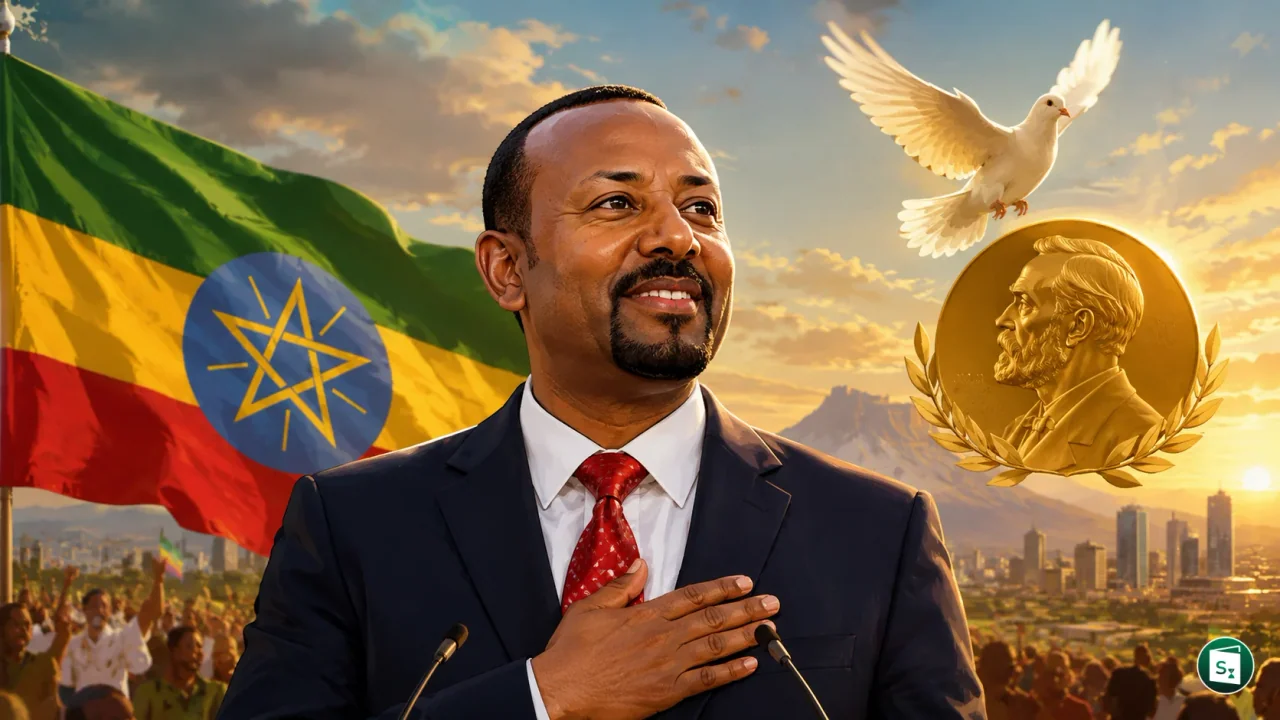
Prime Minister Abiy Ahmed has secured a second consecutive five-year term as Ethiopia’s head of government after his Prosperity Party won a commanding 438 of 501 contested seats in the country’s seventh general election held on 1 June 2026. The National Election Board of Ethiopia (NEBE) certified the results on 21 June, giving the ruling party nearly 90% of the parliamentary seats. Abiy Ahmed, who won the Nobel Peace Prize in 2019 for ending a two-decade conflict with neighbouring Eritrea, now faces the formidable task of steering Africa’s second most populous nation through deep internal divisions.
Abiy Ahmed’s Landslide Victory in the 2026 Election
The seventh general election was held across 501 constituencies with over 54 million registered voters. The Prosperity Party contested 461 seats while the largest opposition party, Ethiopian Citizens for Social Justice (EZEMA), fielded candidates in only 293 constituencies. In 64 constituencies, the ruling party ran unopposed, a sign of the opposition’s limited organisational capacity and resources.
According to the final certified results, EZEMA secured 13 seats, the National Movement of Amhara (NaMA) won 6 seats, and the Medrek coalition took 3 seats. Independent candidates and smaller parties shared the remaining seats. Abiy Ahmed is set to be sworn in for his new term at the beginning of October 2026, after the newly elected House of Peoples’ Representatives convenes.
However, the election was shadowed by serious concerns over its inclusiveness. Voting was not held in the entire Tigray region (38 constituencies) due to what NEBE described as unfavourable conditions following the 2020-2022 civil war. In the Amhara region, 30 constituencies were excluded because of security concerns related to the Fano militia, and several constituencies in Oromia also saw voting suspended due to fighting between government forces and the Oromo Liberation Army (OLA). At least 143 polling stations across the country did not open on election day.
Ethiopia’s Political System: A Federal Parliamentary Republic
Ethiopia operates as a federal parliamentary republic under its 1995 Constitution. The head of state is the President, currently Taye Atske Selassie, who serves a six-year term in a largely ceremonial role. The real executive authority rests with the Prime Minister, who is the head of government and is chosen by the party that commands a majority in the lower house of parliament.
The legislature, known as the Federal Parliamentary Assembly, is bicameral. The lower house is the House of Peoples’ Representatives (Yehizb Tewokayoch Mekir Bete), which has 547 members elected for five-year terms from single-member constituencies using the first-past-the-post system. A party needs at least 274 seats to form a government. The upper house, the House of the Federation, has 112 members chosen by regional councils and represents the interests of Ethiopia’s ethnic groups.
Ethiopia is divided into 12 ethnically based regional states and two chartered cities (Addis Ababa and Dire Dawa). This system of ethnic federalism, established after the fall of the Derg regime in 1991, was designed to accommodate the country’s immense ethnic diversity with over 80 distinct ethnic groups. However, it has also become a source of tension, with regions demanding greater autonomy and the central government seeking to consolidate power.
Who Is Abiy Ahmed?
Abiy Ahmed Ali was born on 15 August 1976 in Beshasha, a small town in western Ethiopia. He joined the armed struggle against the Marxist Derg regime as a teenager and later served in the Ethiopian National Defense Force (ENDF), rising to the rank of Lieutenant Colonel. He served as a radio operator during the 1998-2000 war with Eritrea and was deployed with the United Nations Assistance Mission for Rwanda (UNAMIR) in 1995.
Abiy holds a Bachelor’s degree from Microlink Information Technology College, a Master’s degree from the University of Greenwich, an MBA from Leadstar College of Management, and a PhD from Addis Ababa University. He was a co-founder of the Information Network Security Agency (INSA), Ethiopia’s cyber intelligence agency, and served as its acting director.
He entered electoral politics in 2010 as a member of parliament from the Agaro constituency. After holding several ministerial positions, including Minister of Science and Technology, he was elected chairman of the ruling Ethiopian People’s Revolutionary Democratic Front (EPRDF) coalition in March 2018 and became Prime Minister on 2 April 2018.
In December 2019, Abiy dissolved the EPRDF and created the Prosperity Party, merging several ethnic-based parties into a single national party. The move was aimed at moving away from ethnic federalism toward a more unified Ethiopian national identity, but it was rejected by the Tigray People’s Liberation Front (TPLF), which refused to join. This decision later became one of the triggers for the devastating Tigray War.
The Nobel Peace Prize and the Eritrea Peace Deal
Abiy Ahmed was awarded the 2019 Nobel Peace Prize for his decisive initiative to resolve the long-standing border conflict with neighbouring Eritrea. The Ethiopian-Eritrean border war from 1998 to 2000 had left tens of thousands dead and created a state of no war, no peace that lasted nearly two decades.
In a historic breakthrough, Abiy travelled to Asmara, the Eritrean capital, on 9 July 2018 and signed a Joint Declaration of Peace and Friendship with Eritrean President Isaias Afwerki. The agreement accepted the boundary ruling of the Eritrea-Ethiopia Boundary Commission (EEBC), which had been issued in 2002 but rejected by Ethiopia. The peace deal led to the reopening of embassies, resumption of flights, and the reopening of land borders.
The Norwegian Nobel Committee stated that the prize was awarded for his efforts to achieve peace and international cooperation, and in particular for his decisive initiative to resolve the border conflict with neighbouring Eritrea. At 43, Abiy was the youngest African leader to win the prize at the time.
However, the peace proved fragile. By 2025, relations between the two countries had deteriorated sharply. The border was effectively closed again, and Eritrea has since been reported to have allied itself with Tigrayan leaders, creating a complex and dangerous geopolitical dynamic in the Horn of Africa.
From Reformer to Wartime Leader: A Controversial Journey
Abiy’s early tenure was marked by sweeping reforms. He released thousands of political prisoners, unbanned opposition groups, ended media censorship, and welcomed exiled armed groups back to the country. He appointed a gender-balanced cabinet and pushed for economic liberalisation, including partial privatisation of state-owned enterprises like Ethiopian Airlines.
But his reputation took a sharp turn when the Tigray War erupted in November 2020. The TPLF, which had dominated Ethiopian politics for nearly three decades before Abiy sidelined them, attacked the ENDF’s Northern Command, triggering a full-scale military response from the federal government. The two-year war resulted in an estimated 600,000 deaths according to the African Union mediator, widespread displacement, and accusations of war crimes by all sides. The war ended with the Pretoria Agreement in November 2022.
Since then, other conflicts have erupted. The War in Amhara began in 2023 after the Fano militia refused to disarm and integrate into federal forces. In Oromia, the Oromo Liberation Army (OLA) continues to fight government forces. Multiple insurgencies now stretch Ethiopia’s military across three fronts simultaneously.
Human rights organisations have documented a pattern of democratic backsliding under Abiy’s government, including arbitrary arrests of journalists and opposition figures, internet shutdowns, and restrictions on political space. The European Union and the United States have both expressed concerns about the narrowing of democratic freedoms in Ethiopia.
What Lies Ahead for Ethiopia
Abiy’s second term begins at a moment of immense challenge. The economy, once one of Africa’s fastest growing, has been battered by war-related losses estimated at over USD 80 billion, a forced currency devaluation, and stalled debt restructuring talks with international creditors. The country is also grappling with high inflation and unemployment.
The security situation remains deeply fragile. Analysts fear that deteriorating relations between the federal government, Tigrayan leaders, and Eritrea could reignite a wider regional conflict. The TPLF has restored its pre-war administration in Tigray, disbanding the interim government appointed by Addis Ababa, and there are reports of forced recruitment of young men in the region.
Abiy’s government has also pursued an ambitious agenda of economic transformation, including large-scale infrastructure projects and efforts to attract foreign investment. The Prosperity Party campaigned on its record of economic growth and improved food security. His supporters argue that a strong mandate will allow him to push through necessary but painful economic reforms.
The coming months will test whether Abiy uses his consolidated political power to pursue national dialogue and reconciliation or to intensify military campaigns against remaining insurgent groups. The international community, including the African Union (AU) and the Intergovernmental Authority on Development (IGAD), has urged all parties to prioritise peace and stability in the Horn of Africa.
Key Takeaways
- Abiy Ahmed won a second term as Prime Minister of Ethiopia after his Prosperity Party secured 438 of 501 contested seats (nearly 90%) in the 7th general election held on 1 June 2026.
- Ethiopia follows a federal parliamentary republic system under the 1995 Constitution with a 547-member House of Peoples’ Representatives as the lower house of parliament.
- Abiy Ahmed was awarded the Nobel Peace Prize in 2019 for signing a peace agreement with Eritrea on 9 July 2018 in Asmara, ending a two-decade border conflict.
- The Prosperity Party was formed in December 2019 by merging several ethnic-based parties of the former EPRDF coalition, though the TPLF refused to join, contributing to the Tigray War (2020-2022).
- Voting was not held in the entire Tigray region, 30 constituencies in Amhara, and parts of Oromia due to security concerns, raising questions about the election’s inclusiveness.
- Ethiopia is Africa’s second most populous nation with over 130 million people and more than 80 ethnic groups, governed through a system of ethnic federalism with 12 regional states.