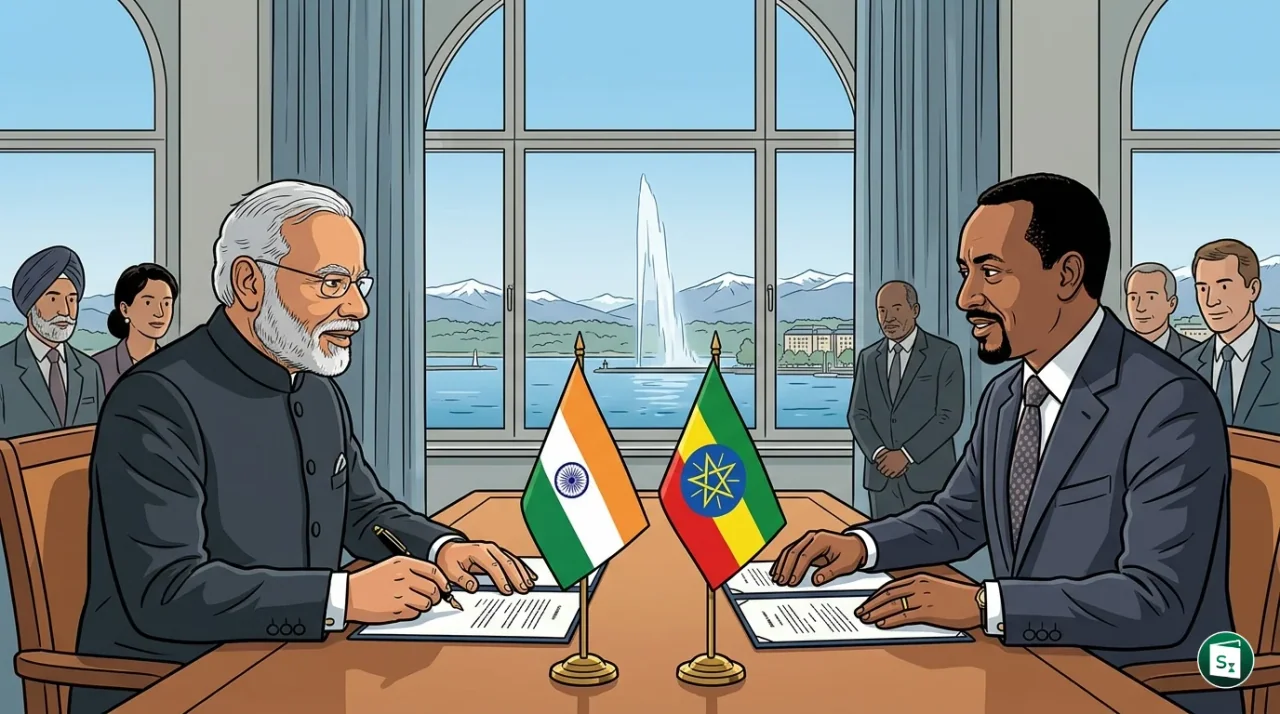
India signed a bilateral accession protocol with Ethiopia in Geneva, Switzerland, on June 3, 2026, marking a significant milestone in Ethiopia’s 23-year journey to join the World Trade Organization (WTO). The agreement, fast-tracked under the guidance of Union Minister Piyush Goyal, underscores India’s commitment to supporting Least Developed Countries (LDCs) in the global trading system. By facilitating this accession, India reinforces its leadership in South-South cooperation and promotes inclusive economic growth across the developing world.
The Roadmap to WTO Membership: Ethiopia’s Journey
The signing of the bilateral protocol is a mandatory step for any country seeking to join the World Trade Organization (WTO). Ethiopia, which first applied for membership in 2003, has been working to align its domestic economic policies with the multilateral trading system for over two decades. The accession process requires the applicant nation to conclude individual market access negotiations with all interested WTO members before its membership can be finalized by the General Council.
As a Least Developed Country (LDC), Ethiopia has benefited from technical assistance and flexibility in its negotiations. The recent protocol with India covers specific commitments for market access in both goods and services, ensuring that trade between the two nations is governed by predictable and transparent rules. This development follows the 7th Working Party meeting held in Geneva earlier in 2026, where Ethiopia demonstrated significant progress in its “Home-Grown Economic Reform” agenda.
Strengthening South-South Cooperation: India’s Role
India has consistently positioned itself as the “voice of the Global South,” advocating for a more equitable and inclusive multilateral trading system. The support for Ethiopia’s WTO accession is a key component of India’s South-South cooperation strategy, which emphasizes mutual growth among developing nations. India was the first developing country to implement a Duty-Free Tariff Preference (DFTP) Scheme for LDCs, launched in 2008 following the WTO Hong Kong Ministerial Declaration.
The DFTP scheme provides duty-free market access on nearly 98.2 percent of India’s tariff lines, helping LDCs like Ethiopia increase their exports to the Indian market. By fast-tracking the bilateral protocol under the guidance of Union Minister Piyush Goyal, India has sent a strong signal of its commitment to the development of African economies. This initiative not only helps Ethiopia integrate into global value chains but also strengthens the collective bargaining power of developing nations within the WTO.
Strategic and Economic Significance of Bilateral Relations
The bilateral protocol is a natural progression of the Strategic Partnership established between India and Ethiopia in December 2025. India is currently Ethiopia’s second-largest trading partner, and the economic ties between the two nations have expanded into diverse sectors including manufacturing, agriculture, and information technology. Indian investments in Ethiopia exceed $6.5 billion, with over 675 Indian companies operating in the country and contributing to local employment and industrialization.
The trade basket between the two countries is diverse, as shown in the table below:
| India’s Exports to Ethiopia | India’s Imports from Ethiopia |
|---|---|
| Pharmaceuticals and drugs | Electronics components |
| Industrial machinery | Agricultural products (pulses, seeds) |
| Iron and steel products | Raw materials (leather, flax yarn) |
| Textiles and chemicals | Precious and semi-precious stones |
This accession protocol is expected to further boost these economic exchanges by providing a more stable and rules-based framework for trade. Furthermore, India’s support for Ethiopia’s entry into BRICS in early 2024 has already paved the way for deeper coordination on global economic issues, including debt restructuring under the G20 Common Framework.
Key Takeaways
- India signed a bilateral WTO accession protocol with Ethiopia in Geneva, Switzerland, on June 3, 2026.
- The agreement was fast-tracked under the personal guidance of Union Minister of Commerce and Industry Piyush Goyal.
- Ethiopia is classified as a Least Developed Country (LDC) and has been pursuing WTO membership since its initial application in 2003.
- India provides preferential market access to LDCs through its Duty-Free Tariff Preference (DFTP) Scheme, which covers 98.2 percent of tariff lines.
- India is Ethiopia’s second-largest trading partner, with bilateral relations recently elevated to a Strategic Partnership in December 2025.
- The World Trade Organization (WTO), headquartered in Geneva, was established on 1 January 1995 to regulate international trade.