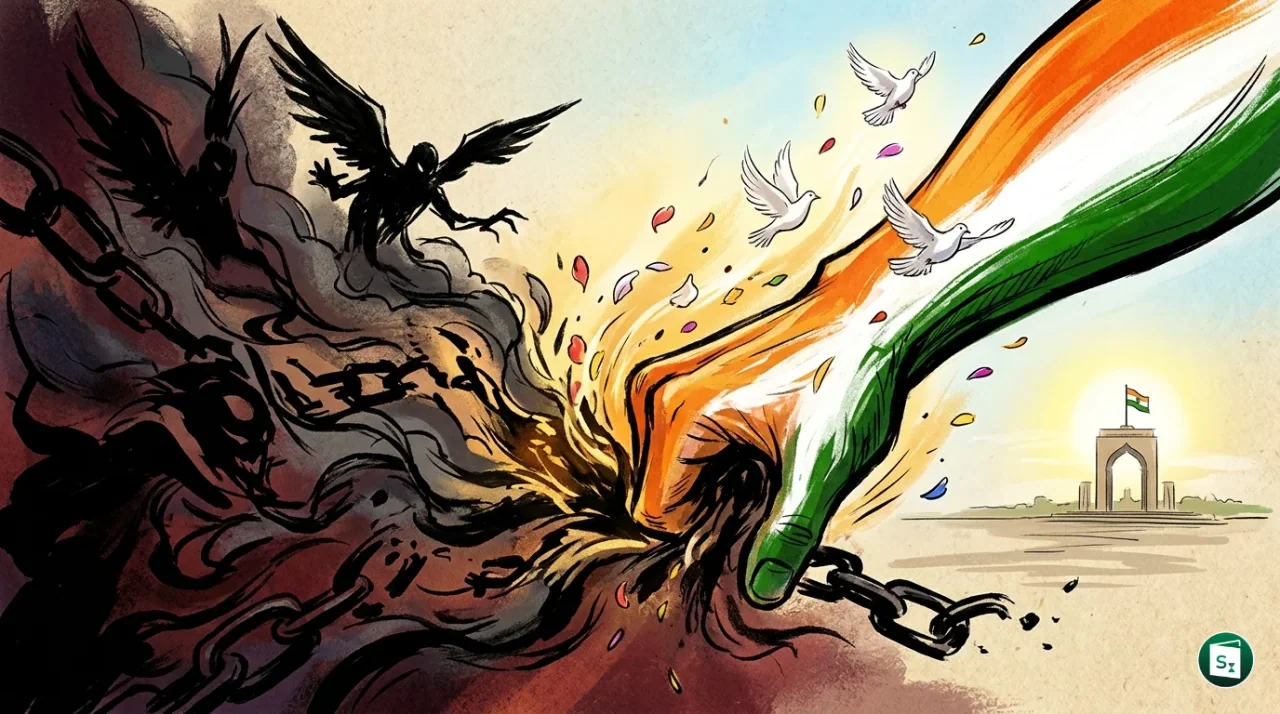
India observed National Anti-Terrorism Day on May 21, 2026, to honour the memory of former Prime Minister Rajiv Gandhi and reaffirm its commitment to global peace. The day marks the death anniversary of India’s youngest Prime Minister, who was assassinated in 1991 during an election rally in Tamil Nadu. By observing this day, the government aims to wean the youth away from extremism and highlight the devastating impact of violence on society.
The Historical Context: May 21, 1991
The roots of National Anti-Terrorism Day lie in one of the most tragic episodes of modern Indian history. On May 21, 1991, former Prime Minister Rajiv Gandhi was assassinated during an election campaign rally in Sriperumbudur, near Chennai. The attack was carried out by a female suicide bomber, Dhanu, belonging to the Liberation Tigers of Tamil Eelam (LTTE), a militant group from Sri Lanka.
The assassination was a direct retaliation for India’s military involvement in the Sri Lankan Civil War. In 1987, the Indian and Sri Lankan governments signed the Indo-Sri Lanka Accord, leading to the deployment of the Indian Peace Keeping Force (IPKF) under Operation Pawan. The conflict that followed between the IPKF and the LTTE eventually culminated in the tragic event at Sriperumbudur. Following the assassination, the V.P. Singh government designated May 21 as National Anti-Terrorism Day to commemorate Gandhi’s sacrifice and condemn the cult of violence.
Legacy of India’s Youngest Prime Minister
Rajiv Gandhi served as the 6th Prime Minister of India from 1984 to 1989. He took office at the age of 40, becoming the youngest person to hold the position. His tenure is often remembered for modernising India’s economy and expanding its technological footprint.
Major Achievements and Reforms
Rajiv Gandhi is widely regarded as the “Father of Information Technology and Telecom” in India. He spearheaded the computerisation of government offices and reduced import duties on hardware to make technology more accessible.
| Field | Key Reform / Contribution |
|---|---|
| Telecommunications | Established the Centre for Development of Telematics (C-DOT) in 1984. |
| Political Reforms | Passed the 52nd Constitutional Amendment Act (1985), which added the 10th Schedule (Anti-Defection Law). |
| Youth Empowerment | Enacted the 61st Constitutional Amendment Act (1988), lowering the voting age from 21 to 18 years. |
| Education | Introduced the National Policy on Education (NPE) 1986 and established Jawahar Navodaya Vidyalayas. |
| Decentralisation | Introduced the 64th Constitutional Amendment Bill for Panchayati Raj, which later became the basis for the 73rd and 74th Amendments. |
His birth anniversary, August 20, is celebrated annually as Sadbhavana Diwas (Harmony Day), promoting communal harmony and national integration.
India’s Fight Against Terrorism: Legal and Institutional Framework
Over the decades, India has built a robust multi-layered strategy to combat terrorism, involving specialized laws and elite agencies. The national stance has evolved into a zero-tolerance policy, which is reinforced every year on National Anti-Terrorism Day through a formal pledge taken by government officials.
Key Anti-Terrorism Laws
The primary legal instrument for prosecuting terror-related activities is the Unlawful Activities (Prevention) Act (UAPA), 1967. Originally enacted to address secessionist threats, it has been amended several times to broaden its scope. A major amendment in 2019 empowered the Central Government to designate individuals as terrorists, a power previously limited only to organisations.
Elite Counter-Terrorism Agencies
India’s institutional response is led by specialized bodies that handle investigation and tactical operations:
- National Investigation Agency (NIA): Established in 2009 following the 26/11 Mumbai attacks, the NIA is India’s premier counter-terrorism law enforcement agency. It has the authority to investigate terror cases across state borders without needing prior permission from state governments.
- National Security Guard (NSG): Formed in 1984, the NSG is an elite federal contingency force under the Ministry of Home Affairs. Known as the “Black Cats”, they are trained to handle exceptional situations like hijackings and terrorist strikes.
Recent Policy Developments
In June 2026, the government unveiled ‘PRAHAAR’, a comprehensive National Counter-Terrorism Policy. This new framework addresses modern-day security challenges, including drone-based threats, cyber-terrorism, and the financing of terror networks. It emphasises a “whole-of-government” approach to ensure that every department works in synergy to maintain national security.
Investigating the Past: Verma and Jain Commissions
Following the assassination of Rajiv Gandhi, two major commissions were established to investigate the lapses and the broader conspiracy behind the attack.
- Justice Verma Commission: This commission investigated the security lapses that occurred during the Sriperumbudur rally. It was critical of the decision to withdraw the Special Protection Group (SPG) cover for the former Prime Minister, calling the security arrangements inadequate.
- Jain Commission: This commission looked into the conspiracy aspect of the assassination. Its findings led to significant political upheaval in the late 1990s, as it highlighted the growth of militant networks and their local support systems.
These investigations eventually led to a overhaul of how high-profile dignitaries are protected in India, emphasizing that security protocols must transcend political transitions.
Key Takeaways
- National Anti-Terrorism Day is observed annually on May 21 to mark the death anniversary of former Prime Minister Rajiv Gandhi.
- Rajiv Gandhi, India’s 6th Prime Minister, was assassinated in 1991 at Sriperumbudur, Tamil Nadu, by the LTTE.
- The 61st Constitutional Amendment Act (1988), passed during his tenure, lowered the voting age from 21 to 18 years.
- The Unlawful Activities (Prevention) Act (UAPA) was amended in 2019 to allow the government to designate individuals as terrorists.
- The National Investigation Agency (NIA) was established in 2009 as a central agency to investigate terror-related crimes across India.
- In June 2026, India introduced ‘PRAHAAR’, a comprehensive national counter-terrorism policy focusing on modern threats like cyber-terrorism and drones.