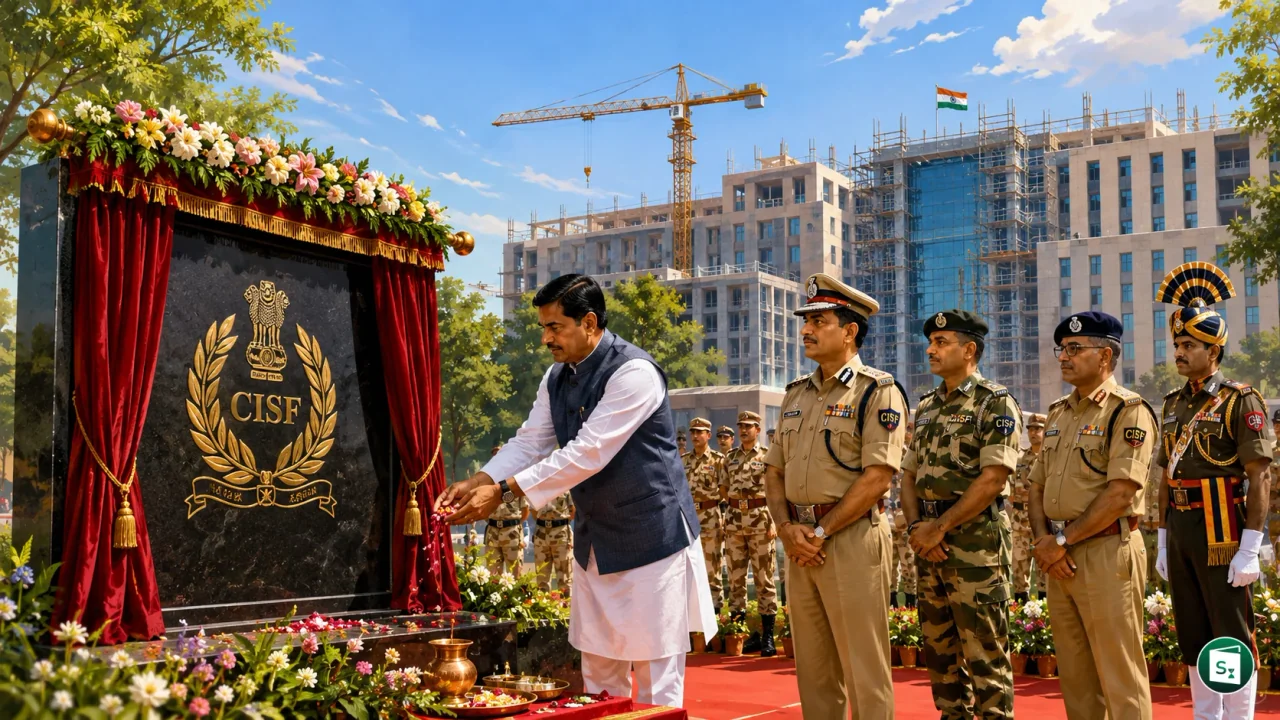
Union Minister of State for Home Affairs Bandi Sanjay Kumar laid the foundation stone for the new Force Headquarters building of the Central Industrial Security Force (CISF) at the CGO Complex on Lodhi Road in New Delhi on 22 June 2026. The nine-storey state-of-the-art facility, being built by the Central Public Works Department (CPWD) at an estimated cost of ₹75.78 crore, will serve as the administrative and strategic nerve centre of the force. Alongside the foundation laying, three completed CISF infrastructure projects worth a combined ₹136.03 crore were also inaugurated and dedicated to the nation.
What Is the Central Industrial Security Force?
The CISF is one of India’s seven Central Armed Police Forces (CAPFs) and operates under the Ministry of Home Affairs (MHA) . It was established under the CISF Act, 1968 (50th Act of Parliament) and came into force on 10 March 1969 with an initial strength of just 2,800 personnel. The force has since grown to over 1.48 lakh active personnel, with a sanctioned strength recently raised to 2 lakh.
The CISF’s primary mandate is to provide security cover to industrial undertakings, critical infrastructure installations, and government buildings across the country. Over the decades, its role has expanded far beyond industrial security. Today, it protects 361 critical national installations, including 70 airports, seaports, metro rail networks (most notably the Delhi Metro), nuclear power plants, space establishments, and heritage monuments such as the Taj Mahal and Red Fort. In December 2023, the force also took over the security of the Parliament House complex in New Delhi.
The force also operates a dedicated Fire Wing for fire protection at guarded installations, a Special Security Group (SSG) for VIP security, and provides security consultancy services to both public and private sector entities. The CISF is headed by Director General Praveer Ranjan, an Indian Police Service officer.
Inside the New Force Headquarters
The new CISF Headquarters is being developed by the Central Public Works Department (CPWD) , the primary civil engineering agency of the Government of India. CPWD was established in July 1854 by Governor General Lord Dalhousie and operates under the Ministry of Housing and Urban Affairs. Headquartered at Nirman Bhawan, New Delhi, it has been the construction agency for numerous iconic government projects from the Rashtrapati Bhavan to the Afghanistan Parliament Building.
The nine-storey facility at the CGO Complex (Central Government Offices Complex) on Lodhi Road will function as the nerve centre for the force’s administrative, operational, and strategic activities. It will house the offices of the Director General and all major branches of the force, a central Control Room, conference facilities, an auditorium, a library, a gymnasium, and other modern amenities.
The CGO Complex itself is a major government office hub in central New Delhi, housing several key central agencies including the Intelligence Bureau (IB) , the National Investigation Agency (NIA) , and the Central Bureau of Investigation (CBI) , among others. Its location, close to the JLN Stadium Metro Station on the Violet Line, ensures excellent connectivity.
The foundation stone ceremony was attended by Union Home Secretary Govind Mohan, Intelligence Bureau Director Tapan Kumar Deka, Member of Parliament Bansuri Swaraj, CISF Director General Praveer Ranjan, senior officers from all CAPFs, officials from CPWD and the State Bank of India (SBI) , and former CISF chiefs.
Three Completed Projects Inaugurated
Alongside the new headquarters foundation, the Minister inaugurated three completed CISF infrastructure projects spread across Hyderabad and Tamil Nadu. These projects aim to strengthen the force’s training infrastructure and residential facilities for personnel.
| Project | Location | Cost |
|---|---|---|
| Subordinate Officers’ Mess “Aditya” | National Industrial Security Academy (NISA), Hyderabad | ₹34.22 crore |
| Advanced Training Building “Abhyas” | National Industrial Security Academy (NISA), Hyderabad | ₹20.53 crore |
| Subordinate Officers’ Quarters | 4th Reserve Battalion, Amravatipuram, Sivagangai, Tamil Nadu | ₹5.50 crore |
The National Industrial Security Academy (NISA) , established on 8 December 1990, is the CISF’s premier training institution. Spread over 245 acres in Hakimpet, Hyderabad (Telangana), it is recognised as a Centre of Excellence in industrial security management by the Government of India. NISA conducts basic induction training for directly recruited Assistant Commandants and Sub Inspectors, along with specialised courses for CAPF officers, public sector executives, and even foreign police personnel. It also houses the Fire Service Training Institute (FSTI) , which was moved from Deoli, Rajasthan, to the NISA campus in 1999.
During the ceremony, the Minister also handed over financial assistance of ₹1 crore under the Personal Accident Insurance Scheme to the families of deceased CISF personnel. Customised motorable wheelchairs were presented to differently abled dependent children of force members through a joint initiative of Sanrakshika and the State Bank of India.
Welfare Initiatives for CAPF Personnel
Addressing the gathering, Bandi Sanjay Kumar highlighted several welfare measures introduced by the central government for CAPF personnel and their families. These include Ayushman CAPF and CAPFIMS, which provide cashless healthcare facilities to personnel and their dependents across a network of empanelled hospitals. The CAPF e-Awas portal has brought transparency to housing allocation, allowing personnel to apply and track accommodation allotment online.
The government has also introduced a compassionate disability policy that enables personnel who become disabled during service to continue their careers with dignity, full service benefits, and career progression. Project MANN, a mental health support initiative, provides counselling and psychological assistance to personnel. The Kendriya Police Kalyan Bhandar network offers financial relief through subsidised goods and welfare schemes for force members and their families.
CISF Prepares for Hybrid Threats and Expanding Mandate
CISF Director General Praveer Ranjan outlined the force’s growing responsibilities in the face of evolving security challenges. He noted that modern threats are increasingly hybrid in nature, involving cyber attacks, digital sabotage, drones, and other technology driven risks. The CISF is adapting its training and equipment to stay ahead of these challenges.
RTC Behror in Rajasthan is being developed as a Centre of Excellence for Drone and Anti-Drone Technology, and the CISF has been designated as the nodal agency for protecting critical infrastructure against rogue drone threats. Specialised cyber security teams are being trained in collaboration with premier institutions such as IIT Madras Pravartak, the National Forensic Sciences University (NFSU), Gandhinagar, and C-DAC (Centre for Development of Advanced Computing).
The force has also been designated as a Recognised Security Organisation (RSO) under the International Ship and Port Facility Security (ISPS) Code. This status enables CISF to conduct security audits and assessments of major ports, contributing to the security of India’s growing Blue Economy. Additionally, the force has taken over security responsibilities at high security correctional facilities in Jammu and Kashmir and continues to expand its internal security footprint.
The Ministry of Home Affairs has also approved the raising of the first all-women CISF Reserve Battalion at Nuh, Haryana, comprising 1,024 personnel.
Key Takeaways
- Union Minister of State for Home Affairs Bandi Sanjay Kumar laid the foundation stone for the new CISF Force Headquarters at the CGO Complex, New Delhi on 22 June 2026.
- The nine-storey headquarters is being constructed by CPWD at an estimated cost of ₹75.78 crore and will serve as the administrative and strategic nerve centre of the force.
- Three completed CISF infrastructure projects were inaugurated: the “Aditya” Subordinate Officers’ Mess (₹34.22 crore) and “Abhyas” Advanced Training Building (₹20.53 crore) at NISA, Hyderabad, and Subordinate Officers’ Quarters (₹5.50 crore) at the 4th Reserve Battalion in Sivagangai, Tamil Nadu.
- The CISF was established under the CISF Act, 1968 on 10 March 1969 and operates under the Ministry of Home Affairs with a current sanctioned strength of 2 lakh personnel.
- The National Industrial Security Academy (NISA) , established in 1990 at Hakimpet, Hyderabad, is the CISF’s premier training institution recognised as a Centre of Excellence for industrial security.
- The Ministry of Home Affairs approved the raising of the first all-women CISF Reserve Battalion at Nuh, Haryana, with 1,024 personnel.