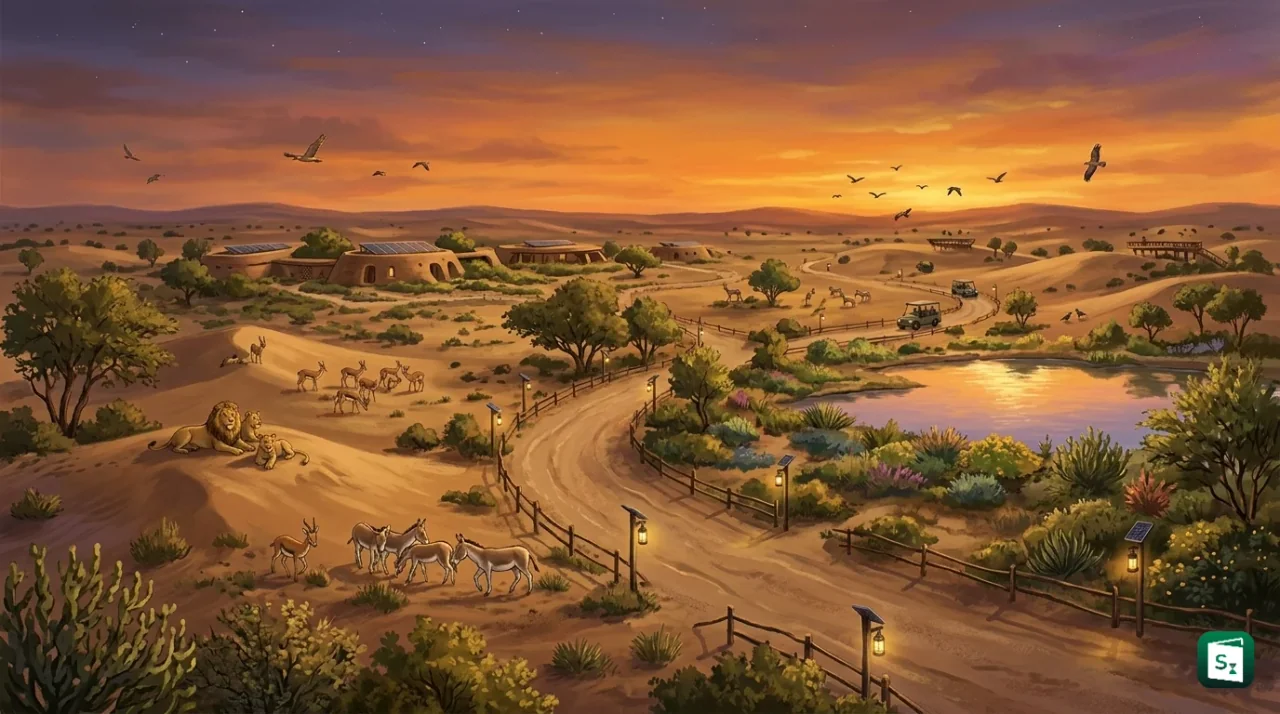
The Central Zoo Authority (CZA) has approved the proposal to build Asia’s first desert zoological park and desert-themed night safari at Juna Deesa in the Banaskantha district of Gujarat. The project, estimated to cost ₹542.14 crore, will come up on 103 hectares of contiguous government land and will be developed as a 100% eco-friendly facility. Once completed, it is expected to become a flagship destination for wildlife conservation and eco-tourism in North Gujarat.
What Is Being Built at Juna Deesa?
The Gujarat Forest Department will develop the Desert Zoological Park and Night Safari on a 103-hectare site at Juna Deesa. Juna Deesa is the original settlement of Deesa town, which lies on the eastern banks of the West Banas River in Banaskantha district, near the Rajasthan border.
The site was chosen for its contiguous 103 hectares of government land, natural sand dunes, proximity to the Banas River, and strong road and railway connectivity. The project will be built strictly in accordance with Central Zoo Authority guidelines and will house around 2,700 native and exotic animals and birds from nearly 83 species.
The facility will have a separate day zoo and five dedicated night safari enclosures, where visitors can observe nocturnal animals after sunset. A drive-through format will allow people to travel through the desert landscape in their vehicles, much like a safari in a national park.
Why a Desert-Themed Park?
The desert theme is rooted in the region’s geography. Banaskantha lies at the northern edge of Gujarat, where the semi-arid landscape of North Gujarat merges into the Thar Desert, the world’s most densely populated desert region. The area is naturally home to hardy species that thrive on little water and high temperatures.
The park will showcase Indian desert species including the chinkara (Indian gazelle), blackbuck, Indian wild ass, Asiatic lion, leopard, Indian wolf, striped hyena, Indian desert fox, caracal, sloth bear, golden jackal, Indian porcupine, Indian hare, desert hare and hedgehog.
Exotic species from other arid regions will also be displayed. Planned African species include the Angolan giraffe, Grevy’s zebra, scimitar oryx, African kudu, springbok, addra gazelle, black rhinoceros, meerkat, African cheetah, African lion, fennec fox, bat-eared fox and ostrich. From Australia, the park plans to house kangaroos, emus and wallabies.
Beyond the animal enclosures, the master plan includes a reptile safari, rainforest biome, aquarium, aviary, reptile house, butterfly park and an interpretation centre. Visitor facilities such as a food court, souvenir shop and golf-cart service are also planned. Herbivore and carnivore zones will be kept strictly separate to maintain animal welfare standards.
Who Approves Zoos in India? The Central Zoo Authority
The Central Zoo Authority (CZA) is the statutory body that regulates every zoo in India. It was established in 1992 under the Wildlife (Protection) Act, 1972, and functions under the Ministry of Environment, Forest and Climate Change. The Authority is headquartered in New Delhi.
The idea for a central agency to oversee zoos came from an expert group set up by the Indian Board for Wildlife in 1972. Following its recommendations, the Wildlife (Protection) Act was amended in 1991 to add a new chapter containing sections 38A to 38J. Section 38A formally created the Central Zoo Authority, and the body began functioning in February 1992.
Key Functions of the CZA
The Authority’s main job is to set minimum standards for the housing, upkeep and healthcare of animals in Indian zoos. No zoo can operate without recognition from the CZA, which is granted under the Recognition of Zoo Rules, 1992 (amended in 2009 and 2013). The CZA also coordinates conservation breeding programmes for endangered species, regulates the exchange of animals listed under Schedules I and II of the Wildlife (Protection) Act among zoos, and approves animal exchanges between Indian and foreign zoos.
The Authority administers the National Zoo Policy, 1998, which reoriented Indian zoos from pure entertainment towards ex-situ conservation, education and research. Today, the CZA has recognised around 155 zoos across India. It is also an affiliate member of the World Association of Zoos and Aquariums (WAZA), the global body for zoo standards.
A 100% Eco-Friendly Design
The project has been planned as a completely eco-friendly facility, with several green technologies built into its design. These measures are meant to minimise the environmental footprint of the park in a water-scarce, energy-scarce desert region.
Solar Energy
A large share of the park’s electricity needs will be met through solar energy. Desert regions receive abundant sunshine for most of the year, making them ideal for solar power generation. Rooftop solar panels and solar farms will power the enclosures, lighting, water pumps and visitor facilities.
Rainwater Harvesting
The site will use rainwater harvesting systems to capture and store rainwater during the monsoon. This stored water will supplement the park’s water supply, reducing pressure on groundwater and the Banas River. In a district that frequently faces drought, such water conservation measures are especially valuable.
Advanced Sewage Treatment
The park will have a sewage treatment plant to recycle waste water for horticulture and landscaping. Alongside this, solid waste management systems will process and segregate the waste generated by visitors and animal facilities.
Native Plantation and Green Buffers
The landscaping plan includes native plantation and green buffer zones around the park. Native plant species are drought-resistant, need less water, and help recreate the natural desert habitat for animals. Green buffers also reduce noise and dust and create a protective ring around the enclosures.
Night Safaris: A Growing Global Trend
The idea of a night safari is to let visitors observe animals that are active after dark. Many species such as hyenas, foxes, porcupines and leopards sleep during the day and become active at night. A night safari, lit by carefully controlled low-intensity lighting that mimics moonlight, allows these animals to display their natural nocturnal behaviour.
The concept was pioneered by Singapore’s Night Safari, which opened in 1994 at what is now the Mandai Wildlife Reserve. It was the world’s first nocturnal wildlife park and still draws around a million visitors a year. India’s proposed facility in Deesa will be the first of its kind anywhere in Asia that is themed around desert wildlife, and it will follow the CZA’s Guidelines for the operation of night safari in recognised Indian zoos.
In India, night safaris are also run in several national parks, such as Pench, Kanha and Bandhavgarh, where visitors are taken into buffer zones after dark to spot nocturnal animals. What makes the Deesa project different is that it combines a dedicated zoo with a drive-through night safari inside a single desert-themed campus.
What Does the Project Mean for Gujarat?
The project carries significance on multiple fronts, from conservation to regional development.
Conservation and Research
The park will function as a centre for conservation breeding, wildlife rescue and rehabilitation. It will also support environmental education and the scientific interpretation of nature. By providing a managed environment for desert species, the facility can help secure the genetic stock of threatened animals and support future reintroduction efforts.
Eco-Tourism and the North Gujarat Circuit
Officials expect the zoo to become a major tourist attraction that will complement existing destinations in North Gujarat, including Vadnagar, Ambaji and Nadabet. Vadnagar, the ancient city that is also the birthplace of Prime Minister Narendra Modi, has seen major heritage tourism development. Ambaji is one of the 51 Shakti Peethas and draws large numbers of pilgrims, while Nadabet has been developed around the history of the India-Pakistan border and the Border Security Force.
The new park adds a wildlife anchor to this circuit. It is expected to draw tourists who would otherwise head to wildlife destinations in Saurashtra or Kutch, and to lengthen the average stay of visitors in the region.
Jobs and Local Economy
Building and operating the park will create direct employment in tourism, transport, hospitality and related services. Local communities near Deesa are expected to benefit from new businesses such as eateries, souvenir shops and transport services around the facility.
India’s Desert Ecosystems and Their Wildlife
The project shines a spotlight on India’s arid and semi-arid landscapes, which support a distinctive group of species found nowhere else in the world.
The Thar Desert, also called the Great Indian Desert, covers about 2.64 lakh square kilometres across Rajasthan, Gujarat, Haryana and Punjab. Its southern edge merges into the Rann of Kutch, a vast seasonal salt marsh in Gujarat. The Indian wild ass sanctuary in the Little Rann of Kutch, spread over about 4,954 square kilometres, is the last home of the Indian wild ass (khur), a species that once ranged across western India, Pakistan, Afghanistan and Iran. Its population had collapsed to barely 362 individuals in the 1960s before conservation efforts brought it back.
The Asiatic lion, now found only in the wild in the Gir forest of Saurashtra, Gujarat, is another species closely tied to the state’s conservation record. Gujarat is also home to the Girnar Wildlife Sanctuary, which functions as a second habitat for Asiatic lions, and the Sakkarbaug Zoological Garden at Junagadh, one of India’s oldest zoos, which runs the purebred Asiatic lion breeding programme.
By housing Indian desert and grassland species alongside their African and Australian counterparts, the Deesa park will let visitors compare how similar species have adapted to arid conditions on different continents. This educational value is a key part of the park’s purpose.
The Way Forward
The project now moves from approval to implementation. The Gujarat Forest Department will prepare detailed designs, obtain clearances and begin construction, with the park planned to open in phases.
For the state, the facility strengthens its growing reputation as a wildlife tourism destination alongside Gir, the Rann of Kutch and the Kutch Desert Wildlife Sanctuary. For wildlife policy, it demonstrates how ex-situ conservation in well-managed zoos can complement in-situ conservation in national parks and sanctuaries.
Successful implementation will depend on careful animal welfare management, adequate water and power arrangements, and responsible tourism practices that keep the park’s environmental footprint low. If these are managed well, Juna Deesa could become a model for how desert landscapes across Asia can combine conservation with sustainable tourism.
Key Takeaways
- The Central Zoo Authority (CZA) has approved Asia’s first desert zoological park and desert-themed night safari at Juna Deesa in the Banaskantha district of Gujarat.
- The project is estimated to cost ₹542.14 crore and will come up on 103 hectares of contiguous government land.
- The facility will house around 2,700 animals and birds from nearly 83 species, including Indian species such as the chinkara, blackbuck, Indian wild ass, Asiatic lion and leopard.
- The park will be a 100% eco-friendly facility, using solar energy, rainwater harvesting, an advanced sewage treatment plant and native plantation.
- The Central Zoo Authority is a statutory body established in 1992 under the Wildlife (Protection) Act, 1972, functioning under the Ministry of Environment, Forest and Climate Change.
- The Singapore Night Safari, the world’s first nocturnal wildlife park, was opened in 1994 and inspired the concept of dedicated night safari facilities.