The government launched a Central Bank Digital Currency (CBDC)-based Direct Benefit Transfer (DBT) pilot under the PM Garib Kalyan Anna Yojana (PMGKAY) in the Union Territories of Chandigarh and Dadra & Nagar Haveli on 14 August 2026. Under this new mechanism, food subsidies are transferred directly into the Digital Rupee (e₹) wallets of eligible beneficiaries instead of their conventional bank accounts. With this launch, the two Union Territories became the first in the country to operationalise food subsidy delivery for all eligible PMGKAY beneficiaries through programmable CBDC tokens.
What Is the CBDC-Based DBT Under PMGKAY?
The Central Bank Digital Currency (CBDC) is a digital form of the Indian rupee issued by the Reserve Bank of India (RBI) as legal tender. The Digital Rupee (e₹), also called e-rupee, is a tokenised digital version of physical currency, and it carries the full backing of the central bank, just like a paper note.
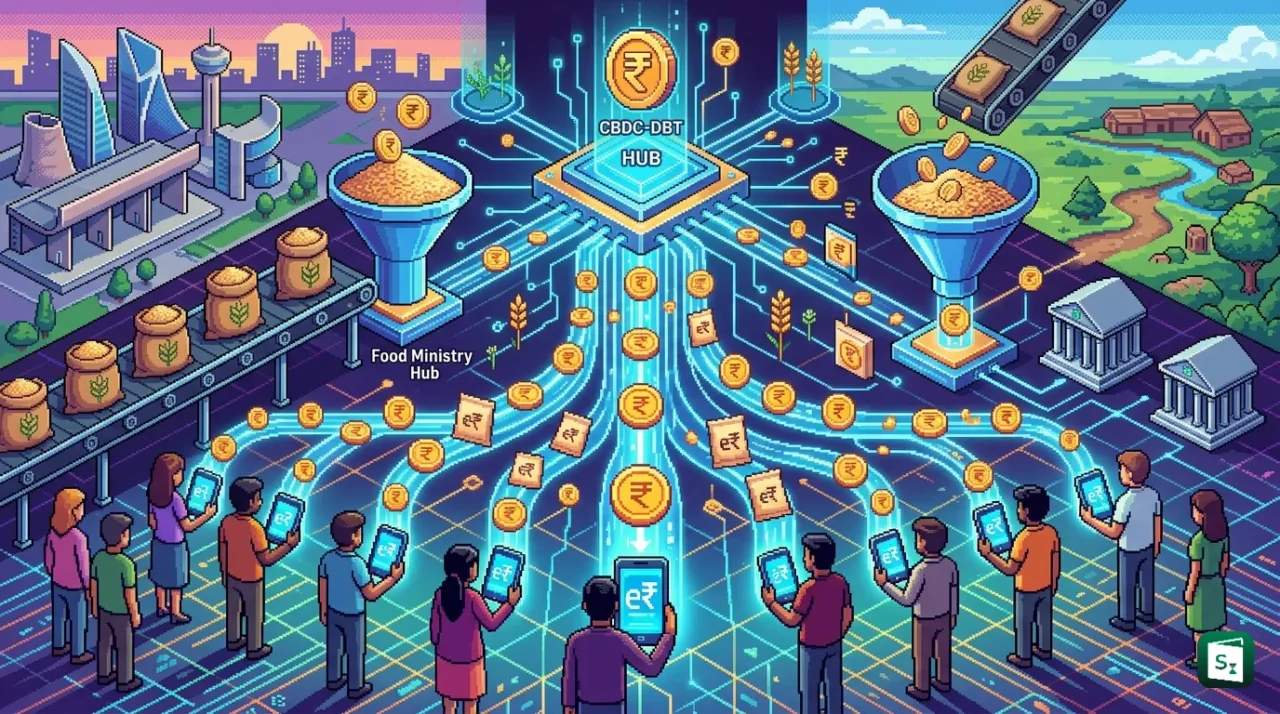
Under the earlier model, beneficiaries received their food subsidy as cash in their Aadhaar-linked bank accounts. They could then use the money for any purpose. The new system replaces this with programmable Digital Rupee tokens that are credited directly into the beneficiary’s CBDC wallet.
The key difference is that these tokens are purpose-bound. They can be used only to purchase entitled foodgrains such as wheat and rice from empanelled merchants and Fair Price Shops (FPS). Beneficiaries can complete the transaction by scanning a QR code at the shop, and the money cannot be diverted for any other use.
The Digital Rupee: From Concept to Launch
The RBI issued a concept note on CBDC on 7 October 2022, outlining the design and purpose of the Digital Rupee. The central bank then launched pilots in two segments. The Digital Rupee-Wholesale (e₹-W) pilot began on 1 November 2022 for settling secondary market transactions in government securities. The Digital Rupee-Retail (e₹-R) pilot followed on 1 December 2022 within a closed user group of participating customers and merchants.
Eight banks, including the State Bank of India, HDFC Bank, ICICI Bank, Bank of Baroda and Kotak Mahindra Bank, were identified for phase-wise participation in the retail pilot. The e₹-R is issued in the same denominations as paper currency and coins, and it does not earn any interest, just like physical cash.
RBI has since expanded the programmable features of the digital rupee to cover use cases such as fuel, groceries, education, healthcare and travel. India is now one of the few large economies, along with China, to operate programmable CBDCs at scale.
The Road from Ration Shops to Digital Wallets
Food subsidy delivery in India has evolved in clear stages. For decades, the Public Distribution System (PDS) distributed physical foodgrains at subsidised rates through a network of Fair Price Shops. Under the Cash Transfer of Food Subsidy Rules, 2015, notified under the National Food Security Act (NFSA), 2013, the government began transferring the food subsidy directly as cash into the Aadhaar-linked bank accounts of entitled households instead of distributing grains.
Chandigarh was among the first regions to implement this DBT model for food subsidy in September 2015, followed by the urban areas of Dadra and Nagar Haveli from March 2016. The latest CBDC initiative builds directly on this DBT framework by adding a layer of digital tracking and purpose restriction on top of the cash transfer.
In other words, the journey has moved from physical distribution of grains, to cash in bank accounts, and now to purpose-bound digital delivery through CBDC. The launch of the pilot in these two Union Territories was a joint effort of the Department of Food and Public Distribution, the RBI, the National Informatics Centre and the Chandigarh Administration, with Punjab National Bank among the participating institutions.
PMGKAY: The Umbrella Food Security Scheme
The Pradhan Mantri Garib Kalyan Anna Yojana (PMGKAY) was announced on 26 March 2020 during the COVID-19 pandemic to protect poor and vulnerable households from hunger during the lockdown. The scheme was originally designed to provide 5 kg of foodgrains per person per month, free of cost, on top of the regular monthly entitlement under the National Food Security Act (NFSA), 2013.
The National Food Security Act, 2013, signed into law on 12 September 2013, converted food security from a welfare matter into a legal right. It covers up to 75 percent of the rural population and 50 percent of the urban population, together roughly two-thirds of the country, which amounts to about 81.35 crore people based on Census 2011 figures.
Under the NFSA, Priority Households receive 5 kg of foodgrains per person per month, while Antyodaya Anna Yojana (AAY) households receive 35 kg per household per month. The subsidised issue prices were set at ₹3 per kg for rice, ₹2 per kg for wheat and ₹1 per kg for coarse grains.
From 1 January 2023, the government merged the PMGKAY with the NFSA and began providing foodgrains completely free of cost to NFSA beneficiaries. In November 2023, the Union Cabinet extended this free foodgrains arrangement for a further five years, from 1 January 2024, at an estimated outlay of about ₹11.80 lakh crore. Today, PMGKAY is among the world’s largest food security schemes, providing free ration to more than 80 crore beneficiaries every month.
The Rollout Journey: From Gujarat to the Union Territories
The use of the Digital Rupee for food subsidy delivery began as a phased pilot. The first CBDC-based Digital Food Currency pilot was launched in Gujarat on 15 February 2026 by the then Union Home Minister, Amit Shah, in the presence of Union Minister for Consumer Affairs, Food and Public Distribution Pralhad Joshi and Gujarat Chief Minister Bhupendra Patel. It covered the districts of Ahmedabad, Anand, Valsad and Surat, and benefited more than 26,000 families.
The second phase followed in Puducherry on 26 February 2026, where Pralhad Joshi inaugurated the pilot project. Drawing on the experience of these pilots, the government expanded the initiative to Chandigarh and Dadra & Nagar Haveli on 14 August 2026.
At the launch event in Chandigarh, the initiative was led by Union Agriculture Minister Shivraj Singh Chouhan, with Punjab Governor and Chandigarh Administrator Gulab Chand Kataria presiding. Pralhad Joshi and Union Minister of State for Consumer Affairs, Food and Public Distribution Nimuben Jayantibhai Bambhaniya were also present. The Dadra & Nagar Haveli phase was launched remotely from Chandigarh on the same day.
The government has positioned the rollout as a proof of concept for the nation. The operational experience gained in integrating CBDC wallets, verifying beneficiaries and tracking subsidy utilisation is expected to inform a wider adoption of the model in other states and Union Territories.
Why the Shift Matters
The CBDC-based DBT model offers several concrete benefits over both physical grain distribution and cash transfers.
First, it ensures end-to-end traceability of public money. Every transaction is recorded digitally from the moment the token is issued until it is spent, which makes it far harder for intermediaries to divert or withhold benefits. Second, the programmable nature of the tokens means the subsidy can be used only for foodgrains, preventing money from being spent on other items. Third, it removes the repeated biometric authentication at ration shops, which had often caused delays and denied genuine beneficiaries their rations when fingerprint or iris scans failed.
The system also strengthens accountability and real-time monitoring of subsidy utilisation and demonstrates the potential of the Digital Rupee for future payment systems. For the government, this supports the broader vision of strengthening Digital Public Infrastructure and delivering citizen-centric services through technology. As Pralhad Joshi noted, digitalisation is helping deliver benefits to eligible beneficiaries transparently while also helping identify ineligible ones.
There are, however, genuine concerns. The same traceability that prevents leakage also creates a detailed record of individual economic behaviour. Privacy advocates have pointed out that every CBDC transaction links a beneficiary to a purchase, a vendor, a location and a timestamp. The system must also work for people who are not comfortable with smartphones, so the pilot has been designed to include feature phone users and to let beneficiaries locate authorised merchant outlets through a simple application.
The Way Forward
The success of the pilot in Chandigarh and Dadra & Nagar Haveli will be judged on measurable outcomes such as reduced leakage, faster disbursement and wider adoption of wallet-based payments. If the model delivers on these counts, other states and Union Territories are expected to follow with similar CBDC integrations for their welfare schemes.
The rollout also supports India’s wider push on Digital Public Infrastructure, alongside systems such as Aadhaar, UPI and DigiLocker. While the RBI has said it is in no hurry for a nationwide CBDC rollout and continues to treat the Digital Rupee as a pilot, welfare-linked programmability has given the project a clear and practical use case.
Key Takeaways
- The CBDC-based Direct Benefit Transfer under PMGKAY was launched on 14 August 2026 in Chandigarh and Dadra & Nagar Haveli, making them the first Union Territories to fully digitise food subsidy delivery through programmable Digital Rupee tokens.
- The Digital Rupee (e₹) is a tokenised digital version of the Indian rupee issued by the Reserve Bank of India as a Central Bank Digital Currency.
- The RBI released its CBDC concept note on 7 October 2022, launched the e₹-W wholesale pilot on 1 November 2022 and the e₹-R retail pilot on 1 December 2022.
- The CBDC-based food subsidy pilots were first launched in Gujarat (15 February 2026) and Puducherry (26 February 2026) before expanding to the two Union Territories.
- The PMGKAY, announced on 26 March 2020, now provides free foodgrains to more than 81.35 crore NFSA beneficiaries, with the scheme extended for five years from 1 January 2024 at an outlay of about ₹11.80 lakh crore.
- Under the earlier DBT model, Chandigarh had begun cash transfer of food subsidy from September 2015, while the urban areas of Dadra and Nagar Haveli followed from March 2016.