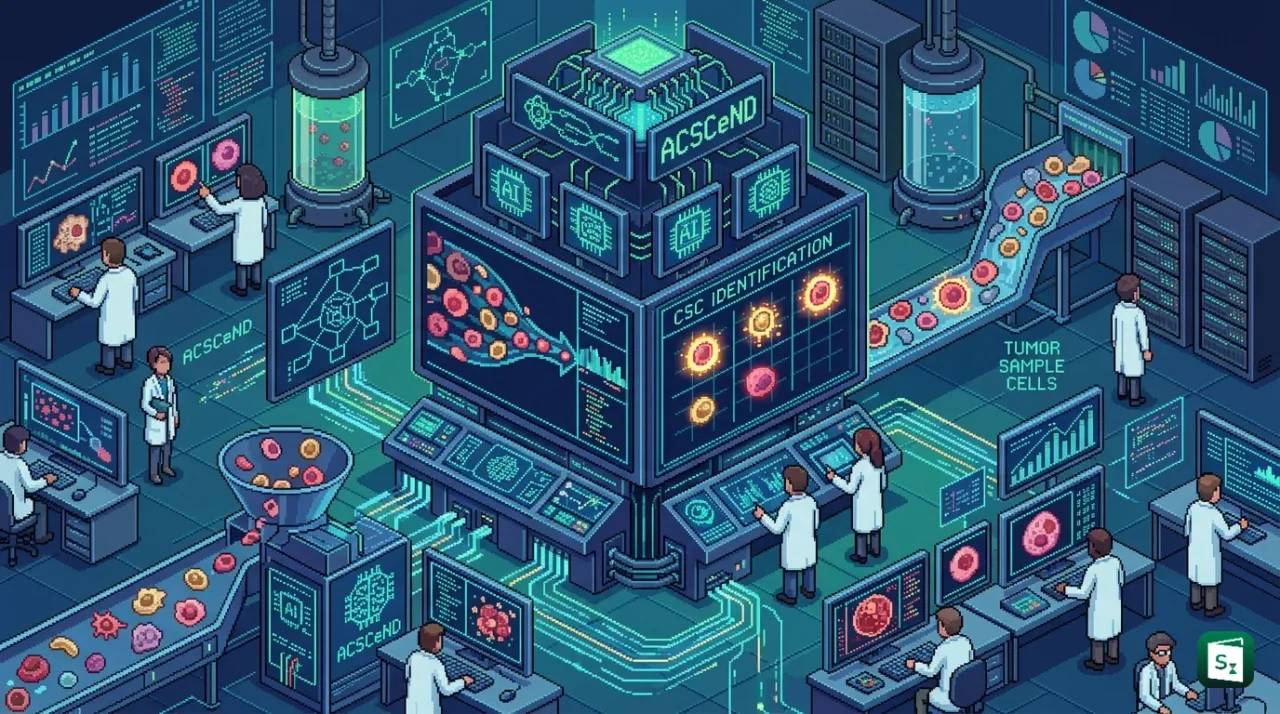
Indian researchers have developed ACSCeND, a deep-learning artificial intelligence framework that can identify hidden cancer stem-like cells (CSCs), the rare cells believed to drive tumour recurrence, metastasis and resistance to treatment. The framework was developed by a team led by Dr Shubhasis Haldar through a collaboration between the SN Bose National Centre for Basic Sciences (SNBNCBS), Kolkata, and Ashoka University, Sonipat. The breakthrough opens the door to studying these elusive cell populations in thousands of patient samples and brings precision cancer medicine closer to reality.
Why Cancer Stem Cells Are Hard to Spot
Most cancer treatments are designed to kill fast-dividing tumour cells, and they often succeed in shrinking a tumour. Yet in many patients the disease returns months or years later, sometimes in other organs, and frequently stops responding to therapy altogether. Scientists have long suspected that a small group of cells inside the tumour is responsible for this pattern.
These cells are known as cancer stem-like cells (CSCs). Like the normal stem cells found in our bodies, they can renew themselves and give rise to many different cell types, which is why they can rebuild an entire tumour even after most of it has been destroyed. They also tend to divide slowly, which makes them naturally resistant to drugs and radiation that target rapidly dividing cells.
Two features make CSCs especially difficult to detect. First, they are extremely rare, sometimes forming less than one percent of the tumour. Second, they constantly change their biological identity, switching between different states in response to their surroundings. This means a cell that looks like an ordinary cancer cell one day can turn into a stem-like cell the next, making it nearly invisible to conventional analysis.
What Is ACSCeND and How Does It Work?
ACSCeND stands for AI-based Cancer Stem-like Cell Profiler and Neoplasm Deconvoluter. The name describes exactly what it does: it profiles, or characterises, cancer stem-like cells and deconvolutes, or separates, the mixed signals inside a tumour to estimate the hidden cell types present.
Until now, the standard computational approach gave a whole tumour a single “stemness” score, a crude measure of how stem-cell-like the tissue was. ACSCeND goes much further. Instead of one number, it identifies three distinct developmental states of cancer stem-like cells, giving researchers a far more detailed picture of what is happening inside a tumour.
The framework works by combining knowledge learned from two types of data. It first learns the genetic signatures of each stem cell state from single-cell RNA sequencing (scRNA-seq), a high-resolution technique that examines gene activity in individual cells. It then applies this learning, through deep learning, to analyse bulk tumour RNA sequencing, the far more common and affordable method that reads the combined genetic activity of a whole tissue sample.
The Three Developmental States of Cancer Stem-Like Cells
ACSCeND classifies cancer stem-like cells into three states based on their developmental potential:
| State | Description |
|---|---|
| Pluripotent-like | The most powerful state. These cells can develop into almost any cell type and are associated with the worst patient outcomes. |
| Multipotent-like | Cells that can turn into several related cell types but not all cell types. |
| Unipotent-like | The most restricted state. These cells can usually produce only one type of mature cell. |
The analysis found that tumours enriched with the highly potent, pluripotent-like stem cells were tied to poorer patient survival, a greater likelihood of recurrence and weaker responses to modern immunotherapies. The framework also exposed the molecular programmes these cells use to survive, adapt and escape the immune system.
How the AI Was Trained
The team built ACSCeND as a dual-platform machine-learning framework. A machine-learning classifier was trained on single-cell transcriptomic data from stem cell populations, such as embryonic stem cells as examples of pluripotent cells, and mesenchymal, neural and skin stem cells as examples of multipotent cells. A deep-learning-based deconvoluter was then trained to estimate the composition of bulk RNA sequencing data using the patterns the classifier had learned.
An analogy helps explain the underlying idea.
Analogy · Finding One Singer in a Chorus Expand analogy
Imagine listening to a recording of a large choir. A single rogue singer with a particular voice style is hiding in the crowd, and you want to know if that singer is present. You cannot pick out the individual voice easily. Now suppose an expert teaches you to recognise that singer’s exact vocal pattern. You can then replay the recording and, even though you hear everyone at once, your trained ear tells you the rogue singer is there. ACSCeND does the same: it learns the genetic “voice” of each cancer stem cell state, then listens for those patterns inside the mixed genetic recording of a whole tumour.
What the Findings Across 25,000 Tumour Samples Reveal
The researchers put ACSCeND through rigorous testing before trusting its results. They compared it against existing computational methods and found that it consistently outperformed them across independent datasets and different sequencing platforms, confirming that the framework works reliably regardless of where the data came from.
They then applied ACSCeND to more than 25,000 tumour samples drawn from two major international cancer databases: The Cancer Genome Atlas (TCGA) and PRECOG. TCGA is a landmark US-led programme, run jointly by the National Cancer Institute and the National Human Genome Research Institute, that molecularly characterised over 20,000 primary cancer and matched normal samples across 33 cancer types. PRECOG, short for Prediction of Clinical Outcomes from Genomic Profiles, is a Stanford University database that links gene expression to patient survival outcomes.
The large-scale analysis produced a clear and important pattern. Tumours with higher levels of pluripotent-like cancer stem cells were associated with poorer survival, a higher chance of recurrence and reduced response to immunotherapies. In other words, the presence of these potent stem-like cells acts as a molecular warning sign, one that existing single-score methods would have missed.
Building on the OncoMark Platform
ACSCeND is not the first AI tool from this research group. It builds directly on the team’s earlier platform, OncoMark, which decodes the biological hallmarks that drive cancer progression.
The hallmarks of cancer are the ten shared capabilities that normal cells acquire as they turn malignant, such as sustaining growth signals, evading the immune system and resisting cell death. OncoMark, developed by Dr Haldar and Prof Debayan Gupta of Ashoka University, was trained on 3.1 million single cells across 14 cancer types and predicts the activity of all ten hallmarks at once, a first for computational oncology. It achieved more than 99 percent accuracy in internal testing and stayed above 96 percent when validated on independent patient cohorts.
Where OncoMark explained the general processes driving cancer progression, ACSCeND tackles a harder, more specific problem: finding the rare stem-like cells that survive treatment and seed recurrence. The two tools together give researchers both the broad picture of how a tumour behaves and the precise identity of its most dangerous cells.
The Institutions Behind the Research
The SN Bose National Centre for Basic Sciences (SNBNCBS) is an autonomous research institute under the Department of Science and Technology (DST), Government of India. Established in 1986 and located in Salt Lake, Kolkata, it was set up to honour the physicist Satyendra Nath Bose, whose work with Albert Einstein led to the discovery of the Bose-Einstein condensate, a state of matter predicted by their pioneering quantum statistics. The Centre carries out research in theoretical, computational and experimental physics and chemistry, including chemical and biological physics, and houses the PARAM Rudra supercomputer.
Ashoka University is a private, non-profit research university in Sonipat, Haryana, founded in 2014 with a focus on liberal education across the humanities, social sciences and natural sciences. Dr Haldar leads the biological sciences work at SNBNCBS, while Prof Debayan Gupta heads the computer science collaboration at Ashoka University, and the two teams together built and validated the framework.
What This Means for Cancer Care in India
The practical significance of ACSCeND lies in its low cost and wide applicability. Single-cell sequencing, the gold standard for spotting rare cells, is expensive, complex and unavailable in most hospitals, particularly outside major cities. Bulk RNA sequencing, by contrast, is cheaper, more common and already used in many clinical and research settings.
Because ACSCeND can extract hidden stem cell information from bulk data, it allows researchers to study huge existing collections of patient samples that were sequenced years ago, without running a single new single-cell experiment. This makes the technology especially relevant for India, where cancer cases are rising steadily and advanced sequencing facilities are concentrated in a few urban centres.
The findings also matter for how patients are treated. If a tumour shows high levels of the most potent pluripotent-like stem cells, doctors may be able to identify it early as high risk, predict a higher chance of relapse and choose therapies accordingly. The framework could help researchers discover new drug targets aimed specifically at these resilient cells and design personalised treatment strategies that go beyond the one-size-fits-all approach of conventional chemotherapy.
The Way Forward
ACSCeND is currently a research framework, not a ready-made clinical diagnostic test. It cannot yet tell a doctor with certainty whether an individual patient’s cancer will return. The next steps involve validating the findings in real-world patient cohorts, linking stem cell states to treatment outcomes in hospitals and translating the molecular insights into targeted therapies.
The project also reflects a broader shift in biomedical research. AI tools that can find complex patterns in massive genomic datasets are increasingly complementing traditional laboratory science. Frameworks such as OncoMark and ACSCeND demonstrate how machine learning can accelerate cancer diagnosis, improve predictions of treatment response and make precision medicine practical even in settings with limited access to advanced sequencing technologies.
Key Takeaways
- ACSCeND (AI-based Cancer Stem-like Cell Profiler and Neoplasm Deconvoluter) is a deep-learning framework that identifies hidden cancer stem-like cells (CSCs) from tumour gene-expression data.
- The framework identifies three developmental states of cancer stem-like cells: pluripotent-like, multipotent-like and unipotent-like, going beyond the single “stemness” score used by older methods.
- It combines learning from single-cell RNA sequencing with deep learning to analyse cheaper, widely available bulk tumour RNA sequencing, making it usable across thousands of existing patient samples.
- ACSCeND was validated against existing methods and applied to more than 25,000 tumour samples from The Cancer Genome Atlas (TCGA) and PRECOG, finding that pluripotent-like stem cells correlate with poorer survival and weaker immunotherapy response.
- The framework was developed by a team led by Dr Shubhasis Haldar, building on the earlier AI platform OncoMark, which decoded the ten cancer hallmarks with over 99 percent accuracy.
- The research was a collaboration between the SN Bose National Centre for Basic Sciences (SNBNCBS), an autonomous DST institute established in 1986 in Kolkata, and Ashoka University, Sonipat, founded in 2014.