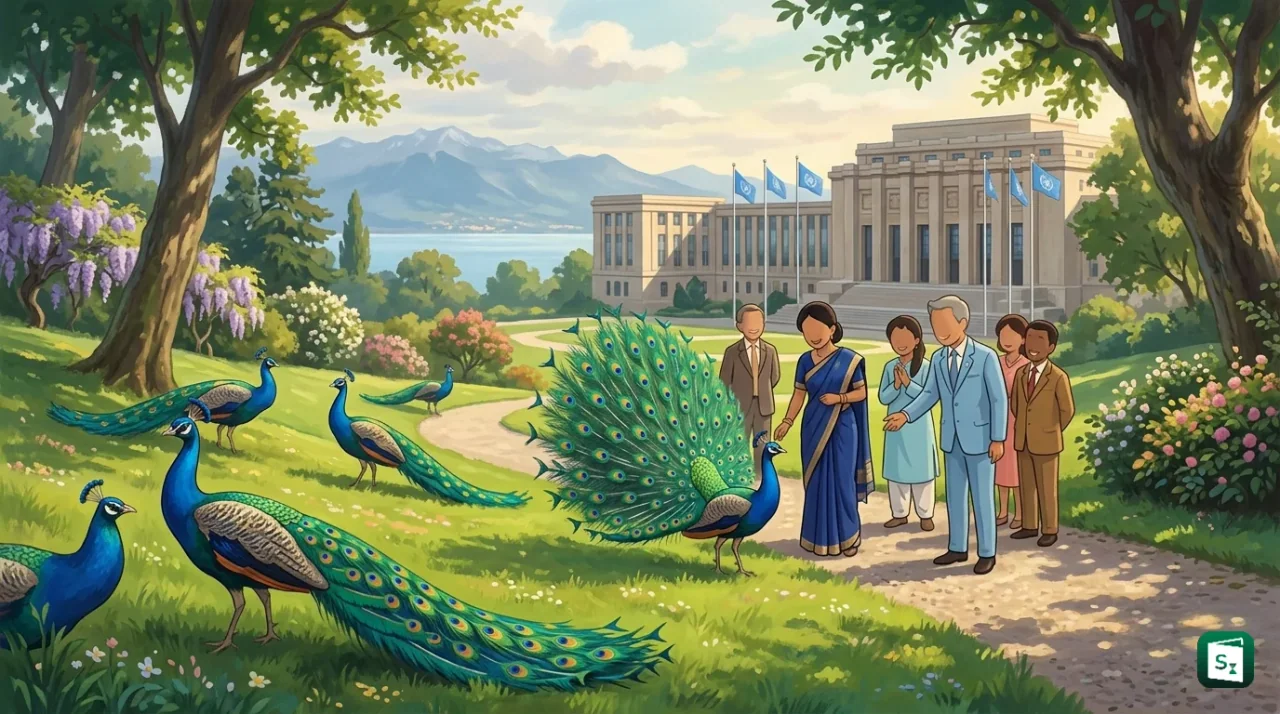
India has donated five Indian peacocks to the United Nations Office at Geneva (UNOG) in Geneva, Switzerland, reviving a historic tradition that dates back nearly a century and a half. The birds, comprising four blue peafowl and one rare white-feathered male, were formally handed over at a ceremony in Ariana Park, the leafy grounds that surround the UN’s European headquarters. The gesture brings back a custom last honoured by India 45 years ago, when former Prime Minister Indira Gandhi gifted a breeding pair from the Delhi Zoo.
The Donation and the Handover Ceremony
India’s Permanent Mission to the United Nations in Geneva officially presented the five peacocks to Tatiana Valovaya, the Director-General of UNOG, on 7 August 2026. Ambassador Arindam Bagchi, India’s Permanent Representative to the UN and other international organisations in Geneva, made the handover at a special ribbon-cutting ceremony held in honour of the new arrivals.
The five young birds were chosen deliberately. Four are classic blue Indian peafowl, while the fifth is a rare white-feathered male. Together, they mirror the official blue and white colours of the United Nations, a detail that gave the gift a symbolic resonance beyond a simple act of goodwill. According to the Indian Mission, the peacock, which is India’s national bird, represents grace, beauty and resilience, and stands for India’s enduring commitment to biodiversity conservation and environmental stewardship.
The birds will first stay in a temporary, enclosed habitat in Ariana Park for about three months so they can settle in. After that, they will be allowed to roam freely across the park’s grounds, just as their predecessors have done for generations. Their care is being overseen by Geneva Bioparc zoo, under its director and qualified veterinarian Dr Tobias Blaha, working alongside UN staff.
This is the second time India has donated peacocks to UNOG. In 1981, then Prime Minister Indira Gandhi sent a breeding pair of Indian peafowl from the Delhi Zoo to Geneva, transporting them on her own plane. The population that grew from that gift later dwindled over the decades, and only a single peacock remained roaming the grounds before the latest donation replenished the park’s stock.
A Century-Old Tradition in Ariana Park
The presence of peacocks in Ariana Park is older than both the United Nations and its predecessor, the League of Nations. The tradition dates back to Gustave Revilliod, a Swiss archaeologist, art collector and philanthropist, who bequeathed his estate in Geneva to the City of Geneva when he died in 1890. In his will, he left the sprawling park, together with the Ariana Museum that he had named after his mother, to the city, on the condition that the estate remain open to the public.
Years later, the City of Geneva made the park available first to the League of Nations and then to the United Nations for their offices, on the understanding that this arrangement would continue for as long as the UN exists. The Palais des Nations, the grand building that houses UNOG, was constructed within the 46-hectare park between 1929 and 1938. The park remains one of the largest and most prestigious green spaces in Geneva, with more than 800 recorded species and trees over 100 years old.
Most of the peacocks seen in the park today were donated in 1997 by a zoo in Japan. The birds have become such a familiar part of the grounds that they are widely treated as residents of the campus. In 1954, during the Cold War, one peacock famously hopped onto a Soviet delegation’s car and was dubbed “the Geneva dove” by the press. The park’s history with the birds even prompted a 1951 local newspaper headline asking whether a peacock named Pierre, then the last survivor, would ever be replaced.
The Peacock: India’s National Bird
The peacock, or Indian peafowl (Pavo cristatus), has held a special place in Indian culture and mythology for centuries. It is linked to deities such as Lord Murugan, whose vehicle it is said to be, and to Goddess Saraswati, and it features widely in Indian art, textiles, dance and folklore. Its elaborate train, fanned out during courtship displays, and its association with the coming of the rains have made it a recurring symbol of beauty and grace.
The Government of India declared the peacock the national bird of India on 1 February 1963. It was chosen over other contenders such as the Great Indian Bustard and the Himalayan Monal because of its wide presence across the country, its universal recognition, and its deep roots in Indian cultural and religious traditions. The bird is native to the Indian subcontinent and is protected under the Wildlife (Protection) Act, 1972, which came into force the same year as the landmark international treaty process that led India to become a party to CITES (the Convention on International Trade in Endangered Species of Wild Fauna and Flora). The species itself is listed as Least Concern on the IUCN Red List.
Animal Diplomacy as Soft Power
The gift of animals between nations is a well-established diplomatic practice. Known as animal diplomacy, it has been used for centuries to signal friendship, build goodwill and strengthen bilateral ties. The most famous modern example is panda diplomacy, through which China has gifted or leased giant pandas to other countries since the 1950s as a symbol of friendship and cooperation.
India’s gift of peacocks fits this tradition of soft power, which refers to a country’s ability to influence others through culture, values and attraction rather than through coercion. For India, the peacock is a distinctive and recognisable national emblem, so the donation showcases the country’s natural heritage and cultural identity on a global stage. It also carries a practical dimension: the new birds replenish a population that had dwindled to a single individual, helping UNOG sustain the biodiversity of its own campus.
The donation is part of a broader pattern of India using cultural symbols to deepen its engagement with international institutions. India’s Mission described the gesture as one that underscores India’s longstanding partnership with the United Nations and reaffirms its commitment to multilateralism and international cooperation.
Significance of the Gesture
The handover matters on several levels. Symbolically, it connects two distinct forms of heritage: Geneva’s role as a global centre of diplomacy and India’s deep cultural association with the peacock. Practically, it sustains a living tradition at UNOG that predates the organisation itself and adds to the biodiversity of the UN’s European headquarters, which received the Nature Reserve Certificate in 2009 from the Swiss non-profit Fondation Nature and Economie for its environment-friendly management of green areas.
For India, the gesture reinforces its image as a nation that blends cultural pride with environmental responsibility. By reviving the 1981 tradition, India also signals continuity in its relationship with the UN and its place within the multilateral system. The ceremony drew visible public interest, with visitors eager to photograph the rare white peacock, and UNOG has announced that it will soon launch a competition to name the five new arrivals.
Key Takeaways
- India donated five peacocks to the United Nations Office at Geneva (UNOG) on 7 August 2026, comprising four blue peafowl and one rare white-feathered male.
- The birds were handed over by Ambassador Arindam Bagchi, India’s Permanent Representative to the UN in Geneva, to UNOG Director-General Tatiana Valovaya.
- This is the second Indian donation of peacocks to UNOG; the first was a breeding pair from the Delhi Zoo sent by Indira Gandhi in 1981.
- The peacocks will stay in an enclosed habitat in Ariana Park for about three months before being allowed to roam freely across the 46-hectare park.
- The tradition dates back to Gustave Revilliod, who bequeathed the estate now housing the Palais des Nations to the City of Geneva in 1890.
- The peacock (Pavo cristatus), declared India’s national bird on 1 February 1963, is protected under the Wildlife (Protection) Act, 1972.