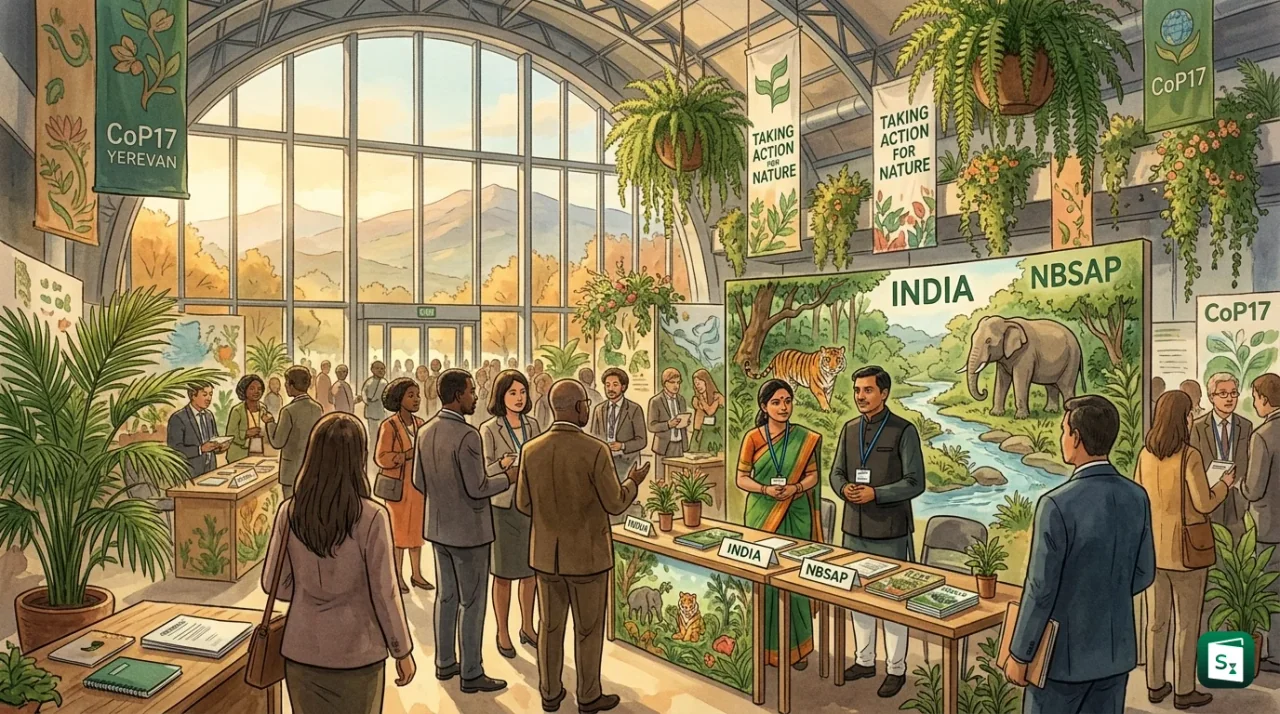
The 17th Conference of the Parties to the Convention on Biological Diversity (CBD COP17) was held from 19 to 30 October 2026 at the Meridian Expo and Event Centre in Yerevan, Armenia, under the theme Taking Action for Nature. The meeting completed the first global review of the Kunming-Montreal Global Biodiversity Framework and adopted the Yerevan Pathway along with nearly 50 decisions. India, led by Union Environment Minister Bhupender Yadav, presented its updated National Biodiversity Strategy and Action Plan with 23 national targets and 142 indicators.
What Is the Convention on Biological Diversity?
The Convention on Biological Diversity (CBD) is the main international treaty for the protection of nature. It was opened for signature at the Earth Summit in Rio de Janeiro on 5 June 1992 and entered into force on 29 December 1993. The CBD now has 196 Parties, which include 195 countries and the European Union, giving it near universal membership.
Biodiversity refers to the variety of life on Earth. It includes three levels, genetic diversity within species, species diversity among plants, animals and microbes, and ecosystem diversity across forests, wetlands, oceans and other habitats. The CBD has three clear objectives, conservation of biological diversity, sustainable use of its components, and fair and equitable sharing of benefits from the use of genetic resources.
The CBD Secretariat is based in Montreal, Canada. The Conference of the Parties (COP) is the governing body of the CBD. It meets once every two years to review progress, set work programmes and take decisions by consensus.
Two binding protocols support the CBD. The Cartagena Protocol on Biosafety, adopted in 2000 and in force since 2003, controls the safe handling, transport and use of living modified organisms from modern biotechnology. The Nagoya Protocol on Access and Benefit Sharing, adopted in 2010 and in force since 2014, sets rules so that benefits from genetic resources and associated traditional knowledge are shared fairly with provider countries and communities.
CBD COP17 in Yerevan: Dates, Venue and Theme
CBD COP17 was held from 19 to 30 October 2026 in Yerevan, Armenia, and closed on 31 October after extended negotiations. The official negotiation venue, called the Blue Zone, was the Meridian Expo and Event Centre in Yerevan. A public Green Zone at the Karen Demirchyan Complex hosted exhibitions, youth events and side events.
The CBD COP17 presidency was held by Armenia, led by Environment Minister Hambardzum Matevosyan as COP President. Armenia had been elected as host at COP16 in Cali, Colombia, in 2024. The COP17 theme was Taking Action for Nature, which stressed moving from promises to implementation.
The 2026 UN Biodiversity Conference brought together about 9,400 participants, including government delegations, scientists, Indigenous Peoples and local communities, business, youth and civil society. It combined three meetings, CBD COP17, the 12th Meeting of the Parties to the Cartagena Protocol (CP-MOP 12) and the 6th Meeting of the Parties to the Nagoya Protocol (NP-MOP 6). A Leaders for Nature Summit on 16 October preceded the talks.
| Fact | Detail |
|---|---|
| CBD COP17 held in which country | Armenia |
| City and venue | Yerevan, Meridian Expo and Event Centre |
| Dates | 19 to 30 October 2026 (decisions adopted 31 October) |
| Theme | Taking Action for Nature |
| President | Hambardzum Matevosyan, Environment Minister of Armenia |
| Previous COP | COP16, Cali, Colombia, 2024 |
| Next COP | COP18, Quito, Ecuador, 2028 |
The Yerevan Pathway and 50 Decisions at COP17
The central outcome of CBD COP17 was the Yerevan Pathway. It is the negotiated response to the first global review of collective progress under the Kunming-Montreal Global Biodiversity Framework. The review was based on the State of Biodiversity Action report. The report found the world is off track to meet the 23 targets by the 2030 deadline.
The Yerevan Pathway sets priorities for faster action through 2030. These include reforming subsidies that harm nature, increasing finance and technology support for developing countries, aligning national budgets and economic decisions with biodiversity goals, and stronger monitoring, reporting and review. The COP adopted nearly 50 decisions on protected areas and forests, sustainable wildlife use, invasive alien species, marine and coastal biodiversity, synthetic biology, risk assessment of living modified organisms and biodiversity mainstreaming.
Sevan Guidelines for Indigenous Peoples and Local Communities
Parties agreed on the Sevan Guidelines, named after Lake Sevan in Armenia. These guidelines set the operating rules for the new permanent Subsidiary Body on Article 8(j). Article 8(j) of the CBD asks countries to respect and maintain the knowledge, innovations and practices of Indigenous Peoples and local communities.
The body was created at COP16. COP17 settled how it will work. One co-chair will be nominated by governments and the other by Indigenous Peoples and local communities. This gives communities a direct and permanent place in global biodiversity decisions.
Finance, Harmful Subsidies and the Cali Fund
Finance was the hardest part of the talks. The global framework calls for mobilising at least $200 billion per year by 2030 from all sources, including at least $30 billion per year in international finance for developing countries. It also calls for cutting harmful subsidies by at least $500 billion per year by 2030. The review found developed countries had missed the interim goal of $20 billion per year by 2025.
COP17 announced nearly $2 billion in new pledges. This included $560 million under the ninth replenishment of the Global Environment Facility (GEF-9) and its Global Biodiversity Framework Fund, $500 million through the Species Recovery Alliance and more than $330 million through the Value Nature Fund to draw private capital into nature. The Asian Development Bank launched a biodiversity bond and investment incubator.
COP17 also advanced the Cali Fund for benefit sharing from digital sequence information (DSI) on genetic resources. DSI means digitised genetic data stored in public databases and used in pharma, biotech, seeds, cosmetics and food research. Large companies using DSI are expected to contribute at an indicative rate of 1 percent of profit or 0.1 percent of revenue. At least half the fund is meant for Indigenous Peoples and local communities. Only a small amount had been paid in by the close of COP17, and detailed rules on thresholds and disbursement were pushed to COP18.
What Is the Kunming-Montreal Global Biodiversity Framework?
The Kunming-Montreal Global Biodiversity Framework (KMGBF) is the global plan to halt and reverse biodiversity loss. Parties adopted it on 19 December 2022 at COP15 in Montreal. It sets 4 long term goals for 2050 for living in harmony with nature and 23 action targets for 2030.
The 23 targets cover three broad areas. The first group reduces threats such as land and sea use change, pollution, overuse of wild species, climate change and invasive alien species. The second group ensures sustainable use and fair benefit sharing. The third group covers tools for implementation such as finance, capacity building, technology, data and inclusive decision making.
Three targets receive special attention. Target 2 calls for restoring at least 30 percent of degraded terrestrial, inland water, coastal and marine ecosystems by 2030. Target 3, known as 30 by 30, calls for conserving at least 30 percent of land, inland water and sea through protected areas and other effective area based measures. Target 19 sets the finance goal of $200 billion per year, while Target 18 sets the harmful subsidy reform goal of $500 billion per year.
Each country implements the framework through a National Biodiversity Strategy and Action Plan (NBSAP). Countries were asked to update their NBSAPs and set national targets aligned with the 23 global targets.
What India Presented at COP17: NBSAP and Conservation Record
Union Minister for Environment, Forest and Climate Change Bhupender Yadav delivered India’s National Statement at the High Level Segment on 27 October 2026. He said implementation of the global framework must respect national priorities, circumstances and laws. He sought adequate and predictable finance, capacity building and technology transfer from developed countries.
India highlighted its updated National Biodiversity Strategy and Action Plan 2024-2030. India released the plan at COP16 in Cali on 30 October 2024. The plan converts the global framework into 23 National Biodiversity Targets and 142 indicators. It follows a whole of government and whole of society approach with 23 central ministries involved. It groups targets into 8 on reducing threats, 5 on sustainable use and benefit sharing, and 10 on tools and mainstreaming. The estimated cost is about ₹81,664 crore per year from 2024-25 to 2029-30.
India’s domestic system rests on the Biological Diversity Act, 2002. The law created a three tier structure, the National Biodiversity Authority (NBA) in Chennai, set up in 2003, State Biodiversity Boards, and local Biodiversity Management Committees. India amended the law in 2023 to simplify access and support benefit sharing.
Yadav listed India’s conservation base, 1,134 protected areas, 103 Ramsar sites, 57 Biodiversity Heritage Sites and 18 biosphere reserves, of which 13 are in the UNESCO Man and the Biosphere network. India is a megadiverse country with four biodiversity hotspots touching its territory, the Himalaya, Indo-Burma, Western Ghats and Sri Lanka, and Sundaland. The Western Ghats, a UNESCO World Heritage Site, is rich in endemic plants, amphibians and freshwater species.
India also flagged the International Big Cat Alliance for seven big cat species, Mission LiFE for sustainable lifestyles, and Ek Ped Maa Ke Naam for tree planting. Restoration programmes include MISHTI for mangroves, Amrit Dharohar for wetlands and the Soil Health Card Scheme for soil fertility. On science issues, India supported benefit sharing from DSI through the Cali Fund and called for a science based, risk proportionate and precautionary approach to synthetic biology and biosafety.
CBD COP18 in Quito in 2028
CBD COP18 will be held in Quito, the capital of Ecuador, in 2028. Parties chose Ecuador by secret ballot at the closing plenary of COP17. Ecuador defeated Panama by 55 votes to 53.
COP18 will meet with only two years left to the 2030 deadline. It is expected to review finance, including whether a new dedicated fund is needed, finalise Cali Fund rules on company thresholds and disbursement, complete pending work on the Article 8(j) friends of the bureau group, and assess national plans and reports.
Key Takeaways
- CBD COP17 was held from 19 to 30 October 2026 at the Meridian Expo and Event Centre in Yerevan, Armenia, under the theme Taking Action for Nature.
- The Yerevan Pathway was adopted as the response to the first global review, which found the world off track on the 23 targets of the Kunming-Montreal Framework.
- COP17 adopted nearly 50 decisions and agreed on the Sevan Guidelines for the permanent body on Article 8(j) for Indigenous Peoples and local communities.
- India’s updated NBSAP 2024-2030 sets 23 national targets and 142 indicators, presented by Bhupender Yadav on 27 October 2026.
- Quito, Ecuador, will host CBD COP18 in 2028 after winning a ballot against Panama by 55 votes to 53.