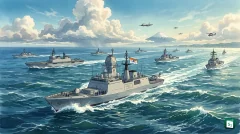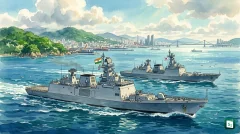
India and Myanmar conducted their inaugural bilateral Tri-Services Humanitarian Assistance and Disaster Relief exercise, Exercise Rahat Mitra, in Chennai on 5 and 6 November 2026. Coordinated by the Indian Navy, the two day drill brought together more than 300 personnel from the Army, Navy and Air Force of both countries. The exercise marks a new step in India Myanmar defence cooperation and joint readiness for cyclones, floods, earthquakes and other disasters.
What Is HADR and What Is Exercise Rahat Mitra?
HADR stands for Humanitarian Assistance and Disaster Relief. It refers to the rescue, medical aid, food supply, shelter support and restoration work carried out by armed forces and civilian agencies after natural disasters such as cyclones, floods and earthquakes, and during humanitarian crises.
Exercise Rahat Mitra is the first bilateral Tri-Services HADR exercise between India and Myanmar. Tri-Services means personnel from all three armed forces, the Indian Army, the Indian Navy and the Indian Air Force, train together with the Myanmar Defence Forces. The name combines two Hindi words. Rahat means relief and Mitra means friend.
The central aim is interoperability. That is the ability of two different militaries to plan together, communicate clearly and act as one team during a real disaster. The exercise focuses on joint planning, sharing of standard procedures and learning from each field demonstration.
Rahat Mitra 2026 in Chennai: Dates, Theme and Participants
Exercise Rahat Mitra 2026 was held between India and Myanmar. It took place in Chennai in the state of Tamil Nadu on 5 and 6 November 2026. The Indian Navy coordinated the exercise.
The theme of the exercise was Together for Humanity, Stronger through Partnership. The theme underlines trust, joint planning and collective response to humanitarian emergencies.
More than 300 personnel from the Army, Navy and Air Force of both countries took part. The Indian side included teams from all three services based in and around Chennai. The Myanmar side sent a delegation of officers and personnel from the Myanmar Defence Forces. The Myanmar delegation also called on Rear Admiral Upal Kundu, the Flag Officer Commanding Tamil Nadu and Puducherry Naval Area.
| Fact | Detail |
|---|---|
| Exercise name | Exercise Rahat Mitra, inaugural edition |
| Type | Bilateral Tri-Services HADR exercise |
| Countries | India and Myanmar |
| Venue | Chennai, Tamil Nadu |
| Dates | 5 and 6 November 2026 |
| Coordinator | Indian Navy |
| Strength | More than 300 personnel from both sides |
| Theme | Together for Humanity, Stronger through Partnership |
How the Two Day Exercise Was Conducted in Chennai
The programme combined classroom planning with live field demonstrations across land, sea and air. This multi domain approach tested how shore units, ships, aircraft, hospitals and communication centres work together in one chain of response.
Joint Planning and Cyclone Scenario Drill
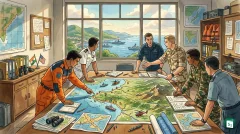
The exercise opened with joint planning sessions and familiarisation with each side’s HADR tools and procedures. Both delegations then took part in a Table-Top Exercise (TTX) built around a severe cyclone scenario.
A Table-Top Exercise is a discussion based drill. Officers sit together, face a simulated disaster and decide step by step how they would respond. In Chennai, the focus was on coordinated response mechanisms, joint disaster management protocols and clear command structures.
Army, Navy and Air Force Demonstrations
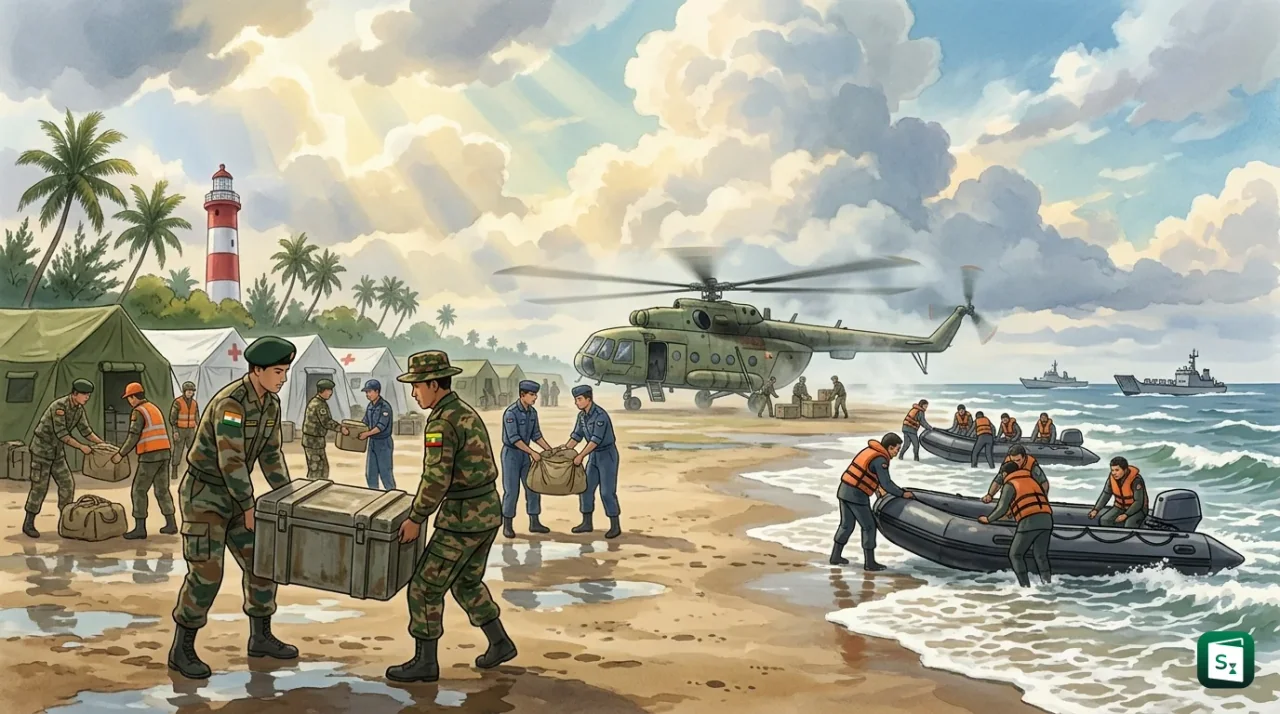
The Indian Army demonstrated Flood Relief Columns and Engineer Task Forces. Practical displays covered rescue work, dewatering of flooded areas, obstacle clearance and bridge laying to restore road links to cut off habitations. The delegations also visited INS Sukanya, a Sukanya class patrol vessel, to study shipborne relief capabilities.
On the second day, INS Adyar and the Communication Network Centre in Chennai showed shore based response and communication systems used for command and control during emergencies. The Military Hospital in Chennai demonstrated field medical triage and organised management of relief camps. Triage is the quick sorting of injured persons by urgency so that the most critical cases receive care first.
The Indian Navy’s Flood Relief Teams (FRTs) displayed specialised boats, pumps and rescue gear for flood operations. Maritime Search and Rescue was shown through joint manoeuvres by a Chetak helicopter and INS Bitra. The Indian Air Force demonstrated casualty evacuation by Advanced Light Helicopter (ALH), with Myanmar officer Commodore Aung Niang Win and two other Myanmar officers on board during the flight. Displays also covered drone assisted search, air dropping of relief loads and hoist based patient transfer.
Why Myanmar Is Important for India
Myanmar is the only Association of Southeast Asian Nations (ASEAN) member that shares both a land and a maritime boundary with India. It serves as India’s land gateway to Southeast Asia and links the Northeast to the wider Indo-Pacific region.
Myanmar shares a land border of about 1,643 km with four Indian states, Arunachal Pradesh, Nagaland, Manipur and Mizoram. The two countries also share a maritime boundary in the Andaman Sea and the Bay of Bengal. This makes Myanmar central to border management, control of insurgent movement and drug trafficking, and security of sea lanes near the Andaman and Nicobar Islands.
Connectivity projects underline the stake. The Kaladan Multi-Modal Transit Transport Project, the India Myanmar Thailand Trilateral Highway and the Sittwe Port in Rakhine State, inaugurated in May 2023, are designed to connect India’s Northeast to Myanmar by road, river and sea. Bilateral trade reached $1.95 billion in 2025-26, with India emerging as Myanmar’s fourth largest trading partner.
Myanmar is also a key partner in India’s Neighbourhood First policy, Act East policy and the MAHASAGAR vision. MAHASAGAR stands for Mutual and Holistic Advancement for Security and Growth Across Regions. Announced in March 2025 during the Prime Minister’s visit to Mauritius, it builds on the earlier SAGAR vision of Security and Growth for All in the Region and promotes trade, capacity building and shared maritime security.
Disaster relief has built deep goodwill. India helped after Cyclone Nargis in 2008, Cyclone Mora in 2017 and Typhoon Yagi in 2024 through Operation Sadbhav. After the 7.7 magnitude earthquake of 28 March 2025 in Myanmar, India launched Operation Brahma and delivered about 1,000 tonnes of aid by air and sea, deployed an 80 member National Disaster Response Force (NDRF) team and ran an Army field hospital in Mandalay that treated 2,519 patients.
India Myanmar Defence Cooperation Beyond Rahat Mitra
Rahat Mitra adds a dedicated HADR pillar to a defence relationship that already covers army training, naval patrols and multilateral events. Regular staff talks of the Army, Navy and Air Force, training exchanges and capacity building courses sustain the partnership.
| Exercise or Mechanism | Nature and Focus |
|---|---|
| IMBAX (India Myanmar Bilateral Army Exercise) | Army exercise on United Nations Peacekeeping Operations. The first edition, IMBAX 2017, was held at Umroi in Meghalaya. The fifth edition was held from 15 to 28 September 2026 at the Joint Training Node in Umroi. |
| IMNEX (India Myanmar Naval Exercise) | Bilateral naval exercise in the Bay of Bengal. The first edition was held in 2013 off Visakhapatnam. IMNEX 18 included frigates, corvettes, a submarine and aircraft. |
| IMCOR (India Myanmar Coordinated Patrol) | Coordinated patrol along the maritime boundary between Myanmar’s Coco Island and India’s Landfall Island in the Andaman group. It improves maritime domain awareness and checks smuggling and illegal activity. |
| MILAN and other multilateral forums | Myanmar regularly joins India hosted naval gatherings such as MILAN, the Goa Maritime Conclave and the Indian Ocean Naval Symposium. |
India follows the same Tri-Services HADR template with other partners. The best known example is Tiger Triumph with the United States. Tiger Triumph stands for Tri-Services India US Amphibious Exercise. First held in 2019 on the eastern seaboard, it combines harbour planning with sea phase landings and field hospitals. The fifth edition, Tiger Triumph 2026, was held as a Table-Top Exercise from 31 October to 5 November 2026 at Visakhapatnam with NDRF participation for the first time.
Rahat Mitra therefore fits a wider pattern in India’s defence exercises. Bilateral drills build country specific trust, while repeated HADR formats create common procedures that can be used with any partner during a real cyclone, flood or earthquake.
Key Takeaways
- Exercise Rahat Mitra is the inaugural India Myanmar bilateral Tri-Services HADR exercise, held in Chennai, Tamil Nadu on 5 and 6 November 2026.
- The exercise was coordinated by the Indian Navy and involved more than 300 personnel under the theme Together for Humanity, Stronger through Partnership.
- HADR stands for Humanitarian Assistance and Disaster Relief, covering rescue, medical aid, food, shelter and restoration work after disasters.
- The drill included a cyclone based Table-Top Exercise, bridge laying displays, a visit to INS Sukanya, Flood Relief Team demos, Chetak and INS Bitra search and rescue, and ALH casualty evacuation.
- Myanmar is the only ASEAN country sharing both land and maritime boundaries with India and is key to the Kaladan Project, Sittwe Port and India’s MAHASAGAR vision.