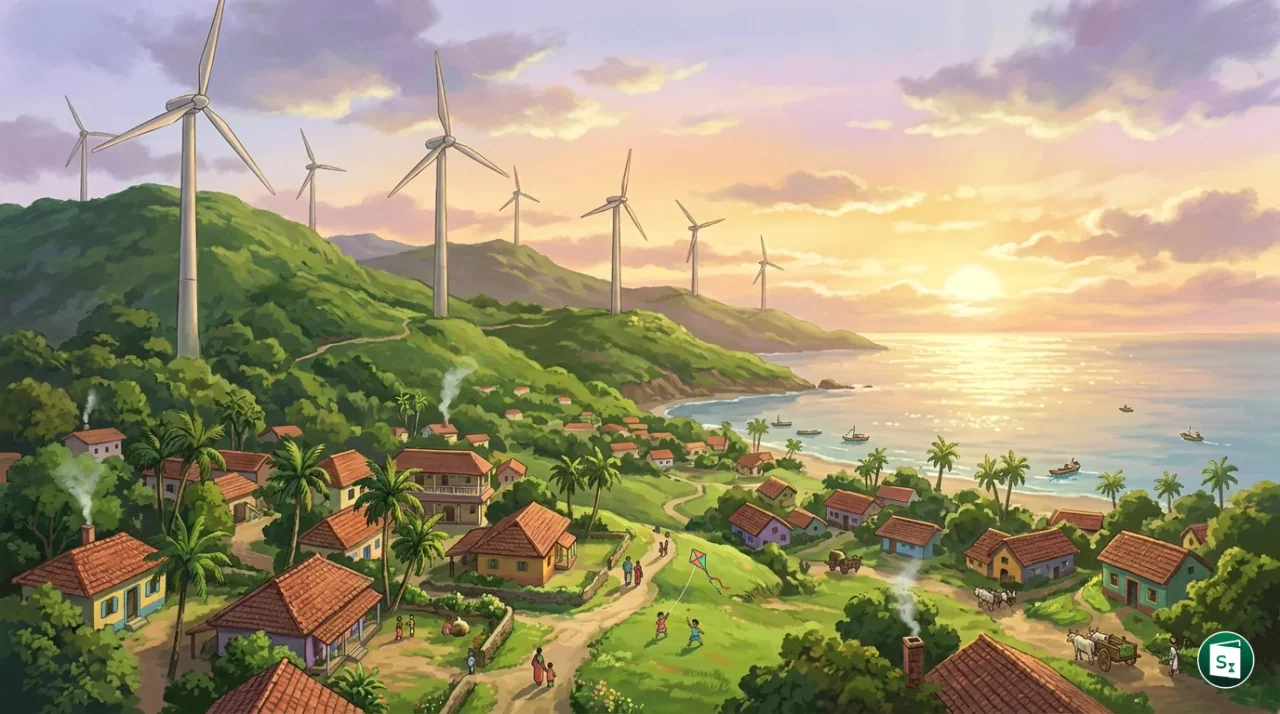
Global Wind Day 2026 was celebrated across the world on June 15 under the theme “Our Wind, Our Community”, highlighting how wind energy transforms local communities while driving the global shift away from fossil fuels. The day, coordinated by WindEurope and the Global Wind Energy Council (GWEC), featured events in dozens of countries ranging from wind farm open days to policy conferences. In India, the Ministry of New and Renewable Energy (MNRE) hosted a major conference in Goa themed “Wind Energy: From Ambition to Acceleration”, underscoring the country’s record-breaking wind capacity additions.
What Is Global Wind Day?
Global Wind Day is an annual worldwide event held on June 15 to celebrate wind energy and raise awareness about its potential to transform energy systems, cut carbon emissions, and create economic opportunities. It was first launched in 2007 by the European Wind Energy Association (EWEA), now known as WindEurope, as a Europe-only initiative called Wind Day. The inaugural edition reached 18 European countries and drew around 35,000 participants.
The event went global in 2009 when EWEA partnered with the Global Wind Energy Council (GWEC), which had been founded in 2005 to represent the wind energy sector internationally. The first Global Wind Day in 2009 featured 300 events across 35 countries, reaching about 1 million people. Today, the event is observed in dozens of countries across all continents.
WindEurope, headquartered in Brussels, Belgium, was founded in 1982 and represents over 450 member companies across the wind energy value chain. GWEC, which moved its global headquarters to Lisbon, Portugal in 2024, represents over 1,500 member organizations in more than 80 countries. Together, they coordinate Global Wind Day activities in partnership with national renewable energy associations worldwide.
”Our Wind, Our Community”: The 2026 Theme
The 2026 theme marked a shift from abstract climate messaging to concrete local impact. Instead of framing wind energy purely as a global climate solution, this year’s campaign focused on how wind farms directly benefit the communities that host them.
WindEurope collected real-world stories from across Europe showing how wind energy projects have revitalised rural areas. For example, in Celado de Fusion in rural Spain, a region that had been losing residents for decades, wind farm revenues funded a new swimming pool, a paddle tennis court, and a taxi service for elderly residents, attracting new inhabitants. In Andilly Les Marais, France, 380 local residents invested €1.2 million to co-own a third of the local wind farm, with the project reinvesting €62,000 every year into local education and infrastructure.
The campaign emphasised four pillars of local confidence: confidence that clean, home-grown energy works; confidence that communities can shape projects in ways that matter to them; confidence that the energy transition can strengthen local life; and confidence that benefit-sharing models such as community funds, shared ownership, and lower electricity bills deliver tangible results.
WindEurope CEO Tinne Van der Straeten called on European policymakers to protect these participation models, warning that overly rigid regulations could slow down projects and undermine the local benefits that wind energy delivers.
Why Wind Energy Matters
Wind energy has become one of the cheapest sources of new electricity in many markets worldwide, making it a cornerstone of the global energy transition. It plays three critical roles in today’s energy landscape.
First, it powers decarbonisation. Wind energy directly displaces coal and gas-fired power, reducing carbon dioxide emissions at scale. The Paris Agreement targets require the world to triple renewable energy capacity by 2030 to limit global warming to 1.5 degrees Celsius, and wind energy is expected to provide the bulk of this new capacity.
Second, it strengthens energy security. By reducing dependence on imported fossil fuels, wind power shields economies from volatile global energy markets and geopolitical shocks. This has become especially urgent after recent disruptions in international oil and gas supply chains.
Third, it drives economic growth. The wind sector already pays an estimated €2.3 billion annually in local taxes in Europe alone. In rural areas, wind farms are often among the largest contributors to municipal budgets, funding schools, roads and healthcare. A single typical onshore wind farm can generate thousands of euros each year for local public services.
Global Wind Energy: Record Growth in 2025
According to the GWEC Global Wind Report 2026, the global wind industry installed a record 165 GW of new capacity in 2025, a 40% increase over the previous record set in 2024. This brought the world’s total installed wind power capacity to 1,299 GW by the end of 2025. A total of 28,395 wind turbines were installed across 57 countries, and 138 countries now generate electricity from wind power.
The top five markets China, the United States, India, Germany, and Brazil accounted for 86% of all new capacity additions in 2025. China alone added more than 120 GW, while India nearly doubled its annual installations to a record 6.3 GW. The Asia-Pacific region contributed nearly 80% of global installations.
Offshore wind added 9 GW globally in 2025, up 18% from the previous year, marking the third-highest annual total for the sector. GWEC projects that global wind capacity will surpass the historic 2 Terawatt (TW) milestone by 2029, just six years after crossing the 1 TW mark in 2023. Between 2026 and 2030, 969 GW of new wind capacity is expected to be commissioned worldwide, averaging 194 GW per year.
India’s Wind Energy Story
India is now the world’s fourth-largest wind power market by total installed capacity. Cumulative wind power capacity has grown from 21.04 GW in March 2014 to 56.09 GW in March 2026, a 2.66-fold increase over twelve years. An additional 28 GW is currently under implementation.
The financial year 2025-26 was a landmark period. India added a record 6.05 GW of new wind capacity, surpassing the previous high of 4.15 GW in 2024-25 by 46%. This was also higher than the earlier peak of 5.5 GW achieved in 2016-17. States such as Gujarat, Karnataka, and Maharashtra led the additions, driven by a mix of standalone wind projects and hybrid installations combining wind and solar.
India’s wind turbine manufacturing capacity has grown from 10 GW in 2014 to about 24 GW as of March 2026, positioning the country as the world’s third-largest wind equipment manufacturing hub. A study unveiled at the Global Wind Day 2026 conference in Goa explored pathways to further elevate India’s wind turbine exports for global markets.
India has set ambitious targets of 100 GW of wind capacity by 2030 and 156 GW by 2036, contributing to its broader goal of 500 GW of non-fossil fuel capacity by 2030 and net-zero emissions by 2070. The government has also approved ₹6,853 crore in Viability Gap Funding (VGF) for the first 1,000 MW of offshore wind capacity, split equally between projects off the coasts of Gujarat and Tamil Nadu.
India’s Wind Energy Potential
According to assessments by the National Institute of Wind Energy (NIWE), established in Chennai in 1998 under MNRE, India’s gross wind power potential is estimated at 695.5 GW at 120 metres and 1,163.9 GW at 150 metres hub height above ground level. However, only about 4.5% of this potential has been utilised so far.
NIWE has installed over 900 wind-monitoring stations across the country and developed wind potential maps at 50m, 80m, 100m, 120m, and 150m hub heights. The potential is concentrated in eight high-resource states:
| State | Wind Potential at 120m (GW) | Wind Potential at 150m (GW) |
|---|---|---|
| Rajasthan | 127.75 | 284.2 |
| Gujarat | 142.56 | 180.8 |
| Maharashtra | 98.21 | 173.9 |
| Karnataka | 124.15 | 169.3 |
| Andhra Pradesh | 74.90 | 123.3 |
| Tamil Nadu | 68.75 | 95.1 |
| Madhya Pradesh | 15.40 | 55.4 |
| Telangana | 24.83 | 54.7 |
| Total (8 states) | 676.55 | 1,136.7 |
| Others | 18.95 | 27.1 |
| India Total | 695.50 | 1,163.9 |
The government has also introduced several policy measures to accelerate wind deployment, including the ALMM (Wind) mandate for domestic sourcing, a dedicated Wind Renewable Purchase Obligation (RPO), and an offshore wind leasing framework. These measures are expected to unlock India’s potential of adding 13-15 GW of wind capacity annually by 2030.
Key Takeaways
- Global Wind Day is observed annually on June 15, first launched in 2007 by the European Wind Energy Association (now WindEurope), and expanded globally in 2009 with GWEC.
- The 2026 theme, “Our Wind, Our Community”, focused on how wind energy projects deliver local benefits such as community funds, shared ownership, and infrastructure development.
- Global wind installations hit a record 165 GW in 2025, bringing total global capacity to 1,299 GW, with 138 countries now using wind power.
- India is the fourth-largest wind market globally with 56.09 GW of installed capacity, and added a record 6.05 GW in 2025-26.
- India’s estimated wind power potential is 695.5 GW at 120 metres and 1,163.9 GW at 150 metres hub height, with Rajasthan and Gujarat holding the highest potential.
- NIWE, established in 1998 and headquartered in Chennai, is the nodal agency for wind resource assessment and offshore wind development in India.