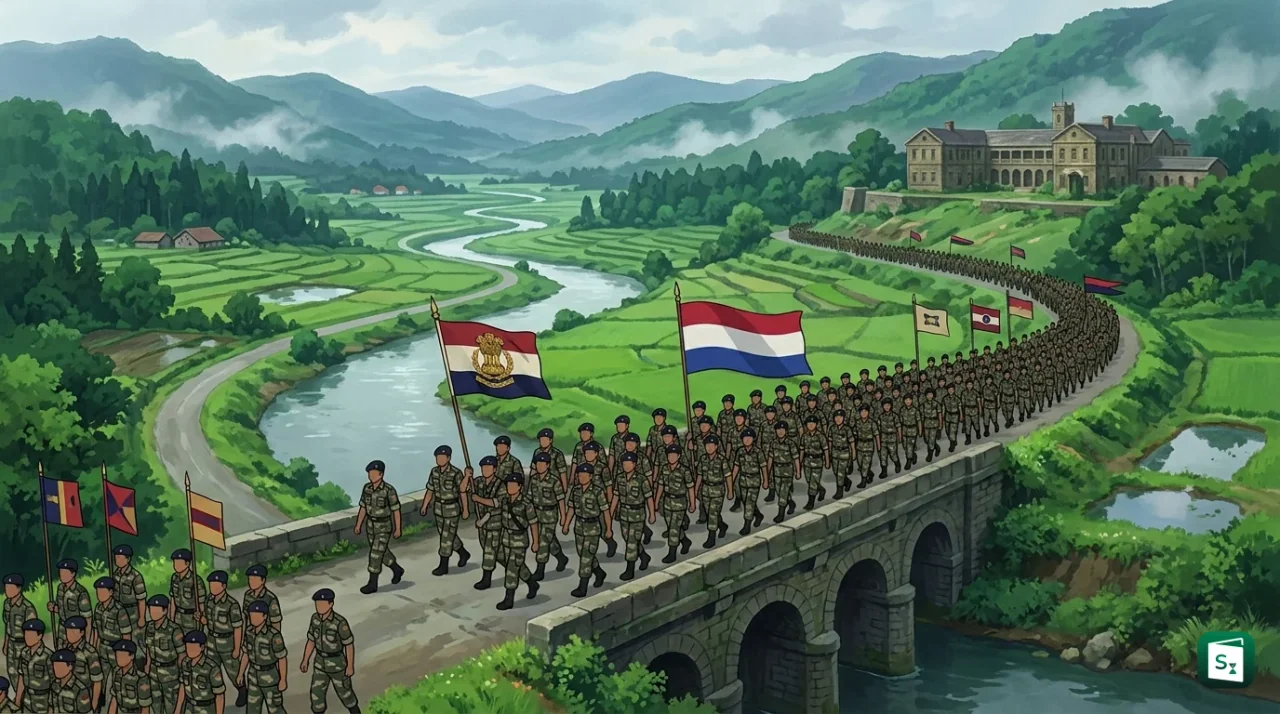
CRPF Foundation Day is observed every year on July 27 to mark the establishment of the Central Reserve Police Force in 1939. The force, originally raised as the Crown Representative’s Police, has since grown into the largest Central Armed Police Force (CAPF) in India, with a strength of over three lakh personnel. The day honours the unwavering service of the force in maintaining internal security, countering insurgency and assisting the nation during natural disasters.
What Is CRPF Foundation Day?
The day is also referred to as the CRPF Raising Day, since it marks the anniversary of the force being first raised, rather than its independence-era renaming. A parade and ceremonial functions are held at the force’s headquarters in New Delhi, where gallantry medals and commendations are conferred upon personnel for exceptional service.
The occasion serves as a moment of national recognition for the force’s contribution. Since its formation, more than 2,200 personnel have made the supreme sacrifice in the line of duty, and the force has been decorated with honours such as the Ashok Chakra, the highest peacetime gallantry award in India, along with numerous Kirti Chakra and Shaurya Chakra awards.
From Crown Representative’s Police to CRPF: A Historical Journey
Origins in Princely India
The force was born in the closing years of the British Raj. It was raised on 27 July 1939 at Neemuch, a town in present-day Madhya Pradesh, as the Crown Representative’s Police (CRP). The immediate trigger was the political unrest that had spread through the princely states, which was set off in part by the Madras Resolution of the All-India Congress Committee in 1936, calling for civil liberties and representative government in these territories.
The Crown Representative was the British official who dealt directly with the princely states. The new police body was created to help these native states preserve law and order, in line with imperial policy. The first battalion raised at Neemuch was meant to be a mobile reserve that could be rushed to any state facing disturbances. The force was therefore a reserve police, held centrally rather than attached to any single province, which is the meaning behind its name.
The 1949 Transformation
After independence, the force was given its present identity. On 28 December 1949, an Act of Parliament renamed it the Central Reserve Police Force, and the CRPF Act, 1949 (Act No. 66 of 1949) constituted it as an armed force of the Union. The then Home Minister, Sardar Vallabhbhai Patel, conceived a multi-dimensional role for the force, suited to the needs of the newly independent nation.
The force’s early service came during the integration of the princely states into the Indian Union. CRPF contingents helped establish order in states like Junagadh and the Kathiawar region of Gujarat, which had initially declined to join the Union. Through the 1950s, its detachments earned wide appreciation for restoring law and order in Bhuj, the Patiala and East Punjab States Union (PEPSU) and the dacoit-infested Chambal ravines.
Mandate and Organisation of the Force
The CRPF functions under the Ministry of Home Affairs (MHA), with its headquarters in the CGO Complex, New Delhi. It is headed by a Director General, an officer of the Indian Police Service. The force is organised into four zones headquartered at Jammu, Kolkata, Hyderabad and Guwahati, each under a Special Director General, and further divided into administrative and operational sectors, ranges, group centres and training institutions.
The force now comprises well over 200 general duty battalions and a total strength of roughly 3 lakh personnel, which makes it the single largest CAPF in the country. Its motto is “Seva aur Nistha”, meaning Service and Loyalty.
The core mandate of the force covers crowd control and riot control, counter-militancy and counter-insurgency operations, dealing with Left-Wing Extremism (Naxal insurgency), VIP protection, security of vital installations, and assistance to state police forces in preserving law and order. The CRPF is not a border guarding force; its domain is internal security across the country.
Specialised Units Within the Force
Over the years the force has developed dedicated units for specific challenges:
| Unit | Full Form | Purpose |
|---|---|---|
| RAF | Rapid Action Force | Raised in October 1992, a riot control force that can deploy rapidly to handle communal and civil unrest |
| CoBRA | Commando Battalion for Resolute Action | Raised between 2008 and 2011, specially trained in guerrilla and jungle warfare to combat Naxal insurgency |
| Mahila Battalions | All-women battalions | Six all-women battalions, the first raised in 1986, to handle situations involving women sensitively |
| VIP Security Wing | Special protection unit | Guards governors, chief ministers, ministers, MPs, MLAs and other high-profile persons |
| SDG | Special Duty Group | Secures the Prime Minister’s residence and office as part of the outer cordon |
About 8.5% of the force is deployed for the protection of critical government installations, while roughly 5.7% is engaged in VIP security. The CRPF also provides security for several sensitive shrines, including the Ram Janmabhoomi complex in Ayodhya, the Kashi Vishwanath Temple in Varanasi, the Krishna Janmabhoomi complex in Mathura and the Mata Vaishno Devi shrine in Katra.
A Force for All Seasons: Key Operations and Achievements
War, Conflict and National Security
The CRPF has fought alongside the Indian Army in times of external conflict. On 21 October 1959, a patrol was ambushed by Chinese troops at Hot Springs in Ladakh, in what was the first Chinese intrusion into Indian territory; 10 CRPF personnel were killed. Their sacrifice is commemorated every year as Police Commemoration Day on 21 October. In the 1962 Sino-Indian War, the force assisted the Army in Arunachal Pradesh, losing eight personnel. It also fought shoulder to shoulder with the Army during the 1965 and 1971 Indo-Pak wars.
Two engagements stand out in the force’s history. The Battle of Sardar Post in Kutch, on 9 April 1965, saw two CRPF companies repulse an assault by a brigade of the Pakistan Army; the day is celebrated as Valour Day across all CAPFs and state police forces. The force also foiled the attack on the Indian Parliament on 13 December 2001 and an assault on Ayodhya on 27 July 2005.
Dealing With Left-Wing Extremism and Insurgency
The CRPF was designated the primary internal security force of the country in 2001. It played a central role in curbing militancy in Punjab during the 1980s and insurgency in Tripura in the 1990s. In recent decades, over one-third of the force has been deployed in Naxal-affected areas, with around 91 units, including CoBRA battalions, operating in the Left-Wing Extremism theatre. Its operations are credited with uprooting Maoism from Jharkhand, Bihar, West Bengal and Uttar Pradesh, and with neutralising senior Maoist leader Kishanji in 2011.
Elections, Disasters and UN Peacekeeping
The CRPF plays a central role in securing elections across the country. It acts as the nodal agency for coordinating the movement and deployment of troops on election duty, works with the Election Commission of India, and provides pre-induction training to troops assigned to election security, particularly in Jammu and Kashmir, Bihar and the Northeast.
The force has also been a first responder in natural disasters, including the Orissa Super Cyclone (1999), the Gujarat Earthquake (2001), the Indian Ocean Tsunami (2004) and the Jammu and Kashmir Earthquake (2005). Abroad, CRPF contingents have served in UN peacekeeping missions in Sri Lanka, Haiti, Namibia, Somalia, Kosovo and Liberia, including an all-women contingent sent to Liberia in 2007.
CRPF in the Family of Central Armed Police Forces
The Central Armed Police Forces (CAPFs) are the armed forces of the Union under the Ministry of Home Affairs, distinct from the territorial army and the state police. The CRPF is one of these forces, alongside the Border Security Force (BSF), Assam Rifles (AR), Indo-Tibetan Border Police (ITBP), Sashastra Seema Bal (SSB), Central Industrial Security Force (CISF) and the National Security Guard (NSG), the specialised counter-terrorism unit.
Each of these forces has a distinct mandate. While the BSF guards India’s borders with Pakistan and Bangladesh, the ITBP patrols the border with China, the SSB guards the Nepal and Bhutan borders, and the CISF secures airports, seaports, nuclear installations and public-sector undertakings. The Assam Rifles, called the “Sentinels of the Northeast”, secures the India-Myanmar border and assists in counter-insurgency in the region. The CRPF, by contrast, is the nation’s internal security force, deployed wherever law and order needs central reinforcement.
Key Takeaways
- CRPF Foundation Day is observed every year on 27 July to mark the establishment of the force in 1939.
- The force was originally raised as the Crown Representative’s Police on 27 July 1939 at Neemuch, Madhya Pradesh.
- It was renamed the Central Reserve Police Force on 28 December 1949 under the CRPF Act, 1949 (Act No. 66 of 1949).
- The CRPF is the largest Central Armed Police Force (CAPF) in India, with a strength of about 3 lakh personnel, and functions under the Ministry of Home Affairs.
- Its motto is “Seva aur Nistha” (Service and Loyalty), and it was designated the primary internal security force in 2001.
- Specialised units include the RAF (Rapid Action Force), CoBRA and six all-women Mahila Battalions; the force was also designated nodal agency for troop movement on election duty.