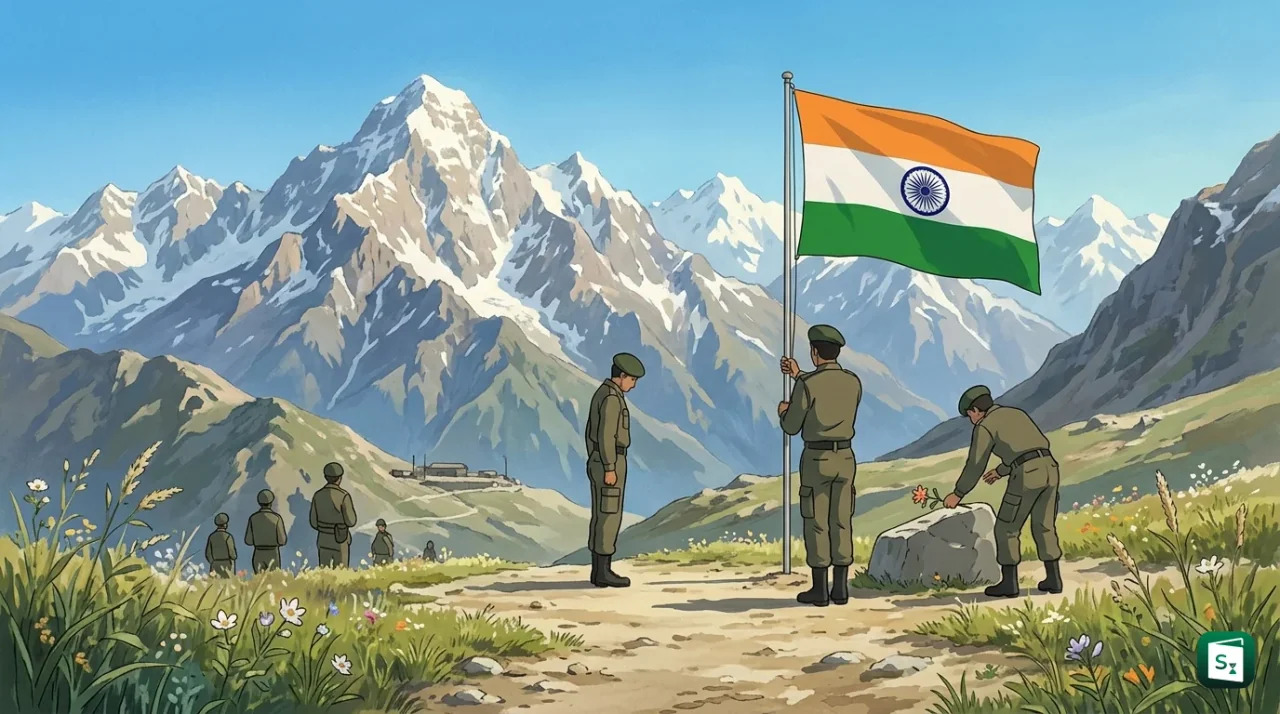
Kargil Vijay Diwas, also known as Kargil Victory Day, is observed across India on July 26 every year to commemorate the successful conclusion of the 1999 Kargil War, in which Indian forces drove out Pakistani intruders who had illegally occupied strategic heights along the Line of Control in the Kargil sector of Ladakh. The war came to an official end on July 26, 1999, when the Indian Army announced the complete eviction of all Pakistani regular and irregular troops from Indian territory. The day honours the valour and sacrifice of the soldiers of Operation Vijay, who fought some of the most challenging battles in military history in sub-zero temperatures at altitudes exceeding 16,000 feet.
What Is Kargil Vijay Diwas?
Kargil Vijay Diwas literally means “Kargil Victory Day” in Hindi. It is an annual day of national commemoration observed on July 26 to mark the end of the Kargil War of 1999, when Indian forces successfully evicted Pakistani soldiers and irregular troops who had infiltrated and occupied high-altitude positions on the Indian side of the Line of Control (LoC). The LoC is the de facto border that separates the India-administered and Pakistan-administered parts of the erstwhile princely state of Jammu and Kashmir, a line established under the Simla Agreement of 1972.
The day is not merely a celebration of military victory. It is a solemn occasion to remember the more than 500 Indian soldiers who laid down their lives during the conflict, many of them young officers and jawans barely out of their teens, who fought in conditions of extreme cold, thin air and steep terrain. Since 1999, the day has been observed every year with wreath-laying ceremonies, military parades and tributes at war memorials across the country, with the principal national commemoration held at the Kargil War Memorial in Dras, one of the world’s highest war memorials, and at Amar Jawan Jyoti at India Gate in New Delhi.
Background: The Road to the Kargil War
The Kargil War must be understood against the long and troubled history of India-Pakistan relations. After the Partition of British India in 1947, the two countries fought wars in 1947-48, 1965 and 1971, and the 1972 Simla Agreement formalised the Line of Control as the ceasefire line in Kashmir. The 1980s and 1990s saw the emergence of an armed insurgency in Kashmir and a prolonged military standoff over the Siachen Glacier, where Indian forces occupy the world’s highest battlefield.
The immediate backdrop of the war was set in 1998, when both India and Pakistan conducted a series of nuclear tests, and then in February 1999, when the two countries signed the Lahore Declaration, a pact pledging to resolve their differences peacefully and to reduce the risk of a nuclear confrontation. The Pakistani intrusion into Kargil, which began within weeks of this declaration, was therefore seen in India as a deep betrayal of that peace initiative.
Pakistan’s Operation Badr
The infiltration that triggered the war was code-named Operation Badr by Pakistan. During the winter of 1998-99, Pakistani regular troops and paramilitary forces, initially disguised as Kashmiri militants, stealthily crossed the LoC and occupied roughly 130 to 200 square kilometres of territory on the Indian side. They dug in on dominant mountain peaks in the Dras, Batalik, Kaksar and Mushkoh sub-sectors of the Kargil district, from where they could observe and fire upon the vital road link between Srinagar and Leh.
Pakistan’s strategic aim was threefold. First, it wanted to sever the National Highway 1, the only road connecting Kashmir with Ladakh, thereby cutting off Indian supply lines to the Siachen Glacier and forcing India to negotiate a settlement of the Kashmir dispute. Second, it hoped to internationalise the Kashmir issue by drawing international attention to the region. Third, it sought to boost the morale of the decade-long insurgency in Kashmir. The intruders’ positions on heights above 16,000 feet gave them a commanding view of the highway, and their heavy artillery shelling from the Pakistan side made the road almost impassable for Indian convoys.
India’s Response: Operation Vijay
The intrusions first came to light on May 3, 1999, when local shepherds reported unusual movement of men and mules in the hills to the Indian Army. Patrols were dispatched, and on May 5 the infiltration was formally detected. The initial assessment assumed the intruders were jihadis, but as the scale and sophistication of the occupation became clear, India realised it was facing a well-planned military aggression by Pakistan’s regular army. The government responded on May 10 by launching Operation Vijay, a full-scale mobilisation that ultimately involved around 200,000 troops of the Indian Army.
Operation Vijay was fought on India’s own territory, against a well-entrenched enemy holding the heights, which meant the Indian Army had to attack uphill, often at night, against prepared defences. The tactics that evolved were brutal and simple: small teams of soldiers, carrying heavy loads of ammunition and supplies, would scale near-vertical cliffs in the dark, assault enemy bunkers with grenades and close combat, and hold the captured peak until relief arrived. Coordinated artillery fire, especially the long-range Bofors howitzers, was used to soften targets before every assault. The operation lasted more than two months, through May, June and July 1999.
The Air War: Operation Safed Sagar
Supporting the army was the Indian Air Force (IAF), which launched Operation Safed Sagar, meaning “White Ocean”, on May 26, 1999. This was the first large-scale use of air power in the region since the 1971 war, and it marked the first time combat aircraft were used at such high altitudes. The IAF flew sorties from forward bases and used precision-guided munitions to destroy enemy bunkers and supply dumps on the peaks, with the Mirage 2000 emerging as the star of the campaign for its accuracy at altitude.
The air war was not without cost. In late May, the IAF lost a MiG-21 and a MiG-27 in separate incidents. Flight Lieutenant Kambampati Nachiketa, whose MiG-27 suffered an engine failure during a strike mission, ejected over enemy territory and was captured, spending about eight days as a prisoner of war before being returned. He became the only Indian prisoner of war of the conflict. The air campaign was eventually scaled back in some areas because the high altitude reduced the effectiveness of air power, placing even greater responsibility on the army and artillery.
Key Battles That Turned the Tide
Several battles in the Kargil War became turning points, each defined by a strategic peak whose capture changed the course of the campaign.
Battle of Tololing
Tololing, a dominant ridge at about 4,800 metres overlooking the Dras-Batalik axis, was the first major objective. Indian forces captured it on June 13, 1999, after nearly three weeks of sustained assault. The capture of Tololing restored control of the Srinagar-Leh road in the Dras sector and marked India’s first significant territorial gain of the war, giving the army a vantage point from which to direct subsequent operations.
Battle of Tiger Hill
Tiger Hill, at around 5,000 metres, was one of the fiercest battles of the war. The peak dominated the approaches to Dras and the National Highway, and the enemy had fortified it heavily. On July 4, 1999, after a daring night assault in which soldiers scaled a sheer, ice-covered cliff, Indian troops recaptured Tiger Hill. The victory is remembered as one of the most audacious operations in Indian military history, with Grenadier Yogendra Singh Yadav, who scaled the cliff despite multiple bullet wounds, playing a pivotal role.
Capture of Point 4875
Point 4875, later renamed Batra Top in honour of Captain Vikram Batra, was captured on July 7, 1999. The peak was strategically critical because from it the enemy could monitor and shell every movement on the Srinagar-Leh Highway. Its capture, along with the fall of adjacent peaks, effectively broke the back of the enemy’s hold over the Dras sector.
The turning point on the diplomatic front came on July 4, 1999, when the then United States President met the Pakistani Prime Minister in Washington and conveyed international pressure on Pakistan to withdraw. On July 11, Pakistan announced the withdrawal of its troops, and on July 14, the then Indian Prime Minister declared Operation Vijay a success. Sporadic fighting continued until July 26, 1999, when the army announced that all Pakistani troops had been evicted and the war officially ended.
Heroes of Kargil: Gallantry Awards
The Kargil War produced some of the most celebrated acts of bravery in Indian military history. The nation honoured these soldiers with its highest gallantry awards. In all, four soldiers were awarded the Param Vir Chakra, India’s highest wartime gallantry decoration, including Grenadier Yogendra Singh Yadav, Rifleman Sanjay Kumar, and posthumously Captain Vikram Batra and Captain Manoj Kumar Pandey. A further 9 soldiers received the Maha Vir Chakra and 55 the Vir Chakra, while hundreds were decorated with other medals.
| Award | Number Awarded |
|---|---|
| Param Vir Chakra | 4 |
| Maha Vir Chakra | 9 |
| Vir Chakra | 55 |
| Sena Medal | 83 |
| Vayu Sena Medal | 24 |
Grenadier Yogendra Singh Yadav of 18 Grenadiers scaled an icy cliff at Tiger Hill under heavy fire on July 3, 1999, destroying enemy bunkers and killing enemy soldiers despite being shot in the shoulder and abdomen. Rifleman Sanjay Kumar of 13 JAK Rifles, in a face-to-face fight at Mushkoh Valley on July 4, 1999, killed three intruders, turned an abandoned enemy machine gun on the fleeing soldiers, and was awarded the Param Vir Chakra.
Captain Vikram Batra of 13 JAK Rifles led the capture of Point 5140, famously radioing “Yeh Dil Maange More” to his headquarters after the victory, and was killed while securing Point 4875 on July 7, 1999. Captain Manoj Kumar Pandey of 11 Gorkha Rifles destroyed enemy bunkers at Khalubar Ridge in Batalik on July 3, 1999, leading his men to victory despite fatal injuries. Batra’s last battle, at the peak now called Batra Top, made his name and his slogan enduring symbols of the spirit of Kargil.
Strategic Significance of the Kargil Sector
The Kargil district lies in the far north of the union territory of Ladakh, which was carved out of the erstwhile state of Jammu and Kashmir in August 2019 under the Jammu and Kashmir Reorganisation Act. The sector sits at the junction of the Karakoram, Zanskar and Himalayas ranges, and its strategic importance rests on the road that passes through it. The Srinagar-Leh National Highway (NH 1), which runs through Dras and Kargil, is the only year-round surface link between the Kashmir Valley and the high-altitude town of Leh and, beyond it, the Siachen Glacier. Whoever controls the heights overlooking this road controls the lifeline of Indian presence in Ladakh.
The climate of the region is as unforgiving as the terrain. Dras, the town nearest the main battlegrounds, is widely regarded as the second coldest inhabited place in the world, after Siberia’s Oymyakon, with winter temperatures plunging to around minus 45 degrees Celsius. Kargil town itself sits at an altitude of about 2,676 metres, while the peaks around it rise to between 4,800 and 5,500 metres. During the war, soldiers fought with limited oxygen at extreme altitudes, suffering from acute mountain sickness, and the frigid conditions jammed weapons and grounded helicopter operations.
The strategic lesson of Kargil continues to shape infrastructure policy in Ladakh today. The Zojila Tunnel, currently under construction beneath the Zojila Pass on NH 1, is a direct response to the vulnerability exposed by the war. This 13.14-kilometre all-weather tunnel, part of the broader Z-Morh and Zojila project package, will bypass the treacherous pass that remains closed for much of the winter, providing round-the-year connectivity between Kashmir and Ladakh for both civilian traffic and military logistics.
The Human Cost of Victory
The victory in Kargil came at a heavy price. Official Indian figures recorded 527 soldiers killed and 1,363 wounded during the conflict. Among the fallen were 537 personnel of the Indian Army, five of the Indian Air Force, one of the Border Security Force and two civilians. The casualties were spread across the country, with soldiers from Jammu and Kashmir, Haryana, Punjab and Himachal Pradesh accounting for about 40 per cent of the martyrs, underlining how the armed forces draw their strength from every region of India.
The names of the martyrs are engraved on the walls of the Kargil War Memorial in Dras, built by the Indian Army at the foot of the Tololing range. The memorial, whose central feature is a sandstone wall bearing the names of the fallen, also houses the Captain Manoj Pandey Gallery and offers views of Tololing, Tiger Hill and Batra Top. The losses also left behind Veer Naris, the war widows, and thousands of bereaved families, whom the armed forces continue to support through welfare and outreach programmes.
Analogy · Climbing a Fortress from Below Expand analogy
Imagine an army that must capture a heavily fortified fortress, except the fortress is a mountain and the only way up is a nearly vertical ice wall in darkness. The soldiers had to climb carrying heavy loads, while the enemy fired down from prepared positions above. Every inch of progress came at the cost of lives, and victory meant physically climbing to the very top, one bunker at a time. This is what the battles of Tololing and Tiger Hill demanded of Indian soldiers in 1999.
Defence Reforms After Kargil
The war exposed significant gaps in India’s intelligence gathering and national security framework. Although the aggression was detected in May, the initial failure to anticipate a large-scale intrusion at such altitudes was a major lesson. Within days of the war’s end, the government set up the Kargil Review Committee on July 29, 1999, chaired by K. Subrahmanyam, to examine the sequence of events and recommend measures to prevent such intrusions in the future. The committee’s report, submitted to the prime minister in January 2000, recommended a comprehensive overhaul of the national security system.
Following the committee’s recommendations, a Group of Ministers (GoM) on national security was constituted in April 2000, which proposed wide-ranging reforms. Several key changes were eventually implemented, including the creation of a full-time National Security Advisor, the establishment of the Defence Intelligence Agency for coordinated military intelligence, the National Technical Research Organisation for technical intelligence, the Integrated Defence Staff for tri-service cooperation, and new tri-service commands such as the Andaman and Nicobar Command. The single most significant reform came nearly two decades later, when the post of Chief of Defence Staff was created in December 2019, a recommendation that had first emerged from the Kargil review process.
How the Day Is Commemorated
The 27th Kargil Vijay Diwas was observed on July 26, 2026, with ceremonies across the country and at the frontiers. The main national commemoration was held at the Kargil War Memorial in Dras, where the Defence Minister led a wreath-laying ceremony attended by serving personnel, veterans and the families of martyrs. In New Delhi, tributes were paid at the Amar Jawan Jyoti at India Gate, and the Prime Minister’s monthly radio address was devoted to the valour of the soldiers of 1999. Across the country, army garrisons, schools and public institutions organised programmes honouring the war heroes.
The commemoration is not limited to a single day. In the years since the war, the Indian Army has organised commemorative expeditions retracing the routes of the original battles, including climbs to Tololing and Gun Hill by soldiers and veterans, and motorcycle rallies such as the Shaurya Vijay Yatra, which run from the National War Memorial in New Delhi to Dras. These events keep alive the memory of the war and connect a younger generation with the sacrifice of the soldiers of 1999. The spirit of Kargil has also shaped India’s broader approach to national security, visible in the surgical strikes of 2016, the Balakot air operations of 2019 and India’s modernised defence posture.
Key Takeaways
- Kargil Vijay Diwas, meaning Kargil Victory Day, is observed every year on July 26 to commemorate India’s victory over Pakistan in the 1999 Kargil War, when the last Pakistani intruders were evicted from Indian territory.
- The war began after Pakistan launched Operation Badr, infiltrating troops across the Line of Control during the winter of 1998-99 to sever the Srinagar-Leh National Highway (NH 1) and force India to negotiate on Kashmir.
- India responded with Operation Vijay, involving about 200,000 troops, supported by the Indian Air Force’s Operation Safed Sagar from May 26, 1999, which marked the first large-scale use of air power since the 1971 war.
- Key battles were fought for Tololing (recaptured June 13, 1999), Tiger Hill (recaptured July 4, 1999) and Point 4875, later named Batra Top after Captain Vikram Batra, one of the four recipients of the Param Vir Chakra.
- India officially recorded 527 soldiers killed and 1,363 wounded; the Kargil War Memorial at Dras, one of the world’s highest war memorials, preserves the names of the fallen.
- The war led to the Kargil Review Committee (set up July 29, 1999, chaired by K. Subrahmanyam) and, decades later, the creation of the post of Chief of Defence Staff in December 2019.
- The Zojila Tunnel, a 13.14-kilometre all-weather tunnel on NH 1, is among the infrastructure projects addressing the connectivity vulnerability exposed by the war.