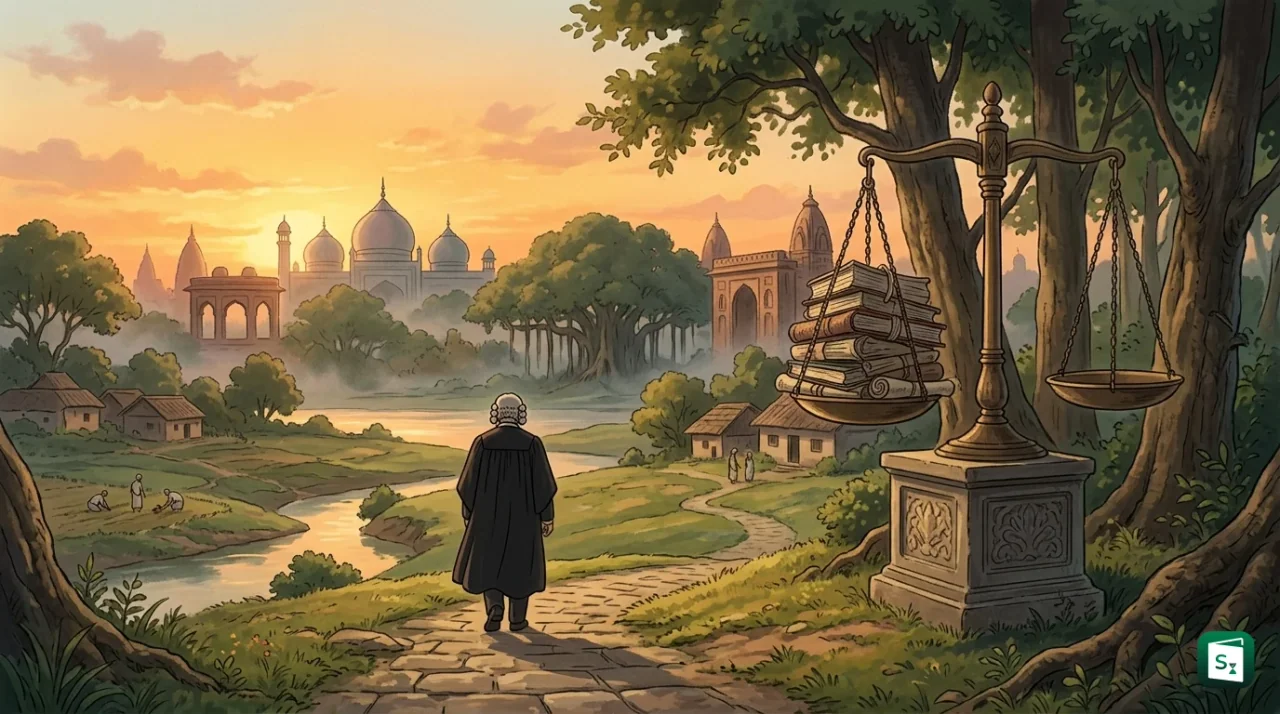
Justice Manmohan Singh Liberhan, who headed the one-man Liberhan Commission of Inquiry into the demolition of the Babri Masjid at Ayodhya, passed away at the age of 87. The retired judge, who served as Chief Justice of both the Madras High Court and the Andhra Pradesh High Court, died in Chandigarh, where his last rites were performed. His passing brings to a close a judicial career spanning more than four decades, remembered most for the inquiry that took nearly 17 years to complete and produced one of the most debated reports in independent India’s history.
A Judicial Life Spent in Service
Born on 11 November 1938 in a village in what is now Haryana, Manmohan Singh Liberhan was the son of Chaudhary Bakhtawar Singh, himself a noted lawyer. Liberhan began his legal practice at the Punjab and Haryana High Court in 1964, after an early start in Ambala. He was elected to the Punjab and Haryana Bar Council in August 1970 and served as its secretary from 1976 to 1983.
Liberhan served as Advocate General of Haryana before being elevated as a permanent judge of the Punjab and Haryana High Court on 11 February 1987. He was later appointed Chief Justice of the Madras High Court on 7 July 1997, and became Chief Justice of the Andhra Pradesh High Court on 28 February 1998, from where he retired. At the time he was chosen to head the Ayodhya inquiry in December 1992, he was a sitting judge of the Punjab and Haryana High Court.
The Demolition and the Commission’s Mandate
The Babri Masjid, a 16th century mosque built in 1527 by Mir Baqi, a commander of the first Mughal emperor Babur, was demolished by a large crowd of kar sevaks (religious volunteers) on 6 December 1992 at Ayodhya in Uttar Pradesh. The demolition, which took place even though the organisers had assured the Supreme Court that the structure would not be harmed, was followed by riots in several Indian cities in which more than 2,000 people died.
The Central Government set up the Liberhan Ayodhya Commission of Inquiry on 16 December 1992, barely ten days after the demolition, under the Commissions of Inquiry Act, 1952. It was constituted by the government of then Prime Minister P V Narasimha Rao as a one-man commission headed by Justice Liberhan.
Terms of Reference
The commission was tasked with inquiring into the sequence of events and circumstances that led to the destruction of the structure, the role played by the then Chief Minister of Uttar Pradesh and his ministerial colleagues, and the deficiencies in the security arrangements that may have contributed to the events of that day. It was also asked to examine the assault on media persons at Ayodhya and other connected matters. The commission was initially asked to submit its report within three months.
A 17-Year Inquiry: India’s Longest-Running Commission
What was meant to be a brief inquiry stretched into nearly 17 years, making the Liberhan Commission perhaps the longest-running commission of inquiry in independent India. The deadline was extended 48 times, and the commission held 399 sittings while examining more than 100 witnesses. The inquiry cost the exchequer roughly ₹8 crore, most of it spent on the salaries and perks of supporting staff.
The witnesses who appeared before the commission included politicians, bureaucrats and police officers across the political spectrum. They included former Prime Minister P V Narasimha Rao, former Deputy Prime Minister L K Advani, Murli Manohar Joshi, Uma Bharti, former Uttar Pradesh Chief Ministers Kalyan Singh and Mulayam Singh Yadav, RSS chief K S Sudarshan, and VHP leader Ashok Singhal. The commission heard its last witness, Kalyan Singh, in August 2005, four years before the report was finally submitted.
The commission submitted its 900-plus-page report to Prime Minister Manmohan Singh on 30 June 2009. Its findings became public in November 2009, when the report was leaked to a newspaper and subsequently tabled in Parliament by the then Home Minister P Chidambaram, along with an Action Taken Report.
Key Findings of the Liberhan Report
The report concluded that the demolition was neither spontaneous nor unplanned, but the result of “great painstaking preparation and pre-planning”. It rejected the theory that the structure was brought down by kar sevaks acting on sudden anger or emotion, pointing instead to the removal of idols and the cash box from under the dome, the quick construction of a makeshift temple, and the availability of demolition tools as evidence of advance planning.
The commission held 68 people culpable for the demolition, including senior political figures such as L K Advani, Murli Manohar Joshi, Atal Bihari Vajpayee and Kalyan Singh. It described Vajpayee, Advani and Joshi as “pseudo-moderates” who pretended to keep a distance from the Ram Janmabhoomi campaign while being aware of the larger conspiracy. The report also named the Rashtriya Swayamsevak Sangh (RSS) as the chief architect of the demolition and said the Kalyan Singh-led government in Uttar Pradesh was the key to executing the plan.
The commission found no fault with the then Congress government at the Centre, supporting the position of Prime Minister Narasimha Rao that President’s Rule could not have been imposed in Uttar Pradesh at the time. This aspect, along with the report’s tone and length, drew criticism from several quarters, including from within the legal and political establishment, which questioned some of its conclusions and its delayed submission.
The Report in Parliament and Later Court Proceedings
When the contents of the report were leaked in November 2009, Parliament was thrown into turmoil, with opposition members accusing the Home Ministry of deliberately leaking the document and the session being adjourned for the day. The Lok Sabha and the Rajya Sabha eventually debated the report in December 2009, with the Bharatiya Janata Party leading the charge against it.
The report’s findings did not translate directly into criminal prosecution. A separate CBI probe into the demolition, registered in October 1993, ran its own course. On 30 September 2020, a special CBI court in Lucknow acquitted all 32 accused, including L K Advani, Murli Manohar Joshi and Uma Bharti, ruling that there was no conclusive evidence of a criminal conspiracy. The acquittal stood in contrast to the commission’s conclusion that the demolition was pre-planned, a point on which Justice Liberhan publicly disagreed, saying he believed there was enough evidence to establish a conspiracy.
In a separate case, a five-judge constitution bench of the Supreme Court delivered a unanimous verdict on 9 November 2019 in the long-running Ayodhya title dispute. The court directed that the disputed 2.77 acres of land be handed over to a trust to build a Ram temple, and that an alternative 5 acres be allotted for the construction of a mosque.
Remembering the Man Behind the Commission
Those who knew Justice Liberhan describe him as a quiet, measured and unfailingly courteous judge who regarded the law as a lifelong public duty rather than a means of prominence. He remained deeply interested in the Punjab and Haryana High Court, where he had spent much of his professional life, and was generous with younger members of the Bar.
Even in retirement, he remained engaged with the events his report had shaped. After the Supreme Court’s 2019 verdict and the subsequent stone-laying ceremony for the Ram temple, he noted that the presence of RSS chief Mohan Bhagwat at the ceremony vindicated his report’s finding about the involvement of RSS cadre in the demolition. His measured observation on that occasion, that “they are happy, what more can I say”, reflected the restraint that defined his public life.
Key Takeaways
- Justice Manmohan Singh Liberhan (11 November 1938 to 2 August 2026) headed the one-man Liberhan Commission of Inquiry into the Babri Masjid demolition at Ayodhya on 6 December 1992.
- The commission, set up on 16 December 1992 under the Commissions of Inquiry Act, 1952, took nearly 17 years, 48 extensions and 399 sittings to submit its report on 30 June 2009, making it India’s longest-running commission of inquiry.
- The report held 68 people culpable and concluded that the demolition was neither spontaneous nor unplanned, but the result of pre-planning.
- On 30 September 2020, a special CBI court in Lucknow acquitted all 32 accused in the demolition case, ruling there was no conclusive evidence of conspiracy.
- On 9 November 2019, a five-judge constitution bench of the Supreme Court handed the disputed 2.77 acres to a trust for a Ram temple and allotted 5 acres elsewhere for a mosque.
- Justice Liberhan also served as Chief Justice of the Madras High Court (from July 1997) and the Andhra Pradesh High Court (from February 1998).