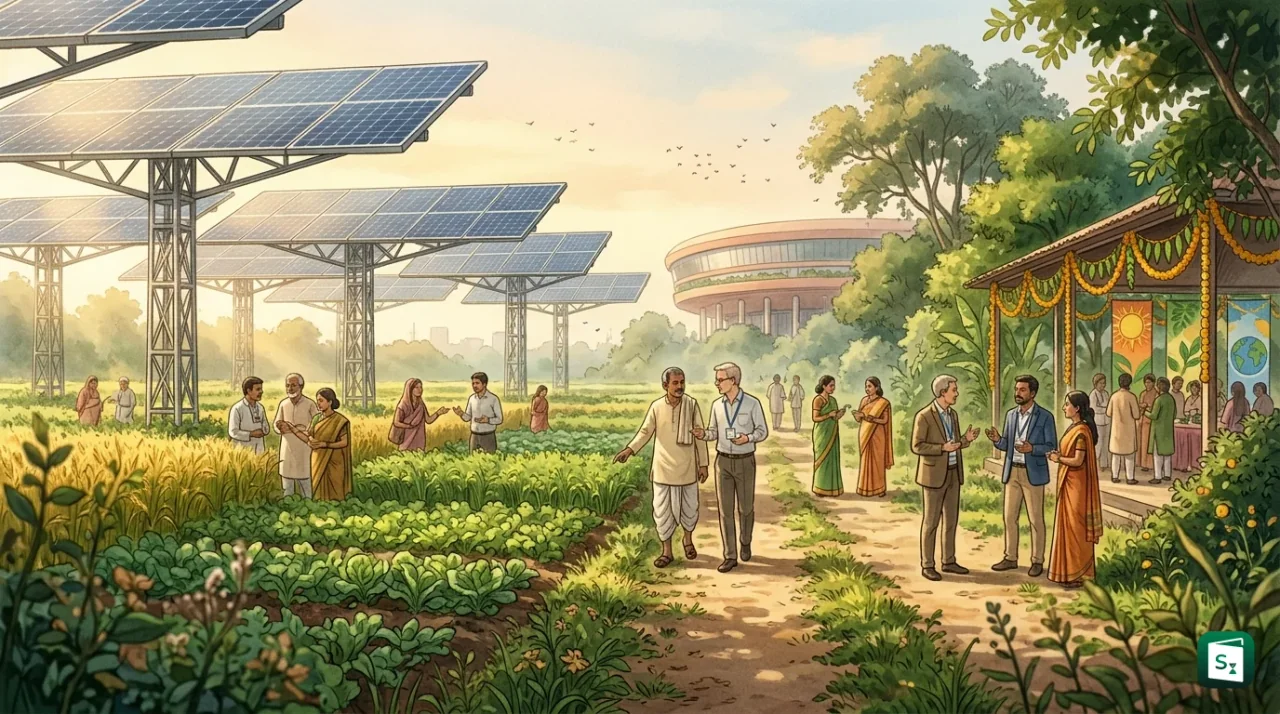
India hosted the 7th Agrivoltaics World Conference 2026 from 21 to 23 October 2026 at Bharat Mandapam in New Delhi under the theme Powering the Global South. Union Agriculture Minister Shivraj Singh Chouhan and Union New and Renewable Energy Minister Pralhad Joshi jointly inaugurated the three day event. It was the first time the global conference was held in India and in the Global South, with more than 1200 delegates including over 150 foreign participants.
What Is Agrivoltaics and How Does It Work?
Agrivoltaics, also written as agri-voltaics or agrovoltaics, is a farming system in which the same land is used at the same time for crop cultivation and solar power generation. Solar panels are fixed on elevated structures above the field or between crop rows, so crops grow below while electricity is produced above.
Agrivoltaics works through three simple design choices. Panels are raised to a height of about 3.5 to 4 metres so farmers, cattle and small machines can move freely underneath. Rows are spaced widely to let enough sunlight and rain reach the crops. The tilt and gap of the panels are adjusted to share sunlight between plants and power generation. The partial shade cools the soil, cuts water loss through evaporation and protects crops from heat, hail and heavy rain.
The technology uses the same photovoltaic process as normal solar plants, where sunlight falling on silicon cells creates electricity. The difference is in design and land use. Conventional solar farms block farming, while agrivoltaics allows dual land use for food and power.
| Feature | Conventional Ground Mounted Solar Plant | Agrivoltaic System |
|---|---|---|
| Panel height | Less than 1 metre above ground | About 3.5 to 4 metres on raised structures |
| Farming on same land | Not possible | Possible, crops or grazing continue below panels |
| Land use | Single use for power only | Dual use for food and power |
| Cost | Lower base cost | About 25 to 30 percent higher due to steel structures and spacing |
| Water and soil effect | No crop benefit | Lower soil temperature, up to 20 percent water saving and less soil erosion in suitable sites |
Field studies in India show that leafy vegetables, fruits, spices, fodder and many horticulture crops suit this system. Shade loving crops like spinach, cabbage, lettuce, tomato and aloe vera perform well. Cereals that need full sun, such as paddy, wheat and sugarcane, are generally less suitable.
7th Agrivoltaics World Conference 2026 at Bharat Mandapam
The 7th Agrivoltaics World Conference was held from 21 to 23 October 2026 at Bharat Mandapam at Pragati Maidan in New Delhi. Bharat Mandapam is India’s large convention centre which opened for the G20 Summit in 2023. The Ministry of New and Renewable Energy (MNRE) hosted the conference with support from Germany’s Federal Ministry for Environment, Climate Action, Nature Conservation and Nuclear Safety and in partnership with Conexio-PSE.
The theme was Powering the Global South. The series began in 2020 in Perpignan in France as an online event organised by France’s National Research Institute for Agriculture, Food and Environment (INRAE) and Germany’s Fraunhofer Institute for Solar Energy Systems (ISE). Later editions were held in Germany, Italy, South Korea and the United States. The 2026 edition was the largest so far and the first to be held in the Global South.
More than 1200 delegates attended, including more than 150 foreign participants from over 40 countries. Policymakers, researchers, industry leaders, startups, farmer groups and development partners took part. The programme had an India Focus Track along with two parallel scientific tracks. Talks covered agro climatic zoning, crop selection, water use, financing models, technology design and farmer centred business models. A session co convened by the Indian Council of Agricultural Research (ICAR) and the International Water Management Institute (IWMI) studied how shade tolerance and microclimate data can guide crop choice in different zones.
ICAR was set up in 1929 and is headquartered in New Delhi. It works under the Ministry of Agriculture and Farmers Welfare. IWMI is headquartered in Colombo, Sri Lanka and works on water use in farming.
Three knowledge resources were released at the start of the conference. MNRE released the AgriPV Policy Handbook on Agrivoltaics in India. The India Agrivoltaics Alliance (IAA) released a Decision Making Tool for project planning. IWMI released the Book of Abstracts with research summaries. The International Solar Alliance (ISA), headquartered in Gurugram, also presented its Global Agrivoltaic Compendium for South South cooperation.
Agrivoltaics in India: Solar Farming, PM-KUSUM Link and New AgriPV Push
India links agrivoltaics closely with the Pradhan Mantri Kisan Urja Suraksha evam Utthaan Mahabhiyan (PM-KUSUM). The scheme was approved on 19 February 2019 and is run by MNRE to cut diesel use in farming, give day time solar power for irrigation and raise farm incomes. It has total central support of about ₹34,422 crore and aims to add 34.8 GW of solar capacity through three components.
| Component | Target | What It Supports |
|---|---|---|
| Component A | 10,000 MW of small plants up to 2 MW each | Grid connected solar plants on barren, fallow, pasture, marshy or cultivable land. On farmland, panels must be on raised stilts so cropping continues. Power is sold to local distribution companies |
| Component B | 20 lakh standalone solar pumps | Replacement of diesel pumps in off grid areas with solar pumps from 0.25 HP to 25 HP |
| Component C | Solarisation of grid connected pumps, including feeder level solarisation | Solar panels for individual pumps and large solar plants near substations to supply farm feeders with day time power |
Under the scheme, farmers can set up plants themselves or lease land to developers. Distribution companies buy the power at rates fixed by state regulators. The government gives capital subsidy of up to 30 or 50 percent for pumps and a procurement based incentive to distribution companies of 40 paise per unit or ₹6.60 lakh per MW per year for five years.
Ministers said about 30 lakh farm pumps have been connected to solar so far, which has reduced night time irrigation hardship. MNRE Secretary Santosh Kumar Sarangi said about 25 lakh pump sets have been solarised, saving diesel and foreign exchange on crude imports. The government has now announced that a large AgriPV programme will be added under the next phase of PM-KUSUM, called PM-KUSUM 2.0 in policy discussions. MNRE has said elevated AgriPV structures cost 25 to 30 percent more, and the new programme aims to bridge this gap for AgriPV capacity.
A study by The Energy and Resources Institute (TERI), established in 1974 and headquartered in New Delhi, estimates that 47.5 million hectares of India’s farm land is technically suitable for agrivoltaics. Maharashtra, Rajasthan, Andhra Pradesh, Madhya Pradesh, Karnataka and Uttar Pradesh together hold about 50 percent of this potential. TERI found that using just 10 percent of this suitable area could meet India’s full electricity demand projected up to 2050. MNRE estimates total AgriPV potential at 1 to 2 terawatts.
The India Agrivoltaics Alliance (IAA) supports this scale up. It was launched on 30 October 2023 with the secretariat hosted by the National Solar Energy Federation of India (NSEFI). It brings together research bodies like ICAR’s Central Arid Zone Research Institute (CAZRI) in Jodhpur, CEEW, CSTEP, IWMI and TERI to build business models, test crop matrices and train farmers.
Why Agrivoltaics Is Important for Farmers and the Global South
Agriculture Minister Shivraj Singh Chouhan summed up the goal as making farmers both annadata and urjadata, or providers of food and energy. New and Renewable Energy Minister Pralhad Joshi described it as one land, two harvests. The farmer earns from crops and also from sale of solar power, while diesel or grid power costs fall.
This dual income matters because more than 85 percent of Indian farmers are small and marginal farmers and the average land holding is only 0.96 hectare. Small plots make it hard to raise income from crops alone. AgriPV can add a steady power income for 25 years, which is the normal life of a solar plant, without stopping cultivation.
For the Global South, three gains stand out. First, land pressure eases because food and power share the same plot. Second, water is saved, with studies showing about 30 percent lower water use and 10 to 20 percent higher yields for suitable vegetables and fruits due to cooler shade. Third, jobs stay in villages through panel cleaning, repair, solar pump service and cold chain work. Assessments cited at the conference estimate 1.10 lakh to 3.32 lakh full time local jobs from large scale AgriPV.
India placed this in its wider clean energy record. Total electricity capacity has risen from about 249 GW before 2014 to more than 560 GW, of which non fossil capacity has crossed 308 GW. Solar tariffs have fallen from about ₹11 per unit in 2012 to 2013 to about ₹2.60 per unit today due to scale. Global AgriPV capacity has crossed 18 GW, with large programmes in Italy, Japan and Germany.
Challenges remain. AgriPV plants need careful design for panel height, row spacing, machine movement, drainage and rainwater harvesting to avoid soil erosion and loss of soil health. Models must match India’s 15 agro climatic zones, since a design for Rajasthan may not suit Assam or coastal zones. Ministers said any damage to long term farm productivity must not be ignored while counting power income, and ICAR will work with MNRE to build zone wise crop matrices with Farmer Producer Organisations and training for rural youth and women.
France to Host 8th Agri-Voltaics World Conference in 2027
The 8th Agri-Voltaics World Conference in 2027 will be hosted by France. The formal handover took place at the closing ceremony in New Delhi on 23 October 2026. The city and exact dates have not been announced yet.
The move takes the series back to the country where it began. The first World Conference was held in Perpignan in France from 14 to 16 October 2020 in online form due to the pandemic. The proposed venue for 2027 is Institut Agro Montpellier in Montpellier. The institute traces its history to 1848 and is one of France’s leading schools for agriculture, food and environment studies. It hosts one of the world’s longest running agrivoltaics test sites.
France, with capital Paris, is a key partner in solar cooperation with India through the International Solar Alliance. The Delhi conference was supported by the Indo German Cooperation on Agrivoltaics and Germany’s International Climate Initiative. ISA Director General Ashish Khanna joined the closing discussions on South South cooperation, common standards and crop data sharing across Africa, Asia and Latin America. The closing call was to move from pilot projects to field level use through sound science, viable finance and direct work with farmers.
Key Takeaways
- The 7th Agrivoltaics World Conference 2026 was held from 21 to 23 October 2026 at Bharat Mandapam, New Delhi under the theme Powering the Global South.
- The 2026 edition was the first held in India and in the Global South, with over 1200 delegates including more than 150 foreign participants.
- Agrivoltaics means dual use of land for crops and solar power, with panels raised to 3.5 to 4 metres to allow farming below.
- The PM-KUSUM scheme, approved on 19 February 2019, supports 10,000 MW under Component A, 20 lakh pumps under Component B and solarisation of grid pumps under Component C.
- France will host the 8th Agri-Voltaics World Conference in 2027, with the proposed venue at Institut Agro Montpellier.