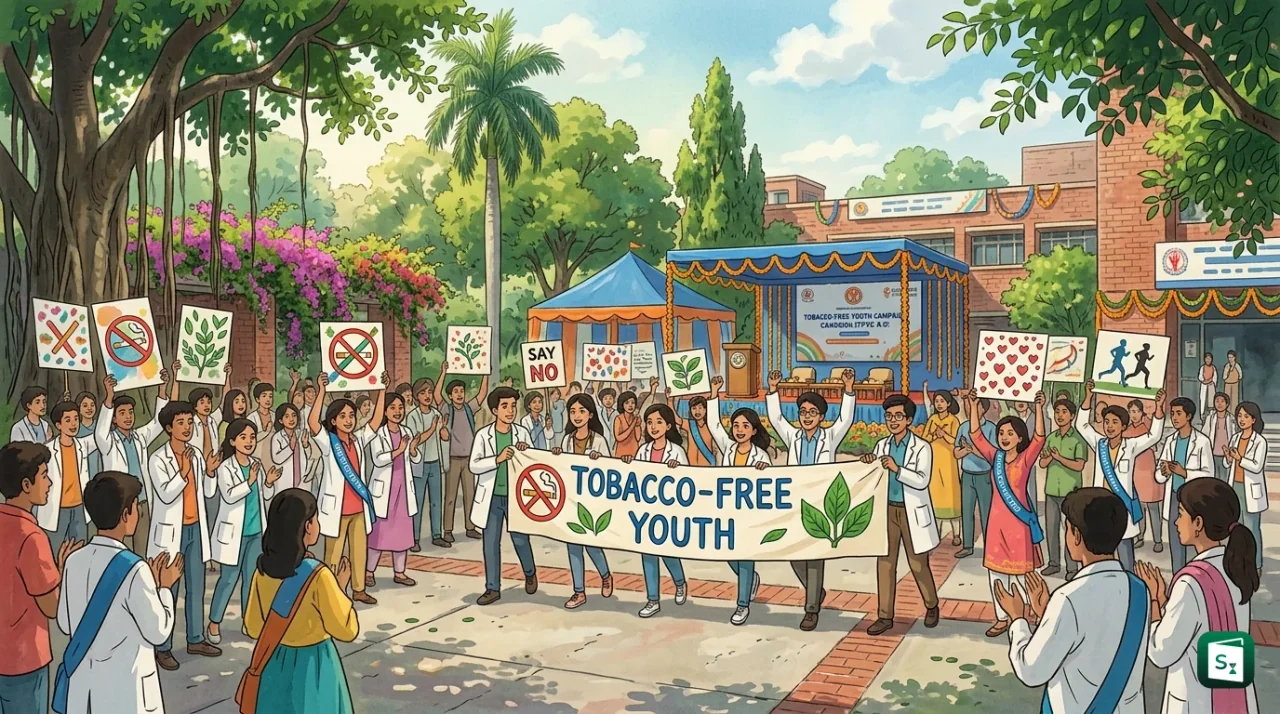
Union Minister of State Prataprao Jadhav launched the Tobacco-Free Youth Campaign 4.0 on 28 October 2026 at ABVIMS and Dr Ram Manohar Lohia Hospital in New Delhi. The 60-day national drive of the Ministry of Health and Family Welfare will run till 26 December 2026 to prevent tobacco initiation among youth and strengthen cessation support and law enforcement. With universities and colleges as the new focus, the campaign builds on three earlier editions that declared over 5.8 lakh educational institutions and 73,000 villages tobacco-free.
What Is the Tobacco-Free Youth Campaign 4.0?
The Tobacco-Free Youth Campaign 4.0 (TFYC 4.0) is a 60-day national campaign of the Ministry of Health and Family Welfare. It started on 28 October 2026 and will continue till 26 December 2026. The campaign was launched at the Atal Bihari Vajpayee Institute of Medical Sciences (ABVIMS) and Dr Ram Manohar Lohia Hospital in New Delhi.
The Ministry runs the campaign through the National Tobacco Control Programme (NTCP). The aim is to stop young people from starting tobacco use, help current users quit, and create tobacco-free surroundings. The Minister administered the Say No to Tobacco pledge at the launch and asked youth to become ambassadors of a tobacco-free India.
TFYC began in 2023 as an annual national drive. The third edition ran from 9 October to 8 December 2025. The fourth edition expands the same model with stronger attention to higher educational institutions. It follows a whole-of-government approach with the Ministries of Education, Panchayati Raj, Youth Affairs and Sports, Information and Broadcasting and others working together.
Six Strategies Driving the 60-Day Campaign
The Ministry of Health and Family Welfare is implementing TFYC 4.0 through six connected strategies. They combine awareness, campus action, village action, law enforcement and digital outreach.
- Stronger public awareness. The campaign spreads clear messages on the harm from tobacco and nicotine, especially among children, adolescents and young adults. It motivates users to seek cessation help.
- Tobacco-Free Educational Institutions. Schools and colleges are asked to follow the Tobacco-Free Educational Institutions (ToFEI) guidelines and keep campuses tobacco-free.
- Tobacco-free villages. The campaign takes the village initiative to more panchayats with help from local administrations and community groups.
- Stronger enforcement of tobacco laws. Field teams will enforce the Cigarettes and Other Tobacco Products Act (COTPA), 2003 and the Prohibition of Electronic Cigarettes Act (PECA), 2019.
- Social media and digital outreach. Short videos, online pledges and youth-led content will widen reach among students.
- Focus on universities and colleges. Higher educational institutions will run awareness drives, peer engagement and campus health activities.
Daily reporting and periodic state reviews will track progress during the 60-day period.
Why Universities and Colleges Are the Focus in 4.0
TFYC 4.0 places Higher Educational Institutions (HEIs) at the centre for the first time. Earlier editions covered mainly schools. This edition asks universities and colleges to lead prevention among students aged 18 and above.
Adolescence and early adulthood are the ages when most tobacco use begins. Peer influence is strong at this stage. A tobacco-free campus, with clear rules and student-led activities, can shape long-term behaviour.
Colleges are expected to display tobacco-free signage, appoint Tobacco Monitors, run awareness events, and link users to quit services. The ToFEI guidelines, first issued in 2008 and revised in 2019, set nine conditions for an institution to be certified as tobacco-free. These include no sale within 100 yards of the campus, no evidence of use inside the premises, awareness posters, at least one tobacco control activity every six months, and inclusion of a no-tobacco rule in the code of conduct. The ToFEI Implementation Manual, released by the Department of School Education and Literacy on 31 May 2024, explains how schools and colleges can meet these conditions.
What Is the National Tobacco Control Programme?
The National Tobacco Control Programme (NTCP) is the nodal programme for tobacco control in India. NTCP stands for National Tobacco Control Programme. The government launched it in 2007-08 during the 11th Five Year Plan.
NTCP has five stated aims. It creates awareness about tobacco harm, reduces production and supply of tobacco products, ensures effective enforcement of COTPA, helps people quit, and implements the strategies of the WHO Framework Convention on Tobacco Control (WHO FCTC). India signed the Convention on 10 September 2003 and ratified it on 5 February 2004. India also hosted the seventh Conference of Parties in Greater Noida in 2016.
The programme works through a three-tier structure with a National Tobacco Control Cell at the centre and state and district cells below. Key tasks include training of health workers and teachers, information and communication activities, school programmes, monitoring of tobacco laws, work with Panchayati Raj Institutions, and tobacco cessation centres at district level. NTCP now covers all 36 states and Union Territories and about 500 districts.
Results from the Global Adult Tobacco Survey (GATS) show a fall in tobacco use from 34.6 percent in 2009-10 to 28.6 percent in 2016-17. The number of users fell by about 81 lakh. The Global Youth Tobacco Survey 2019 found that current tobacco use among students aged 13 to 15 was 8.5 percent, down from 17 percent in 2003.
What Is the COTPA Act 2003?
The Cigarettes and Other Tobacco Products Act (COTPA), 2003 is India’s main tobacco control law. COTPA stands for Cigarettes and Other Tobacco Products (Prohibition of Advertisement and Regulation of Trade and Commerce, Production, Supply and Distribution) Act. Parliament passed it in May 2003.
COTPA regulates smoking in public places, bans direct and indirect tobacco advertising, bans sale to and by persons below 18 years of age, bans sale within 100 yards of educational institutions, and makes large pictorial health warnings compulsory on packs.
| Provision | What the Law Requires |
|---|---|
| Section 4 | No smoking in public places. Hotels with 30 or more rooms, restaurants with seating for 30 or more persons, and airports must provide separate smoking areas. |
| Section 5 | No advertisement of tobacco products and no sponsorship that promotes tobacco use. Only on-pack and in-shop displays are allowed. |
| Section 6a | No sale of tobacco to a person below 18 years of age and no sale by such persons. |
| Section 6b | No sale of tobacco within a radius of 100 yards of any educational institution. Heads of institutions can collect fines for violations. |
| Section 7 | Every tobacco pack must carry specified pictorial health warnings with nicotine and tar contents. |
COTPA came into full effect in phases, with major packaging rules notified from 2007. The related Prohibition of Electronic Cigarettes Act (PECA), 2019 completely bans production, import, sale, storage and advertisement of electronic cigarettes. A first offence under PECA can attract jail up to one year and a fine up to ₹1 lakh.
Is Tobacco Banned in India?
No, tobacco is not banned in India. The COTPA, 2003 regulates tobacco by restricting advertising, smoking in public places and sales to minors and near schools. Gutkha with tobacco is prohibited as food, and all e-cigarettes are fully banned under PECA, 2019.
India follows a regulation model rather than a total ban. Tobacco supports the livelihood of lakhs of farmers and workers, and India is the second largest producer and consumer of tobacco in the world. Public health is a state subject, so states enforce COTPA along with central rules.
Certain products face complete bans. Gutkha and pan masala containing tobacco or nicotine are prohibited as food ingredients under the Food Safety and Standards Regulations, 2011. All forms of Electronic Nicotine Delivery Systems are banned under PECA. Tobacco products also face the highest tax slab of 28 percent under GST, which aims to reduce demand while keeping the trade legal and taxable.
The health cost remains very high. About 13.5 lakh deaths each year in India are linked to tobacco use. Nearly 267 million adults aged 15 and above use tobacco in some form. Tobacco smoke raises the risk of cancer, heart disease, stroke, lung disease and tuberculosis.
What Is Tobacco Cessation and How Does It Work?
Tobacco cessation means helping a tobacco user quit completely and stay quit through counselling, behavioural support and medicines. India offers free help through the National Tobacco Quitline 1800-11-2356, the mCessation missed-call service 011-22901701 and district Tobacco Cessation Centres under the NTCP network.
The National Tobacco Quitline Services, based at the Vallabhbhai Patel Chest Institute in New Delhi, provides telephone counselling in several languages. Regional centres operate at BBCI Guwahati, NIMHANS Bengaluru and Tata Memorial Centre Mumbai. Callers receive planned follow-up for up to one year because relapse risk is high.
The mCessation programme works through a missed call to 011-22901701. The user then receives text messages with quit tips and motivation. District Tobacco Cessation Centres provide face-to-face counselling and drug support. TFYC 4.0 urges schools and colleges to link students who use tobacco to these free services.
How Tobacco Affects the Body and the Heart
Tobacco harms almost every organ. Smoke contains nicotine, tar and carbon monoxide. Nicotine raises heart rate and blood pressure and narrows blood vessels. This raises the risk of heart attack and stroke.
Long-term use damages the lungs and causes chronic cough, asthma and chronic obstructive lung disease. Chewing tobacco causes mouth sores, gum disease and oral cancer, which is common in India. Tobacco also weakens immunity, slows wound healing and harms unborn babies when used during pregnancy. Second-hand smoke harms non-smokers too, especially children. Quitting at any age lowers these risks steadily over time.
Key Takeaways
- The Tobacco-Free Youth Campaign 4.0 was launched on 28 October 2026 in New Delhi and will run for 60 days till 26 December 2026.
- The campaign is run by the Ministry of Health and Family Welfare through the National Tobacco Control Programme, launched in 2007-08.
- Three earlier editions declared over 5.8 lakh educational institutions and 73,000 villages tobacco-free.
- The COTPA, 2003 bans smoking in public places and sale to minors and within 100 yards of schools, while PECA, 2019 bans all e-cigarettes.
- Free quit support is available through the National Quitline 1800-11-2356 and mCessation 011-22901701.