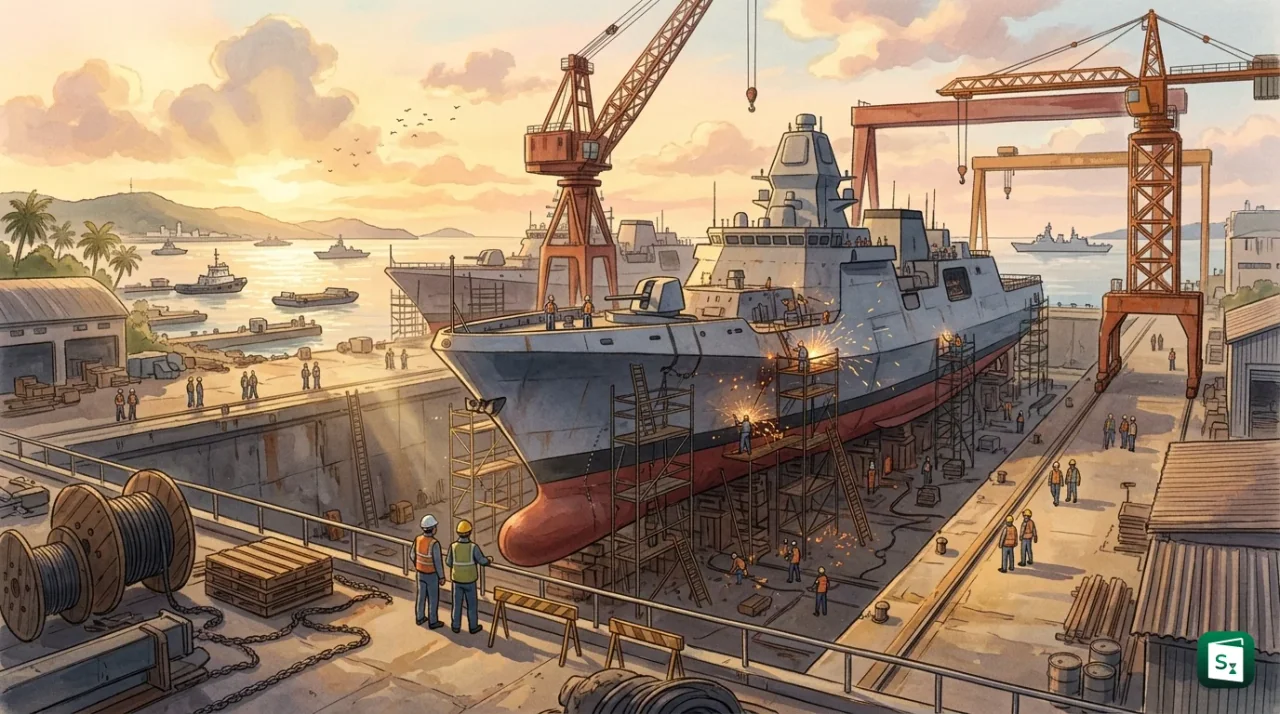
The Ministry of Defence signed contracts worth ₹53,866.50 crore on 2 November 2026 for eight Next Generation Corvettes (NGCs) for the Indian Navy. Garden Reach Shipbuilders and Engineers (GRSE) will build five ships in Kolkata and Goa Shipyard Ltd (GSL) will build three ships in Vasco da Gama. The deal gives the Navy new stealth warships to replace ageing coastal combatants and marks a first in how India orders warships designed in house.
What Is a Corvette Ship?
A corvette ship is a small, fast surface combatant used for coastal defence, escort duties and quick strikes near the shore. The Indian Navy uses corvettes for anti-submarine warfare, anti-surface warfare, patrol and surveillance. Corvettes are smaller than frigates and destroyers but carry missiles, guns and torpedoes.
Corvettes sit at the lower end of major warships by size. A modern Indian corvette displaces about 1,350 to 3,300 tonnes, while frigates displace about 4,000 to 6,700 tonnes and destroyers displace about 7,400 tonnes or more. The smaller size makes corvettes agile in littoral waters, which are shallow waters close to the coast. They need a smaller crew, cost less to build and can be produced in larger numbers to reduce the load on large frontline ships.
ASW means anti-submarine warfare on first reference in naval shorthand. An ASW corvette hunts submarines using hull mounted sonar, towed array sonar, torpedoes and anti-submarine rockets. A missile corvette focuses on enemy ships using surface to surface missiles such as BrahMos.
What the Defence Ministry Signed for Eight Next Generation Corvettes
The Ministry of Defence signed two contracts on 2 November 2026 at Kartavya Bhawan-2 in New Delhi in the presence of Defence Secretary Rajesh Kumar Singh. The total value is ₹53,866.50 crore for eight ships. GRSE will construct five corvettes and Goa Shipyard will construct three corvettes.
The signing followed clearance by the Cabinet Committee on Security (CCS) on 28 October 2026. The CCS is chaired by Prime Minister Narendra Modi and its approval is required before large defence purchases are finalised. The project had been cleared at an estimated cost of more than ₹40,000 crore at that stage.
| Stage in the NGC project | Date | Decision |
|---|---|---|
| Acceptance of Necessity by Defence Acquisition Council | June 2022 | Approval to buy eight NGCs at about ₹36,000 crore |
| Opening of commercial bids | May 2025 | GRSE emerged as the lowest bidder for five ships |
| Approval by Cabinet Committee on Security | 28 October 2026 | Clearance at more than ₹40,000 crore |
| Signing of contracts with GRSE and GSL | 2 November 2026 | Final contracts at ₹53,866.50 crore |
The Defence Ministry has described the NGC project as a milestone. It is the first project in which ships designed in house by the Indian Navy will be built by Defence Public Sector Undertakings (DPSUs) chosen through competition. GRSE was the lowest bidder when price bids were opened, and the shipyard had earlier informed stock exchanges that it expected an order of more than ₹25,000 crore for five ships.
Construction of the first ship is expected to start within a year. The Navy expects the first delivery by 2030, with the remaining seven ships to follow in sequence. The shipyards are studying ways to shorten build time.
Weapons and Roles Planned for the Next Generation Corvettes
The Next Generation Corvettes are planned as multi role stealth warships. Stealth here means design features that reduce radar, infrared, acoustic, magnetic and visual signatures so the ship is harder to detect. The design has been prepared in house by the Warship Design Bureau (WDB) of the Navy. The WDB began as the Central Design Office in 1964 and later became the Directorate of Naval Design. It is the Navy unit that designs surface warships in India.
Reported specifications point to a compact hull of less than 120 metres in length with a displacement of about 2,000 tonnes. The top speed is expected to be about 30 knots and the range about 4,000 nautical miles at economical speed. A knot is a unit of speed at sea equal to one nautical mile per hour. A nautical mile equals 1.852 km. The ships are expected to carry a crew of about 180 personnel and operate a helicopter and a small boat for boarding and rescue tasks.
The weapons and sensors package is meant to let one hull fight in the air, on the surface and below the surface. The package under discussion includes eight surface to surface missiles for strikes on ships and shore targets, a medium range gun, a close in weapon system for last stage defence against missiles and aircraft, torpedo tubes for submarines and anti-submarine rockets. Sensor fits include surface and air surveillance radars, fire control radar, hull mounted sonar and towed array sonar. Towed array sonar is a long cable with listening devices pulled behind the ship to detect quiet submarines at long range.
The Defence Ministry has listed the missions for the eight ships. They will protect sea trade routes, conduct anti-surface and anti-submarine operations, strengthen coastal defence, take part in littoral combat, and carry out presence and surveillance patrols. The ships will also be used for escort of high value vessels, deterrence patrols, Surface Action Group operations and search and attack missions. A Surface Action Group is a small team of warships deployed together for combat tasks.
Corvette vs Frigate vs Destroyer: Where NGCs Fit in the Indian Navy
Corvettes, frigates and destroyers differ mainly in size, range and role. Corvettes are the smallest. They work close to the coast and protect harbours, island waters and trade lanes. Frigates are medium sized multi role ships that escort fleets and convoys over long distances. Destroyers are the largest surface combatants after aircraft carriers. They lead fleet operations and carry long range missiles, advanced radars and helicopters.
| Ship type | Typical displacement | Typical role in Indian Navy |
|---|---|---|
| Corvette | About 450 to 3,300 tonnes | Coastal patrol, anti-submarine and anti-surface strikes, escort in littoral waters |
| Frigate | About 4,000 to 6,700 tonnes | Long range escort, anti-air, anti-submarine and anti-surface warfare |
| Destroyer | About 6,800 to 7,400 tonnes and more | Fleet air defence, land attack, anti-surface and anti-submarine warfare |
The Indian Navy now operates about two dozen corvettes. The main classes are the Kamorta class, the Kora class, the Khukri class and the Veer class.
| Existing corvette class | Builder and role | Status |
|---|---|---|
| Kamorta class (Project 28) | Built by GRSE in Kolkata. Four stealth anti-submarine ships of about 3,300 tonnes. Commissioned between 2014 and 2020. | Active. Complemented by NGCs. |
| Kora class | Four guided missile ships of about 1,400 tonnes built by GRSE and fitted out by Mazagon Dock. Commissioned between 1998 and 2004. Primary role is surface combat. | Ageing. To be replaced by NGCs. |
| Khukri class | Diesel powered ships of about 1,350 tonnes with high indigenous content. Commissioned around 1990 and 1991. | Two ships remain active. To be replaced by NGCs. |
| Veer class | Small 455 tonne missile ships based on the Tarantul design. Used for anti-surface strikes. | Several remain active. New missile vessels and shallow water craft are taking over parts of the role. |
The NGCs are meant to succeed the Khukri and Kora classes by role and to add to the Kamorta class. The Kamorta ships focus mainly on anti-submarine warfare. The NGCs are planned as broader multi role ships that can handle anti-surface, anti-submarine and anti-air tasks. The Navy is also inducting Anti-Submarine Warfare Shallow Water Craft (ASW SWC) of the Arnala class for shallow coastal waters. Those ships displace about 1,490 tonnes and will replace older coastal hunters, while the NGCs will handle heavier combat duties.
Who Will Build the Ships: GRSE and Goa Shipyard
GRSE is based in Kolkata on the Hooghly river. It began in 1884 as a small workshop to repair river craft, was incorporated as Garden Reach Workshops in 1934, was taken over by the Government of India in 1960 and was renamed Garden Reach Shipbuilders and Engineers in 1977. The yard works under the Department of Defence Production of the Ministry of Defence and is headquartered at Garden Reach Road in Kolkata. It received Miniratna Category I status in 2006 and Navratna status on 19 June 2026. GRSE was the first Indian shipyard to build 100 warships and has built the Kamorta class corvettes, landing ships, survey vessels and three stealth frigates of Project 17A including Himgiri, Dunagiri and Vindhyagiri.
Goa Shipyard is based at Vasco da Gama on the Zuari river in Goa. It was set up in 1957 by the Portuguese administration as Estaleiros Navais de Goa to build barges for the mining industry. After the liberation of Goa in 1961, the yard was taken over by India, was managed under lease by Mazagon Dock from 1962 to 1967, and was reconstituted as Goa Shipyard Ltd on 29 September 1967 with its own board from 1 October 1967. The yard works under the Ministry of Defence and specialises in patrol vessels, fast attack craft, offshore patrol vessels and survey ships. It received Miniratna Category I status in 2007.
The NGC project is expected to carry more than 70 percent indigenous content. Indian steel, weapons, sensors, combat management systems and propulsion items will be sourced from domestic firms. The Defence Ministry has said the work will deepen cooperation among DPSUs, private shipyards and MSMEs. Shipbuilding here will generate about 72 lakh person days of work in the two shipyards and about 460 lakh person days in ancillary units and MSMEs over ten years. The project supports self reliance in defence manufacturing and the vision of Security and Growth for All in the Region, which calls for a safe and stable Indian Ocean.
Key Takeaways
- The Ministry of Defence signed ₹53,866.50 crore contracts on 2 November 2026 for eight Next Generation Corvettes for the Indian Navy.
- GRSE will build five corvettes and Goa Shipyard will build three corvettes, with first delivery targeted by 2030.
- The NGC design was prepared in house by the Warship Design Bureau and the ships will be built by DPSUs chosen through competition for the first time.
- NGCs are multi role stealth corvettes meant to replace the ageing Khukri and Kora classes and complement the four Kamorta class anti-submarine corvettes.
- The project will generate about 72 lakh person days of work in shipyards and 460 lakh person days in ancillary industries over ten years.