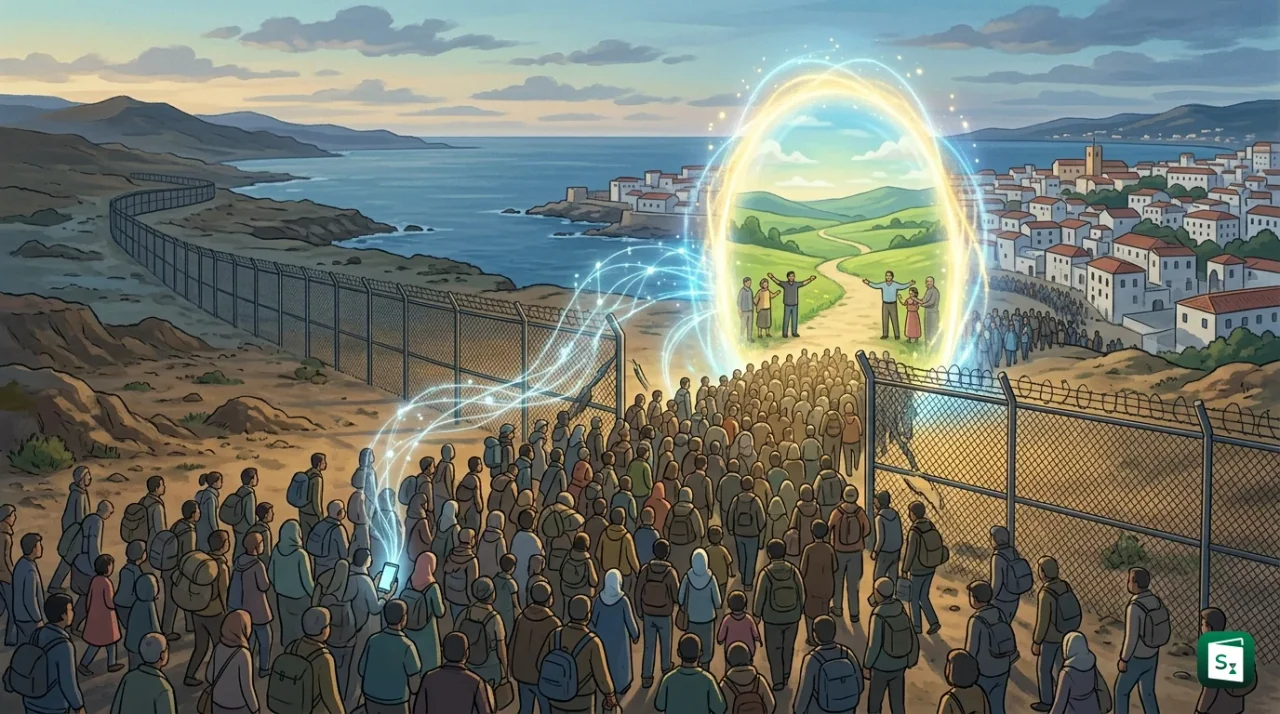
Around 60,000 migrants, most of them young Moroccans, surged from Morocco into the Spanish enclave of Ceuta within about 24 hours starting on 30 July 2026, in the largest such border breach since at least the early 2000s. The sudden influx, equal to roughly 70 percent of Ceuta’s population, overwhelmed the territory’s reception systems and forced Spain to deploy its armed forces. The surge was driven mainly by false social media campaigns claiming that “Spain is Open”, although a recent Spanish Supreme Court ruling on migrant returns and deeper economic and diplomatic tensions also played a role.
What Is Happening in Ceuta?
Most people did not climb the fortified border fence, which remains one of the most heavily guarded land frontiers in the world. Instead, they swam around the two breakwaters at Tarajal and Benzú beaches, wading or swimming a stretch of sea that is barely wider than the Strait of Gibraltar, or walked along the shoreline into the city.
Spanish Interior Ministry figures put the number of arrivals at roughly 50,000 to 60,000 between 30 and 31 July. By the evening of 31 July, about 48,000 people had already returned voluntarily to Morocco, many after discovering that Ceuta offered neither shelter nor a route onward to mainland Europe. The Temporary Center for Immigrants (CETI), Ceuta’s main reception facility, was quickly overwhelmed, and facilities for unaccompanied minors were reported to be operating at around 1,600 percent of their intended capacity.
At least 72 people died during the crossings, most of them drowned in the sea or killed in a stampede near the border checkpoint. Spain responded by sending soldiers and extra police to restore order, using water cannons and tear gas in places. On the Moroccan side, security forces also clashed with crowds near the frontier town of Fnideq. A smaller number of migrants separately tried to force their way into Melilla, Spain’s other North African enclave, about 400 km along the coast, where police made dozens of arrests.
Why the Ceuta Border Is So Sensitive
Ceuta is one of two Spanish autonomous cities located on the North African coast, the other being Melilla. Together they form the European Union’s only land border with Africa, a fact that gives them strategic weight far beyond their size. Ceuta covers just 19 square kilometres and has a population of about 85,000, while Melilla is home to roughly 86,000 people.
The enclaves sit directly opposite Gibraltar on the Strait of Gibraltar, the narrow waterway separating the Atlantic Ocean from the Mediterranean Sea and one of the world’s most important shipping chokepoints. Control of this coast has therefore been contested for centuries. The Portuguese seized Ceuta from Muslim rule in 1415, and it passed to Spain in the seventeenth century after Portugal regained its independence. Spain captured Melilla earlier, in 1497, during the Christian reconquest of the Iberian peninsula. Both cities have been Spanish ever since, even after Morocco gained independence in 1956, and they became autonomous cities in 1995.
Morocco has never accepted Spanish sovereignty over the enclaves and refers to them as occupied cities, alongside a handful of smaller Spanish-held islets in the same stretch of sea. Madrid treats them as integral parts of Spain, sending deputies and senators from Ceuta and Melilla to the Spanish parliament. Because the land frontier with Morocco is only about 8 kilometres long for Ceuta, while the sea routes around it are short, the territory is unusually exposed to any loosening of Moroccan border controls.
What Caused the Sudden Surge?
The Supreme Court Ruling
On 29 June 2026, Spain’s Supreme Court ruled that authorities could no longer carry out summary returns of migrants who reach Ceuta or Melilla by swimming around the sea barriers. Spanish law only allowed immediate “rejection at the border” for people who crossed a physical border element, such as climbing the fence. Someone who swam around a breakwater, the court said, had not crossed such an element, and so could not be pushed back instantly without due process.
Spanish Prime Minister Pedro Sánchez argued that migrant-smuggling networks deliberately misrepresented this narrow technical ruling as an open invitation, telling people that anyone arriving by sea could stay. The government said the interpretation “spread like wildfire” through traffickers’ networks. Migrants who reached Ceuta found no such right to remain, and most turned back within hours.
The “Spain is Open” Disinformation
The most striking driver was a wave of false social media campaigns circulating on platforms such as Facebook, Instagram and X. Videos and posts showed young men in wetsuits and flippers shouting “Spain is Open” and jumping into the sea, alongside old footage and images shot inside Ceuta itself. Some accounts appeared to have been created only weeks earlier, yet several gathered tens of thousands of likes.
Many of those who set out told reporters they had seen these posts and believed Spain had opened its borders, possibly connected to a regularization scheme that allows undocumented migrants already living in Spain to apply for residence and work permits. The promise was false on every count: the migrants who reached Ceuta were met with neither shelter nor any legal pathway onward, and most made their way back to Morocco voluntarily.
Economic and Diplomatic Drivers
Beyond disinformation, structural factors pushed people toward the sea. Youth unemployment in Morocco stands at about 37 percent, one of the highest rates in the region, against a nationwide rate of roughly 13 percent. Spain’s economy, by contrast, has been growing faster than most of the eurozone, and earlier in 2026 the government announced a regularization drive initially expected to cover about 500,000 undocumented migrants, with more than a million applications reportedly filed.
The timing also raised diplomatic suspicions. Morocco has a history of loosening border controls when it wants Madrid’s attention, most famously in May 2021, when about 8,000 to 10,000 people entered Ceuta after Spain admitted the leader of the Polisario Front for medical treatment. The Polisario Front is a Western Saharan independence movement that Morocco opposes; Spain had abandoned its earlier neutrality on Western Sahara in 2022 by backing Morocco’s autonomy plan. Days before the latest surge, Sánchez had visited Algiers to mend ties with Algeria, which broke off relations with Spain over the Western Sahara issue. Rabat, which blames criminal networks, denied any role in the crossings.
The European Political Fallout
The crisis quickly became a test of European unity. Italy announced it was temporarily suspending the Schengen Agreement with Spain for one month, reintroducing passport and document checks on air and sea arrivals from Spain. Schengen, named after the 1985 treaty signed in the Luxembourg village of Schengen, allows passport-free travel across most of the European Union. Italy’s move was largely symbolic, since Ceuta is not part of the Schengen zone in practice and movement between the enclaves and mainland Spain already requires identity checks.
French Interior Minister Laurent Nunez said France would also strengthen checks along its border with Spain, and Finland backed Italy’s demand that Spain be held to its duty to protect the EU’s external border. Right-wing leaders across Europe seized on the images, with Italian Prime Minister Giorgia Meloni calling for urgent talks among EU interior ministers. Spain hit back at what it called a “selfish” and political response, insisting the crisis had been contained.
Domestically, the surge put Sánchez under heavy pressure. The opposition Popular Party called the situation a national security crisis, while the far-right Vox blamed the government’s migration policies directly. A general election must be held in Spain by August 2027, and analysts said the crisis could make migration the defining issue of the campaign.
The Road Ahead
Spain has begun extending Ceuta’s border fence out to sea, attaching lines of floating buoys to the jetties so that swimmers can once again be intercepted and returned immediately, in line with the Supreme Court’s suggestion that physical barriers in the water would restore the legal basis for swift returns. Ships will patrol these new floating barriers. The government also expects to host EU interior ministers in the coming days to discuss how to strengthen the bloc’s external borders.
The deeper questions are unresolved. The episode showed how quickly false information on social media can move thousands of people toward a physical border, and how easily migration can become a tool of pressure between two neighbouring states. It also exposed the fault lines within Europe between governments that want stricter controls and those, like Spain’s, that argue an ageing continent needs more workers.
For now, the immediate humanitarian emergency has receded, as most of those who crossed have returned to Morocco. But the crisis has left dozens of families mourning, strained relations between Madrid and several European capitals, and reopened the debate over who guards Europe’s southern doorstep and how.
Key Takeaways
- Ceuta and Melilla are Spanish autonomous cities on the North African coast and together form the European Union’s only land border with Africa.
- Around 60,000 migrants, roughly 70 percent of Ceuta’s population, crossed into the enclave from Morocco starting on 30 July 2026, and at least 72 people died during the attempt.
- The influx was driven mainly by false social media campaigns carrying the slogan “Spain is Open”, alongside a Spanish Supreme Court ruling of 29 June 2026 that limited summary returns of migrants arriving by sea.
- Ceuta was captured by Portugal in 1415 and passed to Spain in the seventeenth century, while Spain took Melilla in 1497; Morocco, which gained independence in 1956, does not recognise Spanish sovereignty over either city.
- The May 2021 border surge, when about 8,000 to 10,000 people entered Ceuta, followed Spain’s decision to admit a Polisario Front leader for medical treatment amid the Western Sahara dispute.
- Italy temporarily suspended the Schengen Agreement with Spain after the crisis, reintroducing passport checks on air and sea arrivals.