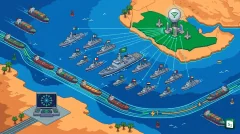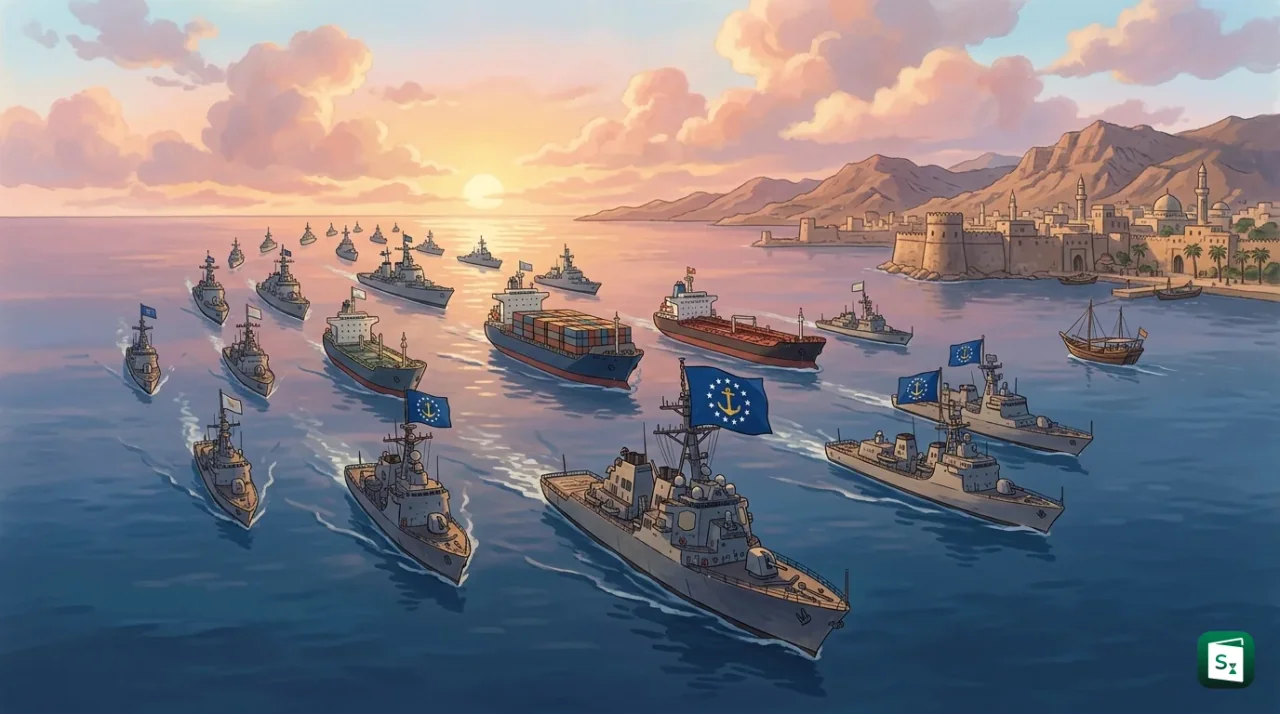
Saudi Arabia and 13 other nations have announced the formation of a Multinational Maritime Defence Alliance to protect shipping in key West Asian waterways and strengthen global maritime security. The founding members include Kuwait, Bahrain, Qatar, Egypt, Jordan, Yemen, Nigeria, Sudan, Djibouti, Turkiye, Pakistan, Bangladesh, and Somalia, alongside Saudi Arabia as the leading state. Riyadh has been designated the founding and leading state of the alliance and will host its permanent secretariat.
Why the Red Sea Is Under Threat
The alliance has been assembled against the backdrop of a sharp escalation in the Red Sea crisis, which began in late 2023. Yemen’s Houthi movement, an Iran-aligned armed group that seized the Yemeni capital Sanaa in 2014, began attacking commercial vessels transiting the Bab el-Mandeb Strait, saying its actions were in solidarity with Palestinians during the war in Gaza. Since then, the group has struck dozens of merchant ships, forcing many shipping lines to abandon the Red Sea route entirely and divert vessels around the Cape of Good Hope in southern Africa.
The crisis reached a new peak in July 2026. The Houthis announced a naval blockade on Saudi Arabia on 20 July 2026, and subsequently claimed a series of attacks on Saudi-linked oil tankers, including the Saudi-flagged vessel NCC Ghazal, which was struck with ballistic missiles and forced to change course. Saudi Arabia responded with air strikes on what it said were Houthi military facilities near the port of Hodeidah in Yemen. Red Sea traffic fell sharply, with only a handful of vessels transiting the waterway on some days, compared with more than 70 ships a day before the crisis.
The escalation is linked to a wider confrontation involving Iran. With the Strait of Hormuz, the other critical West Asian chokepoint, disrupted by the US-Israel war with Iran, Saudi Arabia diverted much of its crude exports to the Red Sea via the port of Yanbu. Those cargoes have now come under Houthi threat, creating pressure on global energy prices and supply chains.
What the Alliance Is
The Multinational Maritime Defence Alliance is a framework for joint naval cooperation among the 14 founding states. Its core objectives are to strengthen maritime security, safeguard freedom of navigation, secure international trade routes and energy supply lines, and protect shared maritime interests in the Bab el-Mandeb Strait, the Red Sea, and the Gulf of Aden.
According to the founding members’ joint statement, the alliance will operate in line with international law, the United Nations Charter, and globally recognised norms and treaties. Members have agreed to cooperate on maritime security, intelligence and information sharing, operational planning, joint exercises, training, capacity building, and joint maritime operations. Participation in alliance activities will remain a sovereign decision for each member state.
The Structure
The founding states have agreed to establish several principal executive bodies in Saudi Arabia, including a Joint Command, command-and-control centres, a Joint Maritime Operations Centre, and a General Secretariat. Saudi Arabia will serve as the alliance’s permanent headquarters and secretariat, with Defence Minister Prince Khalid bin Salman leading the initiative.
The door remains open for other nations to join. Saudi Arabia’s defence ministry said representatives from 43 countries and the European Union attended the international meeting at which the coalition was established, and other nations are completing their national procedures before formally acceding to the alliance’s charter. Notably, the UAE and Oman, two Gulf states with major stakes in the region, have not yet signed on, while Washington has not confirmed whether it will formally join.
Why These Waterways Matter
The alliance focuses on one of the most strategically valuable stretches of ocean in the world. The Red Sea is a narrow body of water lying between Saudi Arabia and Yemen on one side and Egypt, Sudan, Eritrea, Djibouti, and Somalia on the other. It carries roughly 12 per cent of global trade and as much as 30 per cent of global container traffic, making it a vital artery for goods moving between Asia, Europe, and the Middle East.
The critical chokepoint is the Bab el-Mandeb Strait, a 29-kilometre-wide waterway at the southern end of the Red Sea that connects it to the Gulf of Aden and the Indian Ocean. At its narrowest point, it offers only two channels for inbound and outbound traffic. The strait is one of only two exits from the Red Sea, the other being the Suez Canal to the north, and around 4.1 billion barrels of crude oil and refined products passed through it in 2024, roughly five per cent of global oil shipments.
The strait gains added importance because of events at the other major chokepoint. The Strait of Hormuz, which separates Iran from Oman and carries around a quarter of global seaborne oil trade, has been effectively closed by the US-Israel war with Iran since early 2026. That has pushed oil prices higher and forced producers to reroute cargoes, which makes secure passage through Bab el-Mandeb and the Red Sea all the more important for global energy security.
Existing Maritime Security Efforts
The new alliance joins a crowded field of multinational missions already operating in West Asian waters. The Combined Maritime Forces (CMF) is a 47-nation naval partnership headquartered in Bahrain that coordinates several task forces across the region, including Combined Task Force (CTF) 153, which was set up in April 2022 specifically for maritime security in the Red Sea, Bab el-Mandeb, and the Gulf of Aden.
Separately, the United States formed Operation Prosperity Guardian in December 2023, a coalition of more than 20 nations that responded directly to Houthi attacks on shipping. The European Union launched its own naval mission, EUNAVFOR Aspides, in February 2024 to protect merchant vessels and restore freedom of navigation in the region. An earlier arrangement, the International Maritime Security Construct (IMSC), formed in September 2019 with headquarters in Bahrain, focuses on the Persian Gulf and Gulf of Oman.
What sets the new Saudi-led alliance apart is that it is the first major maritime security framework of this kind to be led by a regional Arab state rather than by Washington or Brussels. Its Gulf-based leadership, the diversity of its membership spanning Asia, Africa, and the Middle East, and its stated focus on collective self-defence of shipping give it a distinctly regional character.
Significance and Implications
The formation of the alliance signals a shift in how the region approaches its own security. Saudi Arabia’s decision to take the lead, rather than wait for external forces, reflects a broader trend among Gulf states toward building indigenous defence capacity. By keeping command structures in Riyadh, the kingdom positions itself as a guarantor of maritime security in its own neighbourhood, strengthening its influence across the Red Sea basin.
For global markets, the alliance matters because it addresses the single most disruptive threat to world trade at present. Continued attacks on shipping have raised freight rates, insurance premiums, and energy prices, and any credible effort to restore safe passage through Bab el-Mandeb would ease these pressures. The World Bank’s sister body UNCTAD has warned that disruptions at chokepoints like Hormuz and Bab el-Mandeb raise energy, food, and transport costs, hitting developing economies hardest.
The membership itself is politically significant. The alliance brings together countries that share a common interest in secure trade routes despite differing alignments on other issues, including two nuclear-armed South Asian neighbours, Pakistan and Bangladesh. Egypt and Jordan depend heavily on the Suez Canal and Red Sea trade for revenue, while Red Sea states such as Djibouti and Somalia have major stakes in the security of these waters. The inclusion of Turkiye, a NATO member with its own naval ambitions, also broadens the alliance’s reach.
India’s Stake in the Region
Although India is not a member, the outcome of the alliance directly affects its interests. More than two-thirds of India’s crude oil imports travel from West Asia, and the India-Middle East-Europe Economic Corridor (IMEC), announced in September 2023, is designed to link India with Europe through these very Gulf and Red Sea routes. During earlier phases of the Red Sea crisis, the Indian Navy deployed destroyers, frigates, and surveillance aircraft to protect Indian-flagged and Indian-bound merchant vessels in the Gulf of Aden and the Red Sea. India has consistently called for maritime stability and freedom of navigation in the Indian Ocean region, making the security of these chokepoints a matter of direct strategic concern.
The Way Forward
The alliance now faces the practical challenge of translating its charter into operations. Its stated focus is defensive, and members have committed to operate only under international law and with respect for state sovereignty. In the short term, the credibility of the alliance will depend on how quickly its Joint Command and Maritime Operations Centre in Riyadh become operational and on whether additional countries, including the UAE, Oman, and the United States, formally join.
The longer-term test is whether a regional, defensive framework can succeed where larger coalitions have struggled. Houthi attacks persisted through 2024 and 2025 despite the presence of Prosperity Guardian and Aspides, and the movement retains a large arsenal of drones and missiles. Analysts note that the alliance’s effectiveness will ultimately hinge on political will, intelligence-sharing, and sustained naval presence, rather than on the charter itself. A diplomatic settlement in Yemen and de-escalation between Iran and the West remain the only durable solutions to the underlying crisis.
Key Takeaways
- The Multinational Maritime Defence Alliance is a 14-nation naval framework led by Saudi Arabia, which hosts its permanent secretariat and headquarters in Riyadh.
- The founding members are Saudi Arabia, Kuwait, Bahrain, Qatar, Egypt, Jordan, Yemen, Nigeria, Sudan, Djibouti, Turkiye, Pakistan, Bangladesh, and Somalia.
- The alliance will safeguard shipping and energy routes in the Bab el-Mandeb Strait, the Red Sea, and the Gulf of Aden.
- The Bab el-Mandeb Strait is roughly 29 kilometres wide and is one of only two exits from the Red Sea, the other being the Suez Canal.
- The Strait of Hormuz carries around a quarter of global seaborne oil trade and has been disrupted by the US-Israel war with Iran, raising the strategic value of the Red Sea route.
- The alliance is the first major maritime security framework of its kind led by a regional Arab state rather than by the United States or the European Union.