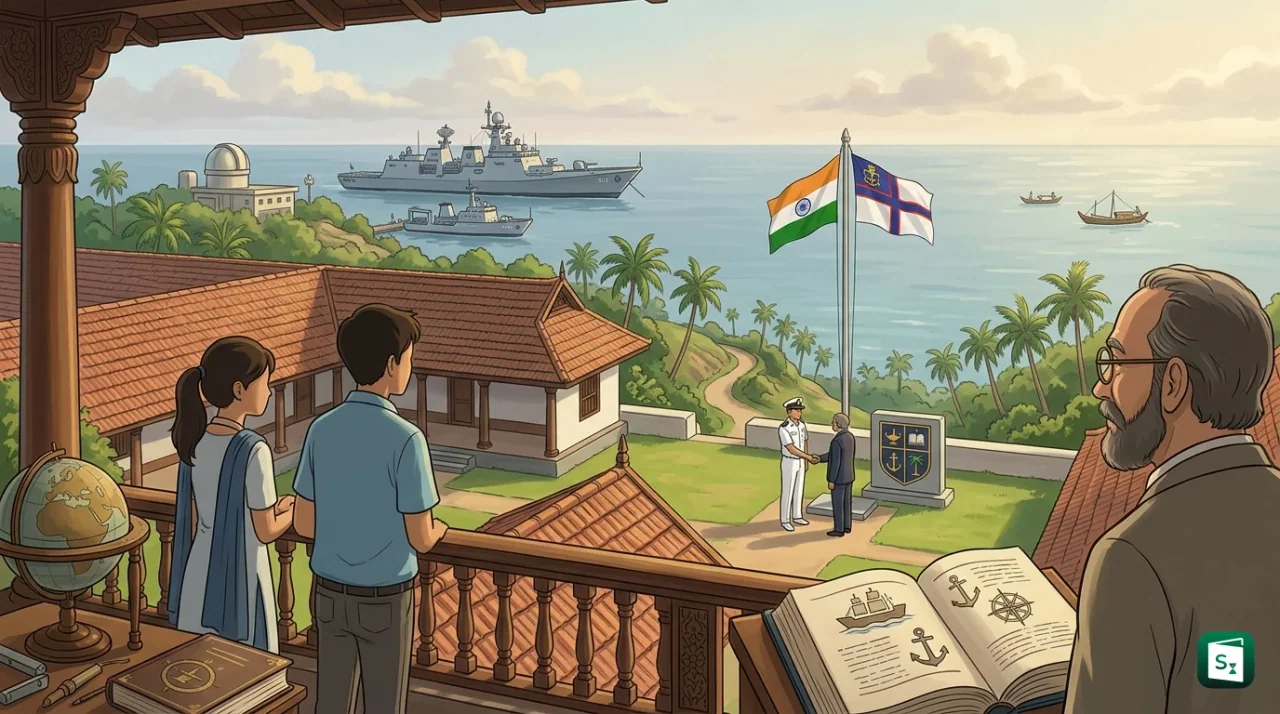
The Central University of Kerala (CUK) has signed a Memorandum of Understanding (MoU) with the Indian Navy to promote academic collaboration, interdisciplinary research and knowledge exchange. The agreement, signed at the Naval War College in Goa, carries a special focus on maritime studies and strategic research. It marks a notable step in bridging academia and the armed forces to deepen India’s maritime and defence knowledge base.
The MoU and Its Signatories
The agreement was signed by Prof. V. B. Sameer, Registrar of the Central University of Kerala, and Commander Kalesh Mohanan, Officer-in-Charge of the Naval History Division (NHD) of the Indian Navy. The signing ceremony took place at the Naval War College in Goa in the presence of CUK Vice-Chancellor Prof. Siddu P. Algur.
Senior naval officers and university officials witnessed the event. Among them were Vice-Admiral C. R. Praveen Nair, Controller Personnel Services, and Rear-Admiral Arjun Dev Nair, Commandant of the Naval War College. From the university side, Prof. Suresh R., Dean of the Department of International Relations, Prof. Sijin Kumar A.V., Director of Research, and Dr. E. Prasad, Director of the Research and Development Cell, attended the ceremony.
CUK Vice-Chancellor Prof. Siddu P. Algur said the MoU aims to promote academic excellence, interdisciplinary research, knowledge exchange and capacity building in areas of mutual interest. Maritime studies and strategic research are identified as the special focus areas of the partnership.
Areas of Collaboration
Under the MoU, the two institutions will work together on collaborative research projects, faculty and student exchange programmes, expert lectures, joint seminars, workshops and internships. Students and researchers at CUK will get access to specialised knowledge in maritime affairs, naval history, national security, defence technologies and related disciplines.
Students are expected to benefit most from direct exposure to the real-world application of science, technology, strategic studies and leadership through interactions with naval experts. Faculty members, in turn, will get the chance to take up joint research projects and contribute to policy-oriented studies on maritime security and national development.
The agreement also lays the foundation for interdisciplinary research in emerging fields. These include maritime technologies, artificial intelligence (AI), cybersecurity, ocean sciences, environmental sustainability, logistics and innovation. Such a wide scope means the partnership is not limited to history or strategy alone, but extends to some of the most technology-driven areas of modern defence and ocean science.
About the Central University of Kerala
The Central University of Kerala was established in 2009 under the Central Universities Act, 2009, which created 15 new central universities across the country for teaching and research. Its main campus sits on the Tejaswini Hills at Periya, about 20 km south of Kasaragod, the northernmost district of Kerala. The President of India is the Visitor of the university.
The university functions through 12 schools and about 27 departments spread across disciplines such as biological, physical, earth, social, economic, legal, business and global studies. The Department of International Relations and Politics, part of the School of Global Studies, is the most relevant to this partnership, and CUK also runs a separate International Relations department at its Capital Centre campus in Thiruvananthapuram.
Its location is itself significant. Kasaragod lies along the Malabar Coast, a long coastline that has been central to Indian trade and naval activity for centuries. Kerala hosts the Southern Naval Command at Kochi, and the state is emerging as a maritime hub with projects such as the Vizhinjam International Seaport, India’s first deep-water transshipment port, near Thiruvananthapuram. This makes a Kerala-based university a natural partner for the Navy’s academic engagements.
Naval War College and the Naval History Division
The MoU was signed at the Naval War College (NWC) in Goa, one of the three war colleges of the Indian Armed Forces. The other two are the Army War College at Mhow and the College of Air Warfare in Secunderabad. The NWC was originally set up in 1988 as the College of Naval Warfare at Karanja in Mumbai, and was renamed the Naval War College and shifted to Goa in 2011. It operates under the Southern Naval Command, which is the training command of the Indian Navy.
The college is headed by a Commandant of Rear-Admiral rank. It runs the Naval Higher Command Course, a flagship 37-week programme for senior officers of Captain and equivalent rank, along with courses such as the Regional Maritime Security Course and the Technical Management Course. Officers completing the higher command course are awarded a Master of Philosophy degree from the University of Mumbai.
The Naval History Division (NHD), from which the Navy’s side of the MoU was signed, has its roots in the Naval History Cell created in 1968 to document the Navy’s wartime and operational record. The cell was elevated to a division in 2006, and the NHD was formally inaugurated by the then Chief of the Naval Staff in 2024. It functions as a research institution that compiles historical data, preserves the Navy’s archival heritage and carries out scholarly work on maritime and naval history. Its location in Goa, on the campus of the Naval War College, places it at the heart of the Navy’s higher academic and strategic training.
Why This Partnership Matters
The agreement comes at a time when India’s maritime outlook has grown more strategic. More than 95% of India’s trade by volume passes through the Indian Ocean, and the region is central to the country’s energy imports and sea line of communication (SLOC) security. India has articulated its maritime vision through the SAGAR doctrine, unveiled in 2015, which stands for Security and Growth for All in the Region, and the more recent MAHASAGAR framework for an Indian Ocean-centred security network.
Naval power is now inseparable from knowledge. Modern warfare and maritime security increasingly depend on cybersecurity, artificial intelligence, autonomous systems and ocean sciences, all of which are covered under this MoU. A partnership of this kind allows the Navy to tap academic research on these technologies while giving universities a window into the operational realities of maritime security.
For CUK, the MoU strengthens its position as a growing centre for strategic studies and international relations. The university’s Department of International Relations already engages with topics such as maritime security and defence, and this formal link with the Navy gives its faculty and students a direct channel to institutional expertise, archives and practitioners. The agreement also fits the wider national push to connect higher education institutions with the defence research ecosystem.
A Broader Defence-Academia Push
This MoU is part of a recognisable pattern of the Indian armed forces building structured ties with academic institutions. The Navy has signed similar agreements with institutions such as the Indian Institute of Science (IISc), IIT Kharagpur and other universities for research on engineering, defence technologies and academic cooperation.
The government has been expanding this ecosystem through several channels. The Defence Research and Development Organisation (DRDO) has set up a network of about 300 academic institutions for defence-relevant research, and has established DRDO Industry Academia Centres of Excellence (DIA-CoEs) at premier institutes across the country. Programmes such as Innovations for Defence Excellence (iDEX), launched in 2018, connect start-ups, industries and academia with the defence establishment to encourage indigenous innovation.
Such academic linkages serve a broader national goal. They help build a skilled scientific and strategic workforce, reduce dependence on imported defence technology, and deepen the country’s capacity for independent research in fields from naval history to artificial intelligence. University partnerships also promote awareness of India’s maritime heritage and strategic thinking among younger generations, which is essential for a nation that sees itself as a future maritime power.
Key Takeaways
- The Central University of Kerala (CUK) signed a MoU with the Indian Navy to promote academic collaboration, interdisciplinary research and knowledge exchange, with a special focus on maritime studies and strategic research.
- The MoU was signed by Prof. V. B. Sameer, Registrar of CUK, and Commander Kalesh Mohanan, Officer-in-Charge of the Naval History Division (NHD), at the Naval War College in Goa.
- The partnership covers maritime technologies, artificial intelligence, cybersecurity, ocean sciences, environmental sustainability, logistics and innovation, along with faculty and student exchange and joint research.
- The Central University of Kerala was established in 2009 under the Central Universities Act, 2009, and is located at Periya in Kasaragod, the northernmost district of Kerala.
- The Naval War College, one of the three war colleges of the Indian Armed Forces, was established in 1988 and shifted to Goa in 2011; it operates under the Southern Naval Command.
- India’s maritime vision is guided by the SAGAR doctrine (Security and Growth for All in the Region), unveiled in 2015, while more than 95% of India’s trade by volume passes through the Indian Ocean.