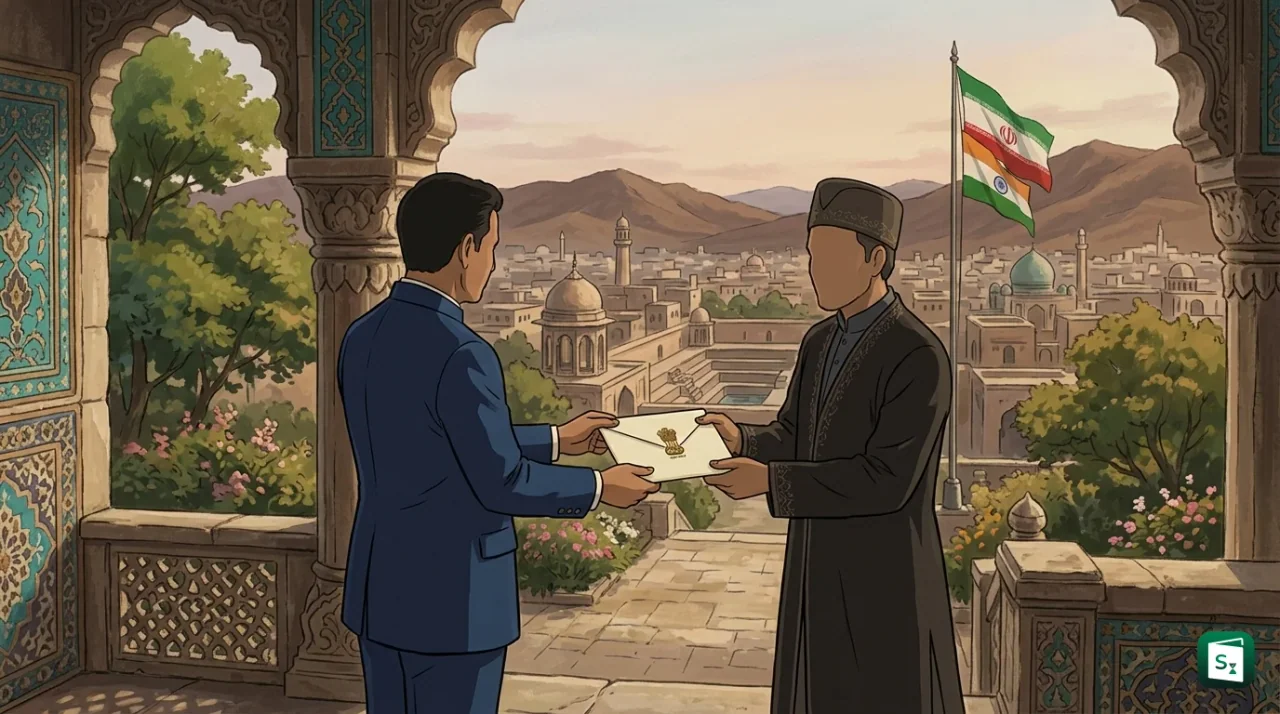
The government has appointed Vishwesh Negi, a 2002-batch officer of the Indian Foreign Service (IFS), as the next Ambassador of India to the Islamic Republic of Iran. Negi, who currently serves as a Joint Secretary in the Ministry of External Affairs (MEA) in New Delhi, is expected to take up his assignment in Tehran shortly. The appointment, announced on 3 August 2026, places an experienced diplomat at the head of one of India’s most strategically demanding missions at a time of heightened tension across West Asia.
Who Is Vishwesh Negi?
Vishwesh Negi is a senior career diplomat with more than two decades of service in the Indian Foreign Service. He belongs to Uttarakhand and entered the service in 2002 after clearing the Civil Services Examination. His foundational training took place at the Lal Bahadur Shastri National Academy of Administration (LBSNAA) in Mussoorie, followed by specialised instruction in diplomacy, foreign languages, international law and international trade at the Foreign Service Institute in New Delhi, which has since been renamed the Sushma Swaraj Institute of Foreign Service (SSIFS).
A Career Across Sensitive Desks
Negi’s career has been built around some of the most demanding desks in the government. He served as Director (Pakistan) in the MEA, handling one of India’s most sensitive bilateral relationships. He later moved to the Ministry of Defence as Joint Secretary (International Cooperation), where he co-chaired defence consultations with Armenia, led strategic military cooperation dialogues and worked to expand India’s international defence partnerships.
Most recently, Negi held the charge of Joint Secretary (Oceania and Indo-Pacific) in the MEA, overseeing India’s engagement with Australia, New Zealand and the Pacific Island countries. In this role he worked on strategic partnerships, economic cooperation and critical mineral collaborations, particularly with Australia. His mix of experience across security, defence diplomacy and regional geopolitics is seen as directly relevant to the complex brief he now takes up in Tehran.
Why the Tehran Posting Matters Now
Negi takes over the mission in Tehran at a moment of acute regional instability. The 2026 Iran War, which began on 28 February 2026 when the United States and Israel launched airstrikes on Iran, has left the wider region in turmoil. Iran closed the Strait of Hormuz for stretches during the conflict, fired on commercial vessels, and at various points the passage of shipping through one of the world’s busiest maritime chokepoints remained uncertain.
The fallout reached India directly. Indian sailors were among those killed and injured when vessels came under fire, and the strait’s disruption pushed up oil and cooking gas prices across India, triggering shortages of LPG (Liquefied Petroleum Gas) cylinders in several states. India’s Embassy in Tehran, along with its consular network, facilitated the return of 2,557 Indian nationals via Armenia and Azerbaijan after the hostilities began, while an estimated 7,000 Indians, including medical and seminary students, workers, seafarers and fishermen, continue to live in Iran.
The ambassador-designate steps in as India presses both dialogue and the safety of its people. External Affairs Minister S. Jaishankar recently spoke with Iranian Foreign Minister Seyyed Abbas Araghchi, conveying India’s deep concern over the hostilities and urging that commercial shipping and seafarers never be targeted. Negi will be the person on the ground expected to keep these channels open and protect Indian interests through the crisis.
India-Iran Ties at a Glance
India and Iran share ties that go back thousands of years, but modern diplomatic relations were formally established on 15 March 1950. The relationship rests on energy, connectivity, trade, regional security and deep people-to-people links, and it has survived its share of friction. India has consistently opposed Iran’s nuclear programme, and New Delhi’s growing engagement with Israel has at times sat uneasily with its Tehran ties. American sanctions on Iran have repeatedly forced India to calibrate how far it can go in economic engagement.
Yet the strategic logic of the relationship endures. Iran offers India its only land bridge to Afghanistan and Central Asia that bypasses Pakistan, making it central to New Delhi’s regional connectivity ambitions. Around 15% of India’s Muslims are Shia, and Iran’s role as a major Shia power has given the two countries a layer of civilisational and cultural connection, visible in shared traditions, language and the presence of Zoroastrian Parsi heritage in India. The Parsi community, which migrated to India centuries ago to escape persecution, is a living reminder of this ancient link.
The Strategic Pillars of the Relationship
Chabahar Port and Regional Connectivity
The most important pillar is the Chabahar Port on the Gulf of Oman in south-eastern Iran. India has long viewed the port as a gateway to Afghanistan and Central Asia, a counter to Pakistan’s Gwadar Port, which is being developed by China. An Indian government-owned company, India Ports Global Limited (IPGL), has operated the Shahid Beheshti Terminal at Chabahar since 2018 through its wholly-owned subsidiary, India Ports Global Chabahar Free Zone (IPGCFZ).
The project received a major push in May 2024 when India and Iran signed a ten-year contract under which India took over port operations. Under the main contract signed between IPGL and Iran’s Ports and Maritime Organisation (PMO) on 13 May 2024, India committed $120 million to the project, a sum it has fully paid, with the final tranche transferred in August 2025. Chabahar is also a vital node in the International North-South Transport Corridor (INSTC), a multimodal route connecting India to Russia and Europe through Iran, Azerbaijan and the Caucasus.
The project, however, faces serious headwinds. The conditional sanctions waiver granted by the United States for Chabahar operations expired on 26 April 2026, and the government has said it remains engaged with all stakeholders to address the implications. The fate of the port is one of the first big files awaiting Negi in Tehran.
The Strait of Hormuz and Energy Security
The Strait of Hormuz, a narrow waterway between Iran and Oman that connects the Persian Gulf to the Gulf of Oman and the Arabian Sea, is the strategic heart of India’s interest in the region. Roughly 90% of India’s LPG imports and a large share of its crude oil move through this strait. When Iran closed the strait during the 2026 war, the consequences for Indian households were immediate, with cooking gas prices jumping and black-market prices for a 14.2 kg cylinder reportedly touching ₹4,000.
Beyond households, the strait carries a substantial portion of global oil shipments, which makes its safety a matter of concern for the world economy. India has repeatedly pressed all parties to keep commercial shipping lanes open and protect seafarers, and the safe passage of ships through Hormuz is a running theme in India’s diplomacy with Iran, the United States and the Gulf states. For the new ambassador, managing this file means balancing India’s energy dependence, its condemnation of attacks on shipping from any quarter, and the need to keep dialogue alive in a region where several powers have competing interests.
Trade and the Resumed Oil Imports
Energy has long been the commercial backbone of the relationship. Iran was historically one of India’s largest oil suppliers, but Indian imports fell sharply after 2019, when New Delhi stopped buying Iranian crude under pressure from the United States. That picture changed in 2026, when India resumed purchases of Iranian oil and gas after a gap of seven years. The resumption drove India’s trade with Iran up sharply in the first months of 2026, even as the broader conflict raised the risks of doing business.
The relationship also carries a large human dimension. Around 40,000 Iranians visit India every year, some 8,000 Iranian students study at Indian universities, and India provides scholarships to Iranian students under programmes such as ITEC (Indian Technical and Economic Cooperation) and the ICCR (Indian Council for Cultural Relations). For the new ambassador, these people-to-people ties, along with the protection of Indian nationals in Iran, will be as much a part of the daily brief as ports and pipelines.
A Challenging First Brief
Negi inherits a mission with several interlocking priorities. On connectivity, he must defend India’s stake in Chabahar at a time when the sanctions waiver has lapsed and its future depends on diplomacy with Washington and Tehran. On energy, he must help sustain the resumed oil trade without exposing India to avoidable sanction risks. On security, he must keep India’s channels open with a government whose military exchanges with the United States and Israel have placed the region on a war footing.
He also inherits an outbound relationship. His predecessor, Rudra Gaurav Shresth, who took charge in Tehran in May 2023, has been appointed India’s next Ambassador to the Republic of Türkiye, leaving the Iranian capital just as the regional situation needs steady handling. The MEA has indicated that Negi will assume charge in Tehran shortly, with the appointment already approved through the government’s regular process.
Key Takeaways
- Vishwesh Negi, a 2002-batch officer of the Indian Foreign Service, was appointed India’s next Ambassador to the Islamic Republic of Iran on 3 August 2026.
- Negi was serving as Joint Secretary in the Ministry of External Affairs at the time of his appointment, and previously served as Director (Pakistan) and Joint Secretary (International Cooperation) in the Ministry of Defence.
- India and Iran formally established diplomatic relations on 15 March 1950, and Tehran hosts India’s mission headed by the Ambassador.
- The Chabahar Port, operated by India Ports Global Limited (IPGL) through its subsidiary India Ports Global Chabahar Free Zone (IPGCFZ) since 2018, is a key node of India’s connectivity with Afghanistan and Central Asia and part of the International North-South Transport Corridor (INSTC).
- The US sanctions waiver for Chabahar operations expired on 26 April 2026, and India had fully paid its $120 million commitment under the May 2024 contract with Iran’s Ports and Maritime Organisation.
- India resumed imports of Iranian oil and gas in 2026 after a seven-year gap, while roughly 90% of India’s LPG imports pass through the Strait of Hormuz.