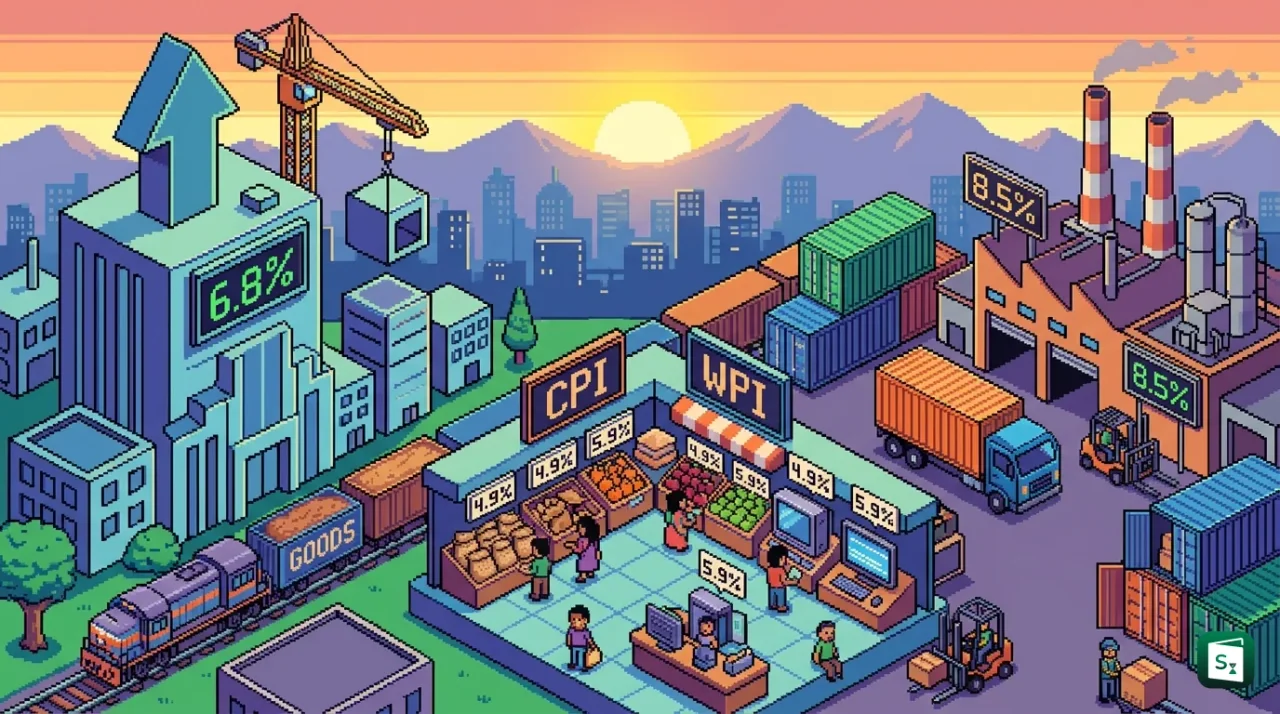
India Ratings and Research (Ind-Ra) has upgraded India\u2019s real GDP growth forecast for fiscal year 2026-27 to 6.8%, up from the 6.7% it estimated in May 2026. The revision, announced on 18 August 2026 in the agency\u2019s mid-year economic outlook report, comes just days after the Reserve Bank of India (RBI) similarly raised its FY27 growth projection to 6.7% from 6.6%. While the upward revision signals domestic resilience, Ind-Ra warned that the unresolved West Asia conflict, elevated crude oil prices, a depreciating rupee, and the looming threat of El Nino on agriculture continue to pose serious downside risks to the growth trajectory.
About India Ratings and Research (Ind-Ra)
India Ratings and Research Private Limited (Ind-Ra) is a credit rating agency headquartered in Mumbai. It is a wholly owned subsidiary of Fitch Group, a global leader in financial information services with operations in more than 30 countries. Ind-Ra is registered with the Securities and Exchange Board of India (SEBI) as a credit rating agency under Section 12 of the SEBI Act, 1992 (SEBI Registration Number: IN/CRA/002/1999). Founded in 1995, the agency provides credit ratings, research, and risk analysis for Indian financial markets. Its parent company, Fitch Group, is majority owned by Hearst and operates dual headquarters in London and New York. Ind-Ra publishes regular economic outlook reports covering GDP growth, inflation, fiscal policy, and other macroeconomic indicators that are closely watched by policymakers, investors, and market participants.
GDP Growth Forecast: What Changed and Why
In its mid-year economic outlook report released on 18 August 2026, Ind-Ra raised India\u2019s real GDP growth forecast for FY27 to 6.8%, a 10-basis-point increase from the 6.7% projected in May 2026. The upward revision was driven primarily by the agency\u2019s decision to lower its average crude oil price assumption for FY27 to USD 85 per barrel, down from the USD 95 per barrel it had assumed in May. Lower oil prices benefit India, which imports over 85% of its crude requirements, by reducing the trade deficit and the current account deficit (CAD).
However, the 6.8% growth projection still represents a notable slowdown from the 7.6% GDP growth India achieved in FY26, as per the provisional estimates released by the National Statistical Office (NSO) using the new GDP series with base year 2022-23. Ind-Ra attributed the moderation to higher fuel and food inflation stemming from the West Asia conflict, a depreciating rupee, and the likely impact of El Nino weather conditions on agricultural output.
Ind-Ra also estimated India\u2019s nominal GDP growth at 10.4% for FY27, significantly higher than the 8.9% recorded in FY26. While real GDP growth is expected to slow, the agency projected that stronger price pressures would push the GDP deflator growth to 3.4% year-on-year in FY27, compared to just 1.1% in FY26.
Quarterly GDP Growth Projections
Ind-Ra broke down its annual GDP forecast into quarterly estimates, projecting a mixed growth trajectory through FY27. The agency expects GDP growth of 6.9% in the first quarter (April to June 2026), followed by a slowdown to 6.6% in the second quarter (July to September), before recovering to 6.7% in the third quarter (October to December) and reaching 6.9% in the fourth quarter (January to March 2027).
These projections are broadly aligned with the RBI\u2019s quarterly forecasts, though with minor differences. The RBI projects Q1 at 7.0%, Q2 at 6.4%, Q3 at 6.5%, and Q4 at 6.8%. The convergence between Ind-Ra and the RBI on the quarterly growth path suggests a broad consensus on the expected pattern of economic activity through the year, with both agencies foreseeing a slight dip in growth during the middle quarters before a pick-up towards the year-end.
| Quarter | Ind-Ra Forecast | RBI Forecast |
|---|---|---|
| Q1 FY27 (Apr-Jun 2026) | 6.9% | 7.0% |
| Q2 FY27 (Jul-Sep 2026) | 6.6% | 6.4% |
| Q3 FY27 (Oct-Dec 2026) | 6.7% | 6.5% |
| Q4 FY27 (Jan-Mar 2027) | 6.9% | 6.8% |
Inflation Outlook: WPI and CPI Projections
Alongside the GDP revision, Ind-Ra provided detailed inflation projections that paint a picture of rising price pressures across both wholesale and retail segments. The agency projected the Wholesale Price Index (WPI) inflation at 8.5% for FY27, a sharp reversal from the near-flat 0.4% recorded in FY26. The surge reflects the impact of higher global crude oil and commodity prices driven by the West Asia conflict, which has pushed up input costs for manufacturers and producers across the economy.
For consumers, the outlook is somewhat more moderate but still elevated. Ind-Ra estimated the Consumer Price Index (CPI) inflation to average 4.9% in FY27, up from 2.1% in FY26. The agency expects retail inflation to peak at 5.9% in the third quarter (October to December 2026) before moderating to 5.0% in the fourth quarter. This trajectory aligns broadly with the RBI\u2019s own inflation forecast of 5.0% for FY27, which it revised downward by 10 basis points at its August 2026 monetary policy review.
The widening gap between WPI and CPI inflation is notable. While WPI captures the full impact of rising input costs at the producer level, consumer prices tend to be stickier and less responsive to wholesale price changes due to regulatory interventions, subsidies, and competitive pressures. Ind-Ra Chief Economist Devendra Pant noted that while lower oil prices positively impact the economy by reducing the trade and current account deficits, higher inflation driven by El Nino may limit the growth upside from lower oil prices.
The CPI inflation data released by the government showed that retail inflation stood at 4.45% in July 2026, up from 4.38% in June, driven largely by food and fuel prices. The RBI\u2019s Monetary Policy Committee (MPC) is mandated to maintain headline CPI inflation at 4%, with a tolerance band of plus or minus 2% for the five-year period from April 2026 to March 2031.
Key Risks to India\u2019s Growth Trajectory
Ind-Ra identified several significant downside risks that could weigh on India\u2019s economic performance in FY27. The most prominent among these is the unresolved West Asia conflict, which erupted at the end of February 2026 and has since caused severe disruptions to global supply chains. The conflict has led to volatile crude oil prices, with the Indian basket averaging USD 101.31 per barrel in the June quarter of FY27 and USD 96.49 per barrel for April to July 2026. While Ind-Ra assumes crude prices will settle at USD 85 per barrel for the full year, any further escalation in the conflict could push prices higher.
The El Nino weather pattern poses a second major risk. El Nino conditions, which typically suppress southwest monsoon rainfall, could adversely affect agricultural output, increase food inflation, and weaken rural demand. The southwest monsoon is critical for India\u2019s farm sector, which directly employs nearly half of the country\u2019s workforce. A deficient monsoon driven by El Nino could increase food prices and offset some of the benefits of lower crude oil prices.
Ind-Ra also flagged the depreciating rupee as a risk factor. A weaker currency makes imports more expensive, adding to inflationary pressures, particularly for crude oil and other commodities priced in US dollars. Additionally, the agency highlighted the US government\u2019s announcement of levying 100% tariff on India for purchasing Russian crude, which could further complicate India\u2019s energy import strategy.
Other risks include weak global trade growth, the base effect from the strong 7.6% growth in FY26, and weaker-than-expected government capital expenditure aimed at minimising fiscal risks. The government\u2019s FY27 fiscal deficit target of 4.3% of GDP was also flagged as challenging, with higher spending on liquefied petroleum gas and fertiliser subsidies expected to add pressure on public finances.
Comparison with RBI and Global Forecasts
Ind-Ra\u2019s upgraded forecast of 6.8% is slightly higher than the RBI\u2019s own projection of 6.7% for FY27, which the central bank revised upward by 10 basis points at its August 2026 monetary policy review. The RBI cited the resilience of the domestic economy, driven by strong private consumption, sustained investment momentum, and robust manufacturing and services activity. However, the RBI also trimmed its FY27 inflation forecast to 5.0% from 5.1%, citing recent softening in global crude oil prices.
The International Monetary Fund (IMF), in its July 2026 World Economic Outlook update, was more cautious, projecting India\u2019s FY27 GDP growth at 6.4%, down from the 6.5% it estimated in April 2026. The IMF, however, raised its FY28 growth estimate to 6.7% from 6.5%, signalling expectations of a recovery once the near-term geopolitical and weather-related risks subside.
Other forecasters have also converged around similar growth estimates. The RBI\u2019s 101st Survey of Professional Forecasters (SPF), conducted in July 2026, pegged FY27 real GDP growth at 6.6%, up from 6.5% projected in the 100th SPF in May 2026. The range of forecasts from various agencies and brokerages for FY27 GDP growth generally falls between 6.0% and 6.9%, reflecting the uncertainty around the trajectory of crude oil prices, the West Asia conflict, and monsoon performance.
| Agency | FY27 GDP Growth Forecast |
|---|---|
| Ind-Ra | 6.8% |
| RBI | 6.7% |
| IMF | 6.4% |
| RBI SPF (101st Round) | 6.6% |
The Bigger Picture: India\u2019s Economic Resilience
Despite the moderation in growth from FY26\u2019s 7.6%, Ind-Ra\u2019s report highlighted that India\u2019s domestic economic fundamentals remain robust. The agency pointed to strong domestic consumption, healthy balance sheets of financial institutions and corporates, rising capacity utilisation in manufacturing, and the government\u2019s continued thrust on capital expenditure as key growth drivers that have cushioned the economy against external shocks.
India\u2019s position as the world\u2019s fastest-growing major economy has been reinforced by the IMF, which projects India to remain the leader in growth among large economies in both FY27 and FY28. The government\u2019s strategy to sustain high growth is centred on improving agricultural productivity, expanding manufacturing, strengthening micro, small and medium enterprises (MSMEs), accelerating infrastructure and logistics development, and simplifying the tax framework. The Union Budget 2026-27 has also placed emphasis on scaling up domestic manufacturing in strategic sectors.
On the external front, the current account deficit (CAD) is projected to widen to 1.5% of GDP in FY27 from 0.6% in FY26, reflecting the impact of higher oil import costs and global trade disruptions. The government has taken several measures to mitigate the impact of the West Asia conflict, including excise duty adjustments, negotiating safe oil transit routes, and creating a buffer fund estimated at approximately USD 6.2 billion to absorb energy price shocks.
India\u2019s services sector continues to be a growth engine, supported by robust exports of IT and business services. The manufacturing sector, while facing cost pressures from higher input costs, is benefiting from government initiatives like the Production Linked Incentive (PLI) scheme and improved domestic demand. The agriculture outlook, however, remains contingent on the progress of the southwest monsoon and the severity of El Nino conditions.
Key Takeaways
- Ind-Ra upgraded India\u2019s FY27 real GDP growth forecast to 6.8% from 6.7% in May 2026, citing lower crude oil price assumptions.
- The agency lowered its FY27 average crude oil price assumption to USD 85 per barrel from USD 95 per barrel in its earlier forecast.
- WPI inflation is projected at 8.5% in FY27, a sharp reversal from the 0.4% recorded in FY26, driven by higher global commodity prices.
- CPI inflation is estimated to average 4.9% in FY27, with retail inflation expected to peak at 5.9% in Q3FY27 before moderating to 5% in Q4FY27.
- India\u2019s GDP growth in FY26 stood at 7.6% (NSO provisional estimates), making FY27\u2019s 6.8% a notable slowdown.
- The RBI projects FY27 GDP growth at 6.7%, while the IMF forecasts it at 6.4%, signalling broad consensus on a moderation in growth.
- Key downside risks include the West Asia conflict, El Nino impact on agriculture, a depreciating rupee, and the 100% US tariff on Indian purchases of Russian crude.