India observes Quit India Movement Day on August 8 every year to mark the launch of the historic Bharat Chhodo Andolan in 1942, the decisive mass uprising that signalled the final phase of the country’s freedom struggle against British colonial rule. The movement, also known as the August Movement or August Kranti, was formally launched at the All India Congress Committee (AICC) session in Bombay on August 8, 1942, when Mahatma Gandhi delivered his iconic “Do or Die” speech at Gowalia Tank Maidan, now known as August Kranti Maidan in Mumbai. The following day, August 9, is observed as August Kranti Diwas, commemorating the mass protests that erupted after the British arrested Gandhi and the entire top Congress leadership in the early hours of that morning.
What Was the Quit India Movement?
The Quit India Movement was a mass civil disobedience campaign launched by the Indian National Congress (INC) under the leadership of Mahatma Gandhi during World War II. It demanded the immediate and unconditional withdrawal of British rule from India. The movement was formally initiated when the All India Congress Committee passed the historic Quit India Resolution at its Bombay session on August 8, 1942. Gandhi, addressing a massive gathering at Gowalia Tank Maidan that evening, gave his now-famous rallying cry: “Here is a mantra, a short one, that I give you. Imprint it on your hearts. The mantra is ‘Do or Die.’ We shall either free India or die trying; we shall not live to see the perpetuation of our slavery.”
The slogan “Quit India” itself is attributed to Yusuf Meherally, a socialist leader and mayor of Bombay. Gandhi had considered alternatives such as “Get Out” and “Withdraw” before approving “Quit India” as the movement’s defining call. The movement represented a decisive shift in the freedom struggle, moving beyond negotiations and constitutional methods to a direct, uncompromising demand for complete independence, known as Purna Swaraj.
Unlike earlier movements such as the Non-Cooperation Movement (1920-22) and the Civil Disobedience Movement (1930-34), the Quit India Movement was unique in its scale and intensity. It saw participation from every section of society, including students, workers, peasants, and women, making it one of the largest mass uprisings in India’s history. The British Viceroy, Lord Linlithgow, described it as “by far the most serious rebellion since 1857.”
Why Was the Movement Launched?
Several converging factors drove the Congress to launch the Quit India Movement in 1942. The most immediate trigger was the failure of the Cripps Mission in March-April 1942. The British government, facing pressure from the United States and China to secure Indian cooperation in the war, sent Sir Stafford Cripps, a member of the War Cabinet, to negotiate with Indian leaders. Cripps offered India Dominion Status after the war and the framing of a new constitution, but the proposal fell short of the Congress demand for immediate self-government. Gandhi famously dismissed the offer as “a post-dated cheque on a crashing bank.”
The second major factor was the threat of a Japanese invasion of India. By mid-1942, Japanese forces had advanced through Burma and were on India’s doorstep. The British failure to defend Singapore, Malaya, and Burma had shattered the myth of British invincibility. Gandhi believed that a free India would be better positioned to defend itself against foreign aggression than one ruled by a foreign power that had proved unable to protect its colonial subjects.
Third, wartime hardships had created widespread anger among the Indian population. High inflation, food shortages, rising prices, and the government’s heavy-handed requisitioning of resources, including boats in eastern India, had left millions of ordinary Indians frustrated. The British government’s selective evacuations in areas threatened by the Japanese, removing white civilians while leaving local populations exposed, further fuelled resentment.
The Congress Working Committee met at Wardha on July 14, 1942, and authorised Gandhi to launch a non-violent mass movement. Gandhi wrote in his newspaper Harijan calling on the British to “leave India to God. If this is too much, then leave her to anarchy.” By the time the AICC met in Bombay in August, the mood was set for a final, decisive confrontation.
August 8 and 9, 1942: The Day That Changed India
The historic AICC session began at Gowalia Tank Maidan in Bombay on August 7, 1942, and concluded past midnight on August 8. The Quit India Resolution was passed unanimously, creating what witnesses described as an “electrifying atmosphere” in the city. That evening, Gandhi addressed thousands of people gathered at the maidan and delivered his now-immortal speech. He told the crowd that he was not seeking concessions or bargaining for ministries. “I am not going to be satisfied with anything short of complete freedom,” he declared. He then urged government servants to openly declare their allegiance to the Congress, soldiers to refuse to fire on their own people, and the rulers of princely states to accept the sovereignty of their own subjects.
Gandhi’s instruction to the people was unequivocal: act as an independent nation, follow non-violent civil disobedience, and be your own guide. The “Do or Die” call was not merely a slogan. It was a directive to every Indian to take personal responsibility for the freedom struggle.
The British response was swift and ruthless. In the early hours of August 9, 1942, the colonial government arrested Mahatma Gandhi, Jawaharlal Nehru, Sardar Vallabhbhai Patel, Maulana Abul Kalam Azad, and virtually the entire Congress Working Committee. The Indian National Congress was declared an unlawful organisation. The AICC, the Working Committee, and four Provincial Congress Committees were banned under the Criminal Law Amendment Act of 1908. Public meetings were prohibited under the Defence of India Rules.
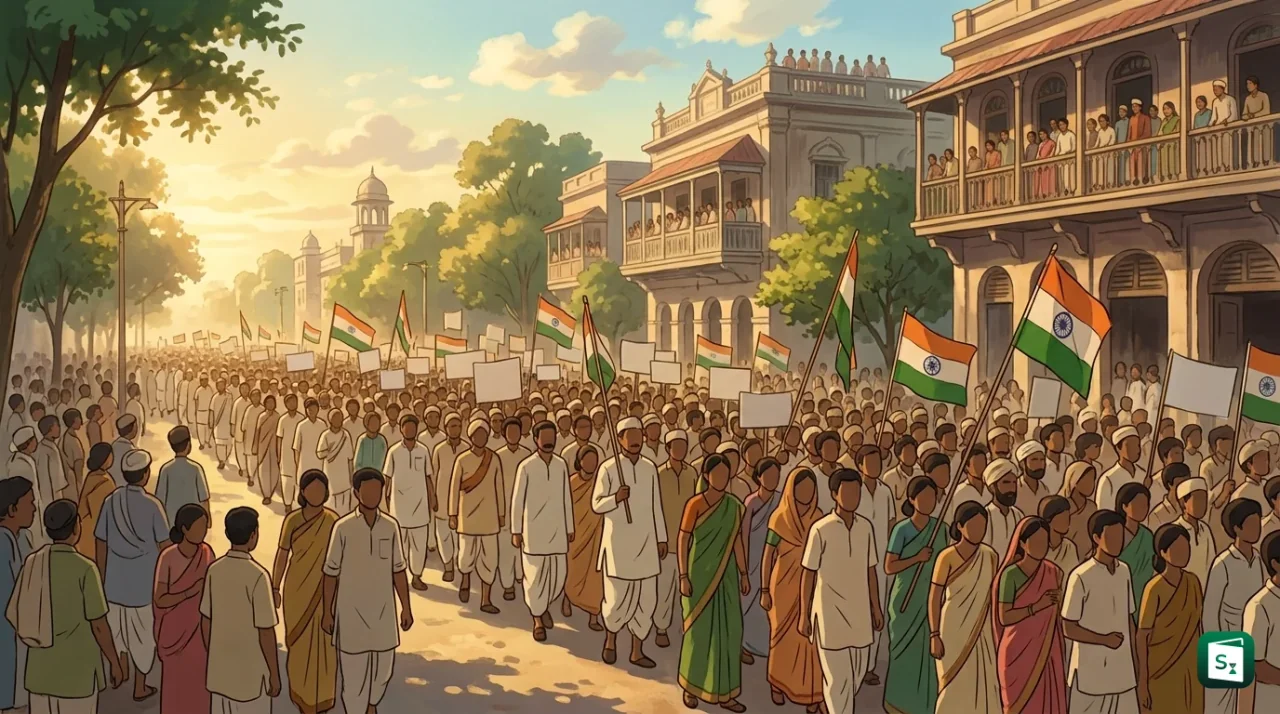
The mass arrests, intended to decapitate the movement before it could begin, had the opposite effect. Within hours, protests erupted across Bombay, Poona, and Ahmedabad. By August 10, demonstrations had spread to Delhi, Uttar Pradesh, and Bihar. Hartals, strikes, and processions defying prohibitory orders broke out in Kanpur, Patna, Varanasi, and Allahabad. The movement had escaped the control of its leaders and spread organically through the masses.
The Underground Resistance: Leaders Who Carried the Fight
With the top Congress leadership behind bars, a younger generation of leaders stepped forward to sustain the movement through underground resistance. These individuals, many of them relatively unknown before 1942, became the backbone of the Quit India struggle.
Aruna Asaf Ali (1909-1996), often called the “Grand Old Lady” of the Indian independence movement, played one of the most iconic roles. On August 9, 1942, just hours after the arrests, she presided over the remaining AICC session and hoisted the Indian national flag at Gowalia Tank Maidan, defying British orders. This act is widely regarded as the symbolic beginning of the mass uprising. An arrest warrant was issued in her name, but she went underground and continued to edit Inquilab, a monthly Congress magazine, alongside Ram Manohar Lohia. The British government announced a reward of ₹5,000 for her capture. She was posthumously awarded the Bharat Ratna in 1997.
Usha Mehta (1920-2000), then just 22 years old, organised the Secret Congress Radio, an underground radio station that began broadcasting on August 14, 1942. Operating from a secret location in Bombay and moving frequently to evade detection, the radio station broadcast recorded messages from Gandhi and other leaders, along with uncensored news banned by the British-controlled government. The first words broadcast were: “This is the Congress radio calling on 42.34 meters from somewhere in India.” The station functioned for three months before police tracked it down on November 12, 1942. Mehta was arrested but described the experience as her “finest moment.” She was posthumously awarded the Padma Vibhushan in 1998.
Jayaprakash Narayan (1902-1979), popularly known as JP, made a dramatic escape from Hazaribag Jail on Diwali night by scaling a 17-foot wall while guards were distracted by celebrations. After his escape, he formed Azad Dasta (Freedom Brigade), a guerrilla group that recruited students, teachers, and defectors from the British army and police. The group organised training camps and carried out acts of sabotage to weaken British military control. The British offered a hefty reward for his capture, dead or alive.
Ram Manohar Lohia (1910-1967) also went underground and played a key role in coordinating resistance across northern India. Achyut Rao Patwardhan led the underground movement in Maharashtra, while Nana Patil and Y.B. Chavan were prominent in Satara district. Sucheta Kripalani, who later became India’s first woman Chief Minister, was another notable underground leader.
Parallel Governments and the Spread of the Movement
One of the most remarkable aspects of the Quit India Movement was the establishment of parallel governments (prati sarkars) in several parts of India. These were spontaneous, people-led administrations that replaced British authority in local areas, running their own courts, collecting taxes, and maintaining order.
In Satara district of Maharashtra, the Satara Prati Sarkar became the most enduring parallel government. Established in early 1943 under the leadership of Nana Patil and Y.B. Chavan, it operated nyayadan mandals (people’s courts) that settled disputes and delivered justice at the village level. The prati sarkar forced police informers and low-level British officials to resign, effectively replacing colonial administration in large parts of the district. Despite British repression and the indifference of the mainstream Congress leadership, the Satara Prati Sarkar continued to function until the elections of 1946. Its last armed encounter with the police took place as late as 1946, after the naval mutiny.
In Ballia, Uttar Pradesh, local leaders overthrew the district administration, broke open the jail, and released incarcerated Congress leaders, establishing a short-lived independent government. In Tamluk and Kanthi in Midnapore district of Bengal, a parallel nationalist government was set up that continued to function until August 1944, despite British military operations and a devastating cyclone in October 1942.
The movement saw widespread sabotage of British infrastructure. Railway lines were uprooted, telegraph wires were cut, government buildings were attacked, and police stations were targeted. In Ahmedabad alone, 8,000 mill workers went on strike. Students across India walked out of schools and colleges to join the protests. The sheer scale and spontaneity of the uprising took the British by surprise.
The British response was severe. An estimated 60,000 people were imprisoned in the first five months alone. Over 100,000 arrests were made across the country. Mass fines were levied on entire communities. Demonstrators were subjected to public flogging, and police and military forces opened fire on unarmed protesters. British Air Force planes machine-gunned unarmed satyagrahis lying across railway tracks in Bihar. Hundreds of civilians were killed in the violence that followed.
Significance: How Quit India Paved the Way for Independence
Although the Quit India Movement was suppressed by 1944 and did not achieve immediate independence, its impact on the trajectory of India’s freedom struggle was profound and irreversible. The movement fundamentally altered the political equation between India and Britain, making it clear that colonial rule could no longer be sustained without the consent of the Indian people.
The most important contribution of the movement was that it demonstrated mass opposition to British rule on an unprecedented scale. The participation of students, workers, peasants, and women from every corner of the country showed that the demand for independence was not limited to political elites but had become a genuinely popular cause. When Ram Manohar Lohia wrote to Viceroy Linlithgow during the movement, he claimed that no less than 20 per cent of the country’s population had participated in the agitation.
The movement also proved that even without its formal leadership, the Indian people were capable of sustained resistance. The parallel governments, underground radio stations, guerrilla networks, and spontaneous protests showed a remarkable degree of self-organisation and determination. The British sense of crisis was strong enough that a battleship was specifically set aside to evacuate Gandhi and the Congress leaders out of India, possibly to South Africa or Yemen, though this step was ultimately not taken for fear of intensifying the revolt.
The Viceroy’s own assessment was telling. Linlithgow described the movement as the most serious challenge to British authority since the Indian Rebellion of 1857. The experience of governing India during the Quit India years convinced many in Britain that the colonial project was no longer viable. As one historian noted, the movement showed the British that “India was no longer governable without the consent of its people.”
In the aftermath of the movement, the British government accelerated the process of negotiations that would eventually lead to independence. When a Labour government came to power in Britain in 1945 under Clement Attlee, it committed itself to granting independence to India. The Cripps Mission offer of Dominion Status, which had been rejected in 1942, was effectively superseded by the momentum the Quit India Movement had created. By the time power was finally transferred on August 15, 1947, the question was no longer whether India would be free, but on what terms.
How the Day Is Commemorated
Every year, India observes August Kranti Diwas on August 8 to honour the launch of the Quit India Movement. The day is marked by tributes from political leaders across party lines, commemorative events at August Kranti Maidan in Mumbai, and educational programmes in schools and institutions across the country.
On the 84th anniversary in August 2026, Prime Minister Narendra Modi paid tribute to the participants of the Quit India Movement, saying their courage continues to inspire every Indian. He noted that “the clarion call of Quit India infused new energy into our freedom struggle and reflected the unwavering determination of our people to break free from colonial rule.” Home Minister Amit Shah, Defence Minister Rajnath Singh, and Vice President CP Radhakrishnan also paid their tributes.
In Mumbai, political leaders, police personnel, and citizens gathered at August Kranti Maidan to offer floral tributes at the Gandhi Smruti Stambh, the memorial that stands at the site of Gandhi’s original “Do or Die” call. Schoolchildren and people from different walks of life visited the martyrs’ memorial to pay their respects. Maharashtra Chief Minister Devendra Fadnavis paid tribute, saying, “On August Kranti Din, we honour the countless freedom fighters whose courage and determination strengthened India’s march towards independence.”
In Karnataka, the state Congress organised a special programme at its headquarters in Bengaluru, with Chief Minister DK Shivakumar and other leaders paying tribute. In Telangana, the Pradesh Congress Committee organised an exhibition at Gandhi Bhavan featuring 1,500 Gandhi statues and 150 charkhas, symbolising Gandhi’s contribution to the freedom movement.
The day is not a public holiday but is widely observed as a reminder of the sacrifices made during the freedom struggle. Both Houses of Parliament observe the anniversary with formal tributes each year. The commemorations serve to reaffirm the values of patriotism, national unity, and democratic participation that the Quit India Movement embodied.
Key Takeaways
- The Quit India Movement was launched on August 8, 1942, when the All India Congress Committee passed the Quit India Resolution at the Bombay session and Mahatma Gandhi delivered his “Do or Die” speech at Gowalia Tank Maidan.
- The slogan “Quit India” is attributed to Yusuf Meherally, a socialist leader and mayor of Bombay, who presented Gandhi with a bow inscribed with the words.
- The Cripps Mission of March-April 1942, which offered Dominion Status after the war, failed to satisfy the Congress demand for immediate self-government and was the immediate trigger for the movement.
- On August 9, 1942, the British arrested Gandhi, Nehru, Patel, Azad, and the entire Congress Working Committee, leading to spontaneous mass protests across the country.
- Aruna Asaf Ali hoisted the Indian flag at Gowalia Tank Maidan on August 9, 1942, and was later awarded the Bharat Ratna posthumously in 1997.
- Usha Mehta ran the Secret Congress Radio, an underground station that broadcast for three months from August 1942, and was posthumously awarded the Padma Vibhushan in 1998.
- The Satara Prati Sarkar in Maharashtra was the most enduring parallel government established during the movement, functioning from 1943 until the elections of 1946.
- An estimated 100,000 people were arrested during the movement, and British Viceroy Lord Linlithgow described it as “by far the most serious rebellion since 1857.”
- Although the movement was suppressed by 1944, it made British rule in India untenable and set the stage for independence on August 15, 1947.
- August Kranti Diwas is observed every year on August 8 to commemorate the launch of the Quit India Movement and honour the sacrifices of freedom fighters.