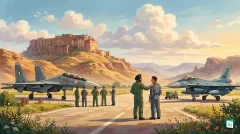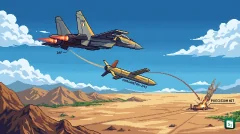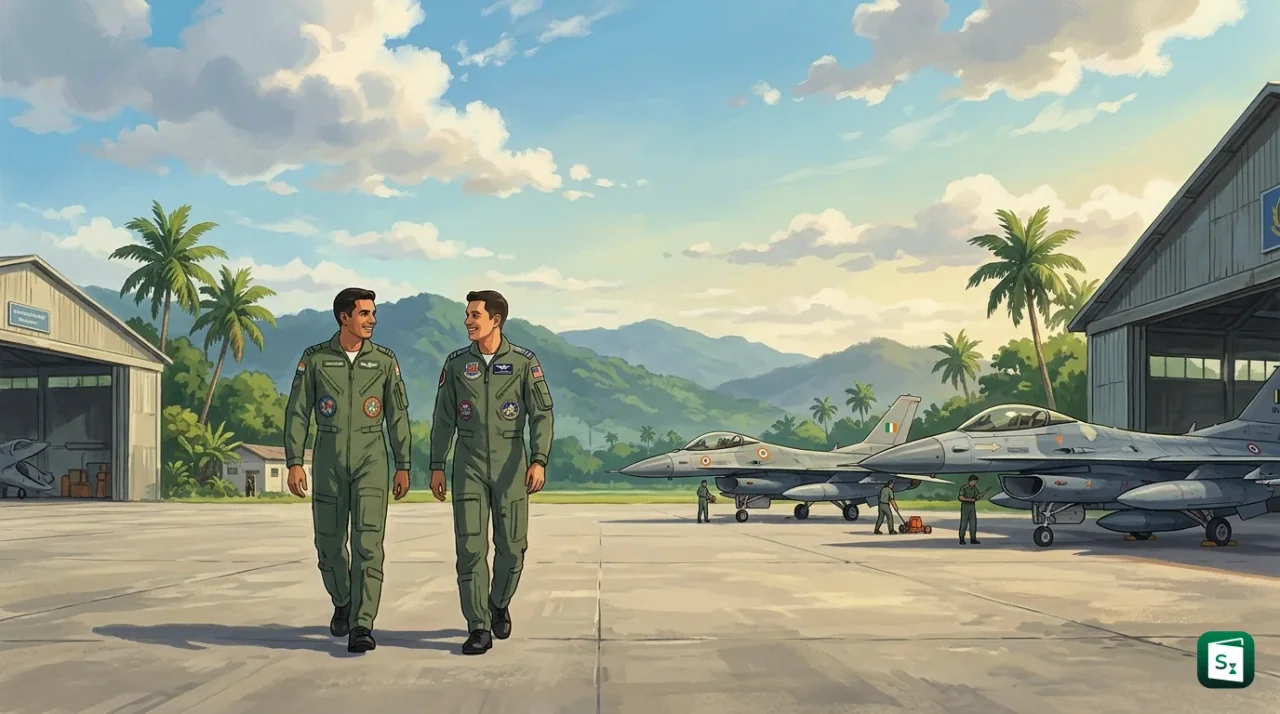
The 3rd edition of Exercise Udara Shakti, a bilateral air exercise between the Indian Air Force (IAF) and the Royal Malaysian Air Force (RMAF), commenced at Subang Air Base in Selangor, Malaysia, on 10 August 2026. The five-day exercise, running until 14 August, brings together 83 personnel and 11 aircraft across five platform types to sharpen interoperability and operational coordination between the two air forces. For the first time in this exercise series, the IAF has deployed its Rafale fighter jets, marking a significant upgrade in the complexity and scope of the bilateral engagement.
What Is Exercise Udara Shakti?
Exercise Udara Shakti is a biennial bilateral air exercise between the IAF and the RMAF, designed to build operational readiness, strengthen defence diplomacy, and deepen mutual trust between the two air forces. The name “Udara Shakti” translates to “Air Power” in Malay, reflecting the exercise’s focus on aerial combat capabilities and coordination.
The exercise is conducted as part of the broader framework of India-Malaysia defence cooperation, which covers all three services. At the army level, Exercise Harimau Shakti has been held since 2012, while the navies conduct Exercise Samudra Laksamana, first held in 2017. Together, these three bilateral exercises form the backbone of military ties between the two nations.
The current edition is being hosted at Subang Air Base in Selangor, which also houses the RMAF Air Warfare Centre. The opening ceremony on 10 August was jointly officiated by RMAF Exercise Director Colonel Shamsul Shahreen Isa and IAF Exercise Director Group Captain Parijat Jha, who symbolically pinned exercise patches to mark the start of the programme. The presence of Indian Defence Adviser Colonel Praveen Sukumaran underscored the diplomatic significance of the engagement.
Aircraft and Squadrons Deployed
The 2026 edition stands out for its platform diversity, combining Russian-designed, American-built, French-manufactured, and European transport aircraft within a compact bilateral training framework. A total of 11 aircraft across five distinct types are participating.
Indian Air Force Contingent
The IAF has deployed four Rafale fighters from No. 101 Squadron (“Falcons of Chamb and Akhnoor”) and two C-17 Globemaster III strategic transport aircraft from No. 81 Squadron. The 101 Squadron, based at Hasimara Air Force Station in West Bengal under the Eastern Air Command, was reactivated with Rafale aircraft in July 2021. It is the second IAF squadron to operate the Rafale, following the 17 Squadron “Golden Arrows” at Ambala.
The Dassault Rafale is a 4.5-generation omnirole fighter manufactured by Dassault Aviation of France. India signed a contract for 36 Rafales in September 2016 under a government-to-government deal worth approximately ₹59,000 crore. The aircraft is equipped with advanced avionics, the Meteor beyond-visual-range air-to-air missile, the SCALP air-to-ground cruise missile with a range exceeding 300 km, and the MICA multirole missile system. Its canard-delta wing configuration provides exceptional manoeuvrability and agility.
The C-17 Globemaster III, built by Boeing, is a heavy strategic airlifter capable of carrying up to 77 tonnes of cargo. It enables the IAF to project forces and equipment across intercontinental distances, making it essential for sustained overseas deployments like the one at Subang.
Royal Malaysian Air Force Contingent
The RMAF has committed two Su-30MKM fighters from No. 12 Squadron, two F/A-18D Hornet fighters from No. 18 Squadron, and one A400M transport aircraft from No. 8 Squadron.
The Sukhoi Su-30MKM is a variant of the Russian-built Su-30 family, specifically customised for Malaysia. It is a twin-engine, multirole air superiority fighter with thrust-vectoring engines and advanced radar systems. The RMAF’s Su-30MKM fleet has been a focal point of India-Malaysia defence ties, with both countries operating different variants of the same Su-30 platform (the IAF operates the Su-30MKI). A bilateral Su-30 Forum was established following Prime Minister Narendra Modi’s visit to Malaysia in February 2026, enabling both air forces to share technical expertise, maintenance protocols, and spare parts strategies.
The Boeing F/A-18D Hornet is a twin-seat, twin-engine multirole fighter of American origin. Its two-seat configuration allows a weapons systems officer to share workload with the pilot, providing an additional tactical dimension during complex missions.
The Airbus A400M is a European tactical and strategic airlifter that can also function as an aerial tanker. Its ability to operate from austere airfields while carrying significant payloads makes it a versatile asset for the RMAF, particularly across Southeast Asia’s vast maritime geography.
Key Training Activities
The flying phase of Exercise Udara Shakti 2026 was conducted from 11 to 13 August, covering a series of tactical training serials designed to test both air forces across multiple layers of airpower.
Dissimilar Air Combat Training
The centrepiece of the exercise is Dissimilar Air Combat Training (DACT) and Dissimilar Basic Fighter Manoeuvres (DBFM), which pit pilots against aircraft types they do not routinely encounter. In this edition, RMAF Su-30MKM and F/A-18D pilots are engaging against the Indian Rafale, an aircraft not present in Malaysia’s inventory.
This kind of training is valuable because it exposes pilots to contrasting aerodynamic performance, sensor behaviour, energy management, and tactical employment concepts. The Su-30MKM’s large twin-engine configuration and high manoeuvrability present Indian Rafale crews with a substantially different tactical problem compared to engagements with comparable lightweight fighters. Conversely, Malaysian crews must adapt to the Rafale’s canard-delta design and sensor-fusion philosophy.
Such exposure matters because future regional contingencies could require Indian and Malaysian forces to deconflict airspace, coordinate humanitarian operations, or support evacuations without sharing identical aircraft, datalinks, or command systems.
Air-to-Air Refuelling
The exercise also includes Air-to-Air Refuelling (AAR) serials, an operational-level capability that extends fighter endurance and mission range. Malaysia’s A400M can serve as both a transport and a tanker, allowing the RMAF to integrate combat aviation with an aircraft capable of moving personnel, equipment, and fuel across dispersed operating locations.
For India, practising AAR during an overseas deployment illustrates how fighter projection depends on airlift, technical personnel, spares, ground equipment, and carefully sequenced transit planning. The two C-17s accompanying the Rafale contingent are central to this sustainment chain.
Subject Matter Expert Exchange
The Subject Matter Expert Exchange (SMEE) programme, held on 12 August, is the non-flying component of the exercise. Officers and specialists from both air forces sit in structured briefing and discussion sessions to exchange technical knowledge on exercise design, collective training concepts, doctrine, scenario planning, and the application of science and technology in modern military training.
While the flying phase tests capability in the air, SMEE transfers knowledge on the ground. The output of these sessions stays with both air forces after the aircraft return to their home bases, whether in the form of refined training methods or aligned procedures. This component has been a consistent feature since the inaugural Udara Shakti in 2022.
A Look Back: History of India-Malaysia Air Exercises
Air training cooperation between the IAF and the RMAF began at Subang Air Base on 20 August 2018, when the two air forces conducted their first bilateral exercise. Known as Elang Shakti by the IAF and Exercise HOP by the RMAF, it ran from 20 to 23 August 2018. The IAF contingent comprised four Su-30MKI aircraft and two transport aircraft (a C-17 and a C-130J), which stopped over at Subang after participating in Exercise Pitch Black in Australia.
The training involved two RMAF Su-30MKMs and two IAF Su-30MKIs, with pilots from both sides given the opportunity to fly in each other’s aircraft. This cross-familiarisation laid the groundwork for the more structured Udara Shakti series that followed.
The inaugural Exercise Udara Shakti 2022 was held from 13 to 16 August at Kuantan Air Base. It involved four Su-30MKIs and two C-17s from the IAF, and four Su-30MKMs and one A400M from the RMAF, with approximately 200 participants. The Su-30MKIs were drawn from the IAF’s No. 20 Squadron.
The second edition, Udara Shakti 2024, took place at Kuantan from 5 to 9 August, with the IAF again participating with Su-30MKI fighters. The 2026 edition marks the first deployment of Rafale fighters in this exercise series and a return to Subang Air Base.
India-Malaysia Defence Cooperation: The Bigger Picture
Exercise Udara Shakti 2026 takes place against the backdrop of a rapidly deepening India-Malaysia strategic relationship. The two countries elevated their ties to a Comprehensive Strategic Partnership in August 2024 during Malaysian Prime Minister Anwar Ibrahim’s visit to India. Prime Minister Narendra Modi subsequently made an official visit to Malaysia from 7 to 8 February 2026, during which several defence-related outcomes were announced.
The joint statement issued after Modi’s meeting with Anwar Ibrahim welcomed the establishment of a Strategic Affairs Working Group (SAWG) and the Su-30 Forum, which enables both air forces to share technical expertise and maintenance protocols for their respective Su-30 variants. Defence industry cooperation has also expanded, with the annual Mini Defence Expo in Kuala Lumpur in February 2026 drawing participation from 12 Indian and 35 Malaysian defence companies.
Malaysia has also shown interest in the air-launched version of the BrahMos supersonic cruise missile, which is already integrated with the IAF’s Su-30MKI fleet. India has exported the ground-based BrahMos system to the Philippines, and reports indicate that Malaysia is considering the air-launched variant for integration with its Su-30MKM fleet.
The exercise also connects to India’s broader Act East Policy, which prioritises military engagement with Southeast Asia. The IAF contingent’s participation in Udara Shakti came during its transit back from Exercise Pitch Black 2026 in Australia, a multinational air combat exercise involving 20 nations. This pattern of combining transit deployments with bilateral training allows the IAF to extract maximum operational value from long-range overseas missions.
Strategic Significance for the Indo-Pacific
Exercise Udara Shakti operates as a form of defence diplomacy, developing familiarity and trust between two strategically autonomous air forces without constituting a formal alliance or permanent basing arrangement. For Kuala Lumpur, engagement with India broadens Malaysia’s portfolio of defence partners while preserving its diversified foreign policy. For New Delhi, the exercise extends Indian air power engagement into Southeast Asia, a region central to the Indo-Pacific security architecture.
The presence of Rafales, Su-30MKMs, and F/A-18Ds in a single exercise produces visible strategic signalling, demonstrating that Malaysia and India can convene advanced combat platforms without establishing a permanent combined force structure. While five training days and six fighters do not create collective defence guarantees, repeated exercises gradually reduce operational uncertainty and build the procedural familiarity needed for future cooperation in more demanding scenarios such as humanitarian assistance, disaster response, or maritime security operations.
The exercise also highlights a practical reality of modern air power: combat aircraft provide visible signalling, but transport capacity, maintenance depth, refuelling access, and trained ground teams determine whether that signalling can translate into sustained operational capability.
Key Takeaways
- Exercise Udara Shakti 2026 is the 3rd edition of the biennial bilateral air exercise between the IAF and the RMAF, held from 10 to 14 August at Subang Air Base, Malaysia.
- The IAF deployed four Rafale fighters from No. 101 Squadron and two C-17 Globemaster III transports from No. 81 Squadron, marking the first Rafale participation in this exercise series.
- The RMAF committed two Su-30MKM fighters from No. 12 Squadron, two F/A-18D Hornets from No. 18 Squadron, and one A400M transport from No. 8 Squadron.
- The exercise included Dissimilar Air Combat Training (DACT), Dissimilar Basic Fighter Manoeuvres (DBFM), Air-to-Air Refuelling (AAR), and a Subject Matter Expert Exchange (SMEE).
- India-Malaysia air cooperation began at Subang in 2018 as Exercise Elang Shakti (IAF) and Exercise HOP (RMAF); the Udara Shakti series started in 2022 at Kuantan Air Base.
- India and Malaysia elevated their ties to a Comprehensive Strategic Partnership in August 2024, and a bilateral Su-30 Forum was established during PM Modi’s visit to Malaysia in February 2026.