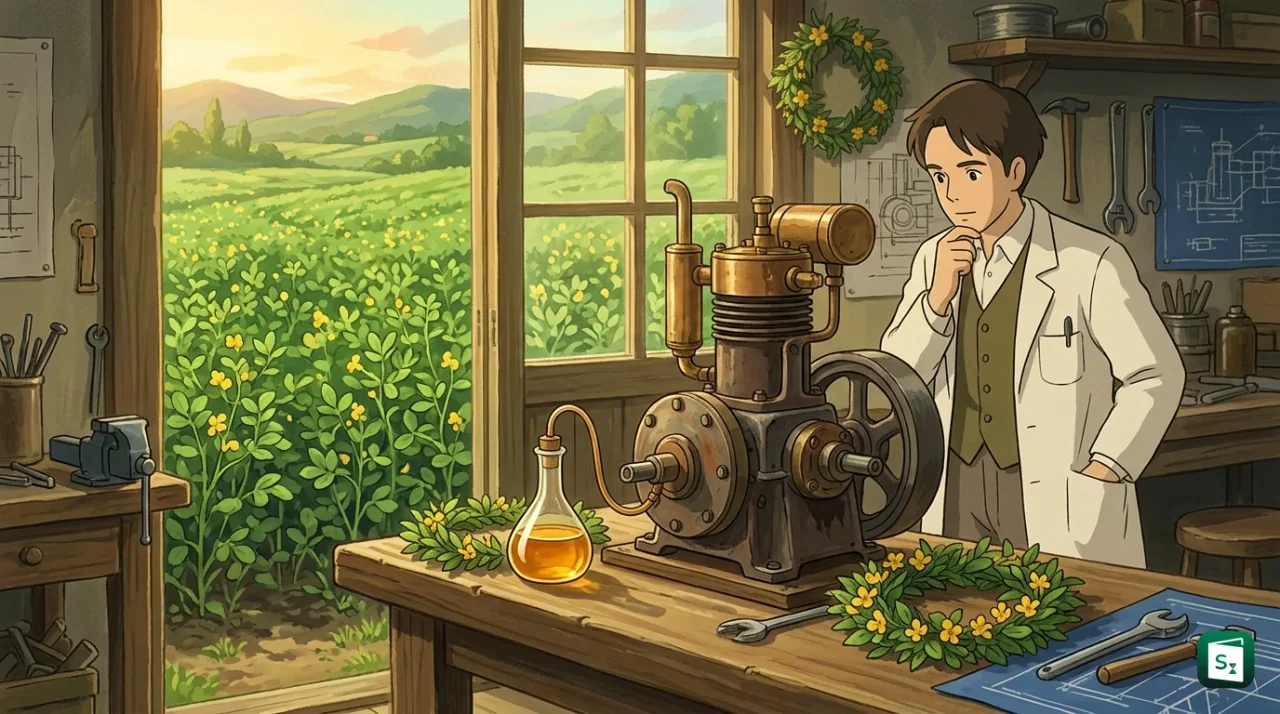
World Biofuel Day is observed every year on 10 August to raise awareness about biofuels as clean, renewable alternatives to fossil fuels. The day commemorates the successful first run of a diesel engine on peanut oil by German inventor Rudolf Diesel in 1893, an experiment that laid the conceptual groundwork for modern biofuel development. India\u2019s Ministry of Petroleum and Natural Gas (MoPNG) has been officially observing this day since 2015, spotlighting the country\u2019s ambitious push to reduce crude oil dependence through ethanol blending, compressed biogas, and other biofuel initiatives.
The Origin: Rudolf Diesel and the Peanut Oil Experiment
The story of World Biofuel Day goes back to 10 August 1893, when a 10-foot iron cylinder roared to life for the first time in Augsburg, Germany. The engine was the creation of Rudolf Diesel, a German mechanical engineer who had patented his compression-ignition engine design in 1892. What made this experiment remarkable was not just that the engine ran, but what fuel it ran on: peanut oil, a vegetable oil, instead of the petroleum distillate that would later become synonymous with diesel engines.
Diesel\u2019s experiment was not a one-off curiosity. At the 1900 Paris World Exposition (Exposition Universelle), a small Diesel engine built by the French Otto Company ran entirely on peanut oil at the request of the French Government. The French wanted to test whether groundnuts, which grew abundantly in their African colonies, could be used as a domestic power source, reducing dependence on imported coal or liquid fuel. Diesel later noted that the engine ran so smoothly that very few onlookers even noticed it was not running on mineral oil.
In a 1912 speech to the Institution of Mechanical Engineers in London, Diesel famously predicted: \u201cthe use of vegetable oils for engine fuels may seem insignificant today but such oils may become, in the course of time, as important as petroleum and the coal-tar products of the present time.\u201d That prediction proved remarkably prescient. Today, biofuels derived from agricultural biomass, waste oils, and organic matter form a critical pillar of the global clean energy transition.
What Are Biofuels?
Biofuels are fuels produced from biological materials, unlike conventional fossil fuels which come from ancient organic matter buried underground for millions of years. They are renewable, biodegradable, and can be derived from a wide range of sources including sugarcane, corn, agricultural residues, used cooking oil, animal fats, algae, and municipal solid waste. Because the carbon dioxide released when biofuels are burned is roughly equivalent to what the source plants absorbed during growth, they are considered a lower-carbon alternative to petroleum-based fuels.
Biofuels are classified into three generations based on the feedstock and production technology used:
- First Generation (1G): Produced from food crops such as sugarcane, corn, and vegetable oils. Ethanol (from sugarcane or grain) and biodiesel (from vegetable oils or animal fats) fall under this category. These are the most commercially mature biofuels and form the backbone of India\u2019s current blending programme.
- Second Generation (2G): Made from non-food biomass such as agricultural residues (rice straw, wheat straw, corn stover), forestry waste, and municipal solid waste. These avoid the food-versus-fuel conflict and are a key focus area for India\u2019s future biofuel production.
- Third Generation (3G): Derived from algae and other microorganisms. These are still largely at the research and development stage but hold enormous potential because algae can produce significantly more oil per hectare than any terrestrial crop.
India\u2019s National Policy on Biofuels, 2018, categorises biofuels as \u201cBasic Biofuels\u201d (1G ethanol and biodiesel) and \u201cAdvanced Biofuels\u201d (2G ethanol, bio-CNG, 3G biofuels, and drop-in fuels), with different financial and fiscal incentives for each category to encourage investment across the spectrum.
India\u2019s Journey: From Policy to Progress
India is the third-largest consumer of crude oil in the world, after the United States and China, and imports over 85% of its crude oil requirements. This heavy reliance on imported oil makes the country vulnerable to global price volatility and geopolitical disruptions. Biofuels offer a strategic pathway to reduce this dependence while simultaneously supporting farmer incomes, managing agricultural waste, and meeting climate commitments.
The government\u2019s journey in promoting biofuels gained serious momentum after 2014. The Ethanol Blending Programme (EBP), which began as a modest initiative, was given a major push with streamlined procurement procedures, administrative pricing mechanisms for ethanol, and long-term procurement policies for oil marketing companies (OMCs). Ethanol procurement rose from 38 crore litres in the Ethanol Supply Year (ESY) 2013-14 to 408 crore litres by ESY 2021-22, a more than tenfold increase.
The landmark moment came in June 2018, when the Union Cabinet approved the National Policy on Biofuels. This policy set ambitious targets: 20% ethanol blending and 5% biodiesel blending by 2030. In May 2022, the policy was amended to advance the ethanol blending target by five years, moving the deadline from ESY 2030 to ESY 2025-26. India achieved this 20% ethanol blending target by 2025, five years ahead of the original schedule, marking a significant milestone in the country\u2019s clean energy journey.
Key Government Initiatives Driving India\u2019s Biofuel Programme
India\u2019s biofuel ecosystem is supported by a range of government schemes and programmes, each targeting a different aspect of production, procurement, and awareness.
Ethanol Blending Programme (EBP)
The EBP is the flagship initiative under which ethanol is blended with petrol to reduce fossil fuel consumption. The programme covers the entire country and is implemented through public sector OMCs (Indian Oil Corporation, Bharat Petroleum Corporation, and Hindustan Petroleum Corporation). The government also reduced the Goods and Services Tax (GST) on ethanol meant for blending from 18% to 5% to make it economically viable. The supply chain has expanded from cane molasses and juice to include rice, damaged grains, maize, and millets as feedstock sources.
SATAT Initiative
Launched on 1 October 2018, the Sustainable Alternative Towards Affordable Transportation (SATAT) initiative aims to establish an ecosystem for producing Compressed Bio Gas (CBG) from various waste and biomass sources. Under SATAT, entrepreneurs are encouraged to set up CBG production plants, with the produced fuel marketed through OMCs as a green transport fuel. The target was to set up 5,000 Bio-CNG plants with a production capacity of 15 million metric tonnes by 2023-24.
PM JI-VAN Yojana
The Pradhan Mantri JI-VAN (Jaiv Indhan) Yojana, launched in March 2019, provides financial support for setting up Second Generation (2G) ethanol projects using lignocellulosic biomass and other renewable feedstocks. The scheme envisions about 12 commercial-scale and 10 demonstration-scale advanced biofuel projects across the country, with financial support of \u20b91,800 crore for commercial projects and \u20b9150 crore for demonstration projects.
GOBAR-DHAN Scheme
The Galvanising Organic Bio-Agro Resources Dhan (GOBAR-DHAN) scheme, launched in April 2018 under the Swachh Bharat Mission (Grameen), focuses on converting cattle dung and solid farm waste into biogas and compost. It provides financial assistance of up to \u20b950 lakh per district for setting up cluster or community-level biogas plants, helping villages manage organic waste while generating clean energy and organic manure.
Global Biofuels Alliance (GBA)
On 9 September 2023, on the sidelines of the G20 Summit in New Delhi, Prime Minister Narendra Modi launched the Global Biofuels Alliance along with leaders of the USA, Brazil, Italy, Argentina, Singapore, Bangladesh, Mauritius, and the UAE. The alliance aims to facilitate international cooperation, promote sustainable biofuel trade, share policy best practices, and provide technical support for national biofuel programmes worldwide. It mirrors the success of the International Solar Alliance (ISA), which India co-launched with France in 2015. As of its launch, 24 countries and 12 international organisations had agreed to join the GBA.
The Impact: What Biofuels Mean for India
The benefits of India\u2019s biofuel push extend far beyond simply replacing imported fuel. They create a ripple effect across multiple sectors of the economy and society.
Energy Security
With India importing over 85% of its crude oil, every litre of ethanol blended into petrol directly reduces the import bill. The government has estimated that the ethanol blending programme helped save foreign exchange worth approximately \u20b94,000 crore annually in its early years, a figure that has grown substantially as blending volumes increased. India\u2019s 2070 Net Zero target, announced at COP26 in Glasgow in 2021, makes the transition to domestic biofuels a strategic imperative rather than just an economic preference.
Farmer Income and Rural Economy
Biofuel production has created a direct cash flow link between the energy sector and the agricultural community. Sugarcane farmers benefit from the sale of ethanol to OMCs, while rice and maize farmers now have a new market for surplus and damaged grains. During ESY 2021-22, approximately \u20b925,750 crore worth of ethanol was purchased, a large share of which went directly to farmers. The SATAT and GOBAR-DHAN schemes have additionally created rural employment opportunities in waste collection, biogas plant operation, and organic fertiliser production.
Environmental Benefits
By replacing fossil fuels with biofuels, India reduces vehicular carbon emissions and improves urban air quality. The 2G ethanol plant at Panipat, Haryana, dedicated to the nation by Prime Minister Modi on World Biofuel Day 2022, processes approximately 2 lakh tonnes of rice straw annually, producing around 3 crore litres of ethanol. By preventing the burning of crop residue, this single plant reduces greenhouse gas emissions equivalent to removing nearly 63,000 cars from the road each year. The RUCO (Repurpose Used Cooking Oil) initiative similarly channels used cooking oil from hotels and restaurants into biodiesel production, turning waste into fuel while improving food safety.
Challenges on the Road
Despite impressive progress, India\u2019s biofuel programme faces several challenges that need to be addressed for sustained growth.
The food versus fuel debate remains a sensitive issue. When food crops like rice, maize, or sugarcane are diverted to ethanol production, it can affect food prices and availability. This is precisely why the government has expanded feedstock options to include damaged grains, surplus rice, and agricultural residues, and is investing in 2G technology that uses non-food biomass. However, the transition from 1G to 2G production at scale is still underway.
Blending infrastructure remains uneven across the country. While urban areas have widespread access to ethanol-blended petrol, rural and remote regions still face supply chain gaps. Similarly, the network of CBG stations under the SATAT initiative is still being built out, and achieving the target of 5,000 plants requires sustained private investment and state-level coordination.
The higher cost of second-generation technology compared to conventional fuel production is another barrier. Advanced biofuel projects require significant capital investment, and the economic viability depends on supportive pricing mechanisms, viability gap funding, and stable long-term policies. The government has indicated willingness to extend financial incentives including tax credits, advance depreciation, and differential pricing for 2G ethanol vis-\u00e0-vis 1G ethanol to address this gap.
Key Takeaways
- World Biofuel Day is observed on 10 August every year to raise awareness about biofuels as clean and renewable alternatives to fossil fuels.
- The day commemorates the first successful run of a diesel engine on peanut oil by German inventor Rudolf Diesel on 10 August 1893 in Augsburg, Germany.
- India\u2019s Ministry of Petroleum and Natural Gas (MoPNG) has been officially observing World Biofuel Day since 2015.
- The National Policy on Biofuels, 2018 (amended in 2022) set a target of 20% ethanol blending in petrol, which India achieved by 2025, five years ahead of the original 2030 deadline.
- The Global Biofuels Alliance (GBA) was launched on 9 September 2023 on the sidelines of the G20 Summit in New Delhi, with 24 countries and 12 international organisations as founding members.
- Key government initiatives include the Ethanol Blending Programme (EBP), SATAT (Compressed Biogas), PM JI-VAN Yojana (2G ethanol), and GOBAR-DHAN (waste-to-energy).