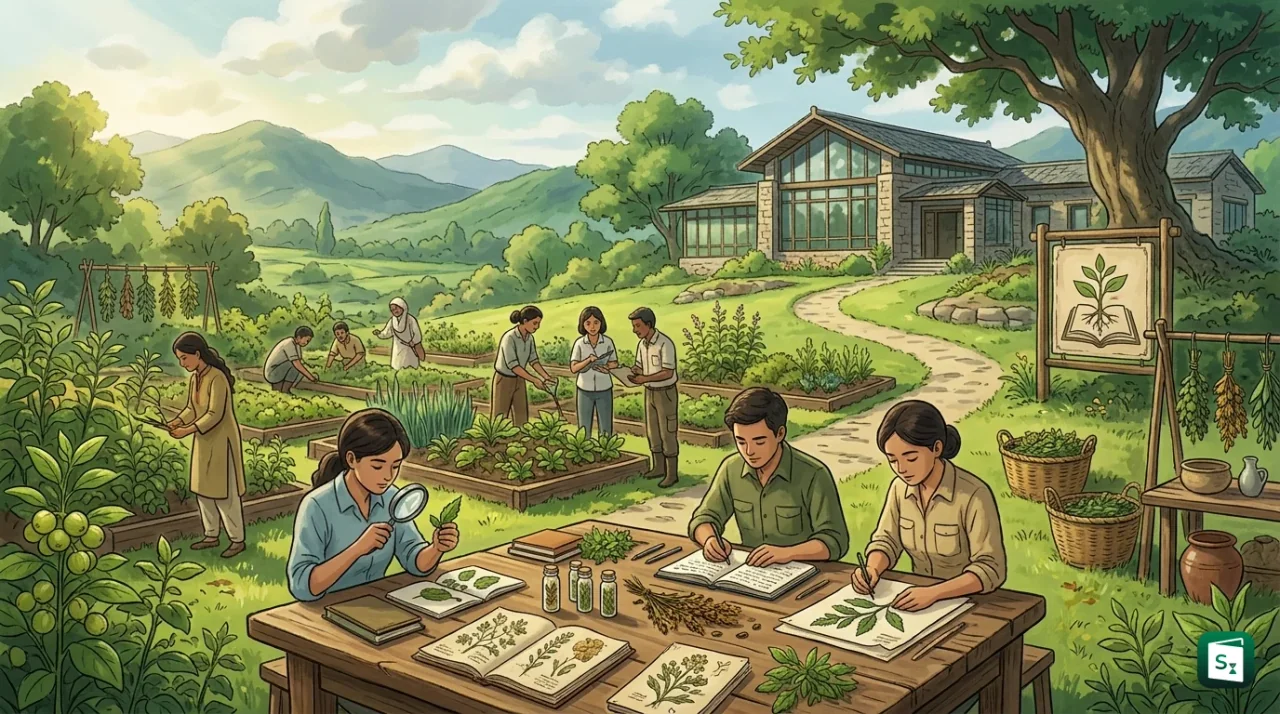
On 12 August 2026, the Pharmacopoeia Commission for Indian Medicine and Homoeopathy (PCIM&H) and the Indian Pharmacopoeia Commission (IPC) renewed their Memorandum of Understanding (MoU) for a further three years to continue the “One Herb, One Standard” initiative. The agreement, exchanged at Kartavya Bhavan in New Delhi, was signed by PCIM&H Director-in-Charge Dr Kousthubha Upadhyaya and IPC Secretary-cum-Scientific Director Dr V. Kalaiselvan in the presence of Union Minister of State (Independent Charge) for AYUSH Prataprao Jadhav and AYUSH Secretary Vaidya Rajesh Kotecha. The renewed partnership builds on a 2022 inter-ministerial pact that produced 50 harmonised monographs of medicinal plants and now aims to expand uniform quality standards across Ayurveda, Siddha, Sowa-Rigpa, Unani and Homoeopathy.
What Is the “One Herb, One Standard” Initiative?
India recognises five traditional systems of medicine: Ayurveda, Siddha, Sowa-Rigpa, Unani and Homoeopathy. Each system has its own pharmacopoeia, a collection of official drug-quality standards. Before the “One Herb, One Standard” initiative was launched in 2022, a single medicinal plant could carry different quality parameters depending on which pharmacopoeia governed it. This created confusion for manufacturers, exporters, testing laboratories and regulators.
The initiative seeks to establish a single, scientifically validated quality standard for the same medicinal plant, regardless of which traditional system uses it. A monograph, the core output of this effort, is a formal reference document that specifies a drug’s identity, purity, strength, analytical methods, contaminants limits and storage conditions. When a herb like Ashwagandha (Withania somnifera) appears in both the Ayurvedic Pharmacopoeia of India (API) and the Indian Pharmacopoeia (IP), the aim is to ensure that both references prescribe identical testing protocols and acceptance criteria.
The initiative is an inter-ministerial collaboration between PCIM&H under the Ministry of AYUSH and the IPC under the Ministry of Health and Family Welfare. The original MoU was signed on 30 August 2022 to promote this harmonisation and to bring Indian quality standards in line with global benchmarks.
Phase I Achievements: 50 Monographs
The first phase of the initiative, which ran from 2022 to 2025, achieved a significant milestone. PCIM&H and IPC jointly developed 50 monographs of medicinal plants used across traditional medicine systems. Each monograph specifies the plant’s botanical identity, marker compounds, identification tests, assay methods, contaminant limits and storage conditions.
These monographs carry the same legal sanctity as those published in the ASU&H (Ayurveda, Siddha, Unani and Homoeopathy) pharmacopoeias and the Indian Pharmacopoeia. A joint committee was constituted for selecting medicinal plants and their constituent markers, ensuring that the standards reflected both Indian requirements and international quality expectations.
The development process involved sharing scientific information, drug raw materials and extracts between the two institutions. Workshops, seminars and training programmes supported the collaboration. The sole authority for publishing monographs under the “One Herb, One Standard” banner rests with PCIM&H, while the IPC’s contribution is formally recognised in each published monograph.
What the Renewed MoU Envisages
The renewed three-year MoU builds on the foundation laid during Phase I and expands the scope of standardisation in several key areas.
Harmonised Standards Across Five Systems
Under the renewed framework, the two institutions will develop uniform, reliable and scientifically robust quality standards for single drugs of plant origin used across Ayurveda, Siddha, Sowa-Rigpa, Unani and Homoeopathy. The goal is to harmonise standards for the same medicinal plant across different traditional systems, reducing ambiguity among stakeholders.
Alignment with International Benchmarks
Each new monograph will incorporate both Indian standards and international quality requirements. This dual approach ensures that Indian medicinal plants meet the regulatory expectations of major global markets. The IPC has already received observer status at the European Directorate for the Quality of Medicines (EDQM) and the European Pharmacopoeia (EP), and several IP monographs have been adopted into the British Pharmacopoeia, European Pharmacopoeia and United States Pharmacopoeia.
Expanded Monograph Development
While Phase I produced 50 monographs, the renewed partnership aims to develop a larger set of harmonised monographs. Officials indicated that the next phase will focus on strengthening quality assurance for plant-based medicines and expanding the standardisation framework to cover a wider range of medicinal plants.
Streamlined Testing Protocols
A harmonised monograph provides a single reference standard for testing laboratories, regulators and manufacturers. This eliminates the need to follow conflicting analytical requirements when the same herb is tested under different pharmacopoeias, simplifying compliance and reducing costs.
The Two Institutions Behind the Initiative
Pharmacopoeia Commission for Indian Medicine and Homoeopathy (PCIM&H)
PCIM&H is a subordinate office under the Ministry of AYUSH. It was initially established on 18 August 2010 as the Pharmacopoeia Commission for Indian Medicine (PCIM), an autonomous body registered under the Societies Registration Act, 1860. In 2014, Homoeopathy was incorporated and the Commission was renamed PCIM&H. In 2020, the Union Cabinet approved its re-establishment as a subordinate office by merging into it two central laboratories: the Pharmacopoeia Laboratory for Indian Medicine (PLIM) and the Homoeopathic Pharmacopoeia Laboratory (HPL), both established at Ghaziabad in 1975.
PCIM&H is responsible for developing pharmacopoeial standards for Ayurvedic, Unani, Siddha and Homoeopathic drugs. It also serves as the Central Drug Testing and Appellate Laboratory for Indian systems of medicine. The Commission consolidated the work of four earlier pharmacopoeia committees: the Ayurvedic Pharmacopoeia Committee (set up in 1962), the Siddha Pharmacopoeia Committee (1975), the Unani Pharmacopoeia Committee (1964) and the Homoeopathic Pharmacopoeia Committee (1962). Since its merger restructuring, PCIM&H has published over 2,199 quality standards on raw materials and 405 quality standards of ASU&H formulations across various pharmacopoeias.
Indian Pharmacopoeia Commission (IPC)
The IPC is an autonomous institution under the Ministry of Health and Family Welfare, headquartered in Ghaziabad, Uttar Pradesh. It was established in 1956 under the Drugs and Cosmetics Act, 1940 and became fully operational as an autonomous body on 1 January 2009. The IPC’s mandate is to publish and regularly update the Indian Pharmacopoeia (IP), the official book of drug standards in India.
The IPC publishes herbal drug monographs that include details on botanical identity, marker compound limits, identification tests, assay techniques using High-Performance Thin-Layer Chromatography (HPTLC) fingerprinting and High-Performance Liquid Chromatography (HPLC), contaminant testing and storage conditions. The current official edition is the ninth edition of the IP, published in 2022. The IPC has published over 150 herbal monographs and continues to expand its coverage at approximately 10 per cent per year.
Why Uniform Standards Matter for India’s Traditional Medicine
India’s AYUSH sector has grown rapidly, with the domestic market size estimated at ₹1,28,000 crore (approximately $15.5 billion) in 2022. The country has nearly 9,500 registered herbal industries and a large number of unregistered cottage-level units, all depending on a steady supply of medicinal plants. More than 6,000 higher plant species are used in India’s codified and folk healthcare traditions, and about 70 per cent of the country’s population relies on plant-based healthcare at some level.
The Problem of Multiple Standards
Before the initiative, the same medicinal plant could have different quality standards in the Ayurvedic Pharmacopoeia of India, the Siddha Pharmacopoeia of India, the Unani Pharmacopoeia of India, the Homoeopathic Pharmacopoeia of India and the Indian Pharmacopoeia. Different analytical methods, different marker compound limits and different testing protocols created ambiguity. Manufacturers had to comply with multiple sets of requirements for a single herb. Exporters faced additional complexity when international buyers demanded standards that did not align with any single Indian pharmacopoeia.
Benefits for Manufacturers and Exporters
Harmonised standards reduce this burden. A single, scientifically validated set of specifications allows manufacturers to produce medicines that satisfy all regulatory requirements simultaneously. For exporters, alignment with global benchmarks such as those in the European Pharmacopoeia and United States Pharmacopoeia improves market access. The AYUSH and herbal exports sector has shown steady growth, with exports of medicinal and aromatic plants recording a compound annual growth rate of 6.45 per cent between 2014 and 2020, and India accounting for approximately 11.2 per cent of global exports in this segment.
Conservation of Medicinal Plant Resources
Uniform standards also support the conservation of India’s biodiversity. When quality parameters are clearly defined, there is greater incentive to source plants from regulated cultivation rather than wild harvesting. The National Medicinal Plants Board (NMPB) has estimated that the annual demand for botanical raw drugs in India is approximately 3,19,500 metric tonnes. Many wild medicinal plant populations face extinction pressure from indiscriminate harvesting, and standardised cultivation protocols linked to pharmacopoeial standards help address this challenge.
Global Alignment and Export Potential
The global market for herbal medicines was valued at approximately $70.57 billion in 2023 and is projected to reach $90.24 billion by 2030. India, with its rich biodiversity of over 7,500 medicinal plant species and deep traditional knowledge systems, is well positioned to capture a larger share of this expanding market.
Harmonisation as a Non-Tariff Trade Enabler
Non-tariff barriers, particularly differences in quality standards and testing requirements, are among the biggest obstacles for Indian herbal product exporters. Many countries require compliance with pharmacopoeial standards that differ from Indian specifications. By aligning the ASU&H pharmacopoeias with the Indian Pharmacopoeia and incorporating international quality parameters, the “One Herb, One Standard” initiative directly addresses this gap.
The initiative also supports India’s broader goals under the Aatmanirbhar Bharat vision. When domestic standards meet international benchmarks, Indian manufacturers gain the confidence to compete in global markets without depending on foreign certification bodies. The harmonised monographs will have the same legal sanctity as those in the ASU&H pharmacopoeias and the IP, giving manufacturers a single, authoritative reference.
Phytopharmaceuticals and Value-Added Exports
India’s phytopharmaceutical and herbal extract sector contributed approximately $5.6 billion annually to the national GDP as of 2023 and generated over 1.2 million direct and indirect jobs. Standardised monographs enable manufacturers to shift from exporting raw materials to higher-value processed products such as standardised extracts, phytopharmaceutical drugs and nutraceuticals. This transition is critical because raw material exports command lower margins while value-added products attract premium prices in international markets.
Strengthening India’s Global Position
India currently ranks as one of the top exporters of Medicinal and Aromatic Plants (MAPs), accounting for approximately 11.2 per cent of global MAP exports in 2020. The country recorded a compound annual growth rate of 6.45 per cent in MAP exports between 2014 and 2020, outpacing China’s negative growth of 4.9 per cent in the same period. By establishing scientifically robust and globally aligned standards, India reinforces its position as a trusted standard-setter in the traditional medicine space, complementing its efforts through the Traditional Knowledge Digital Library (TKDL) to protect against biopiracy.
Key Takeaways
- The MoU between PCIM&H and IPC was renewed on 12 August 2026 for a further three years to continue the “One Herb, One Standard” initiative.
- The initiative aims to establish a single, scientifically validated quality standard for the same medicinal plant across Ayurveda, Siddha, Sowa-Rigpa, Unani and Homoeopathy.
- During Phase I (2022 to 2025), the two institutions jointly developed 50 monographs of medicinal plants.
- PCIM&H, established in 2010 and restructured in 2020, operates under the Ministry of AYUSH and serves as the Central Drug Testing and Appellate Laboratory for Indian systems of medicine.
- IPC, established in 1956 and headquartered in Ghaziabad, is an autonomous body under the Ministry of Health and Family Welfare that publishes the Indian Pharmacopoeia.
- The harmonised monographs will incorporate international quality requirements to improve the global acceptance of Indian medicinal plants and traditional medicine products.