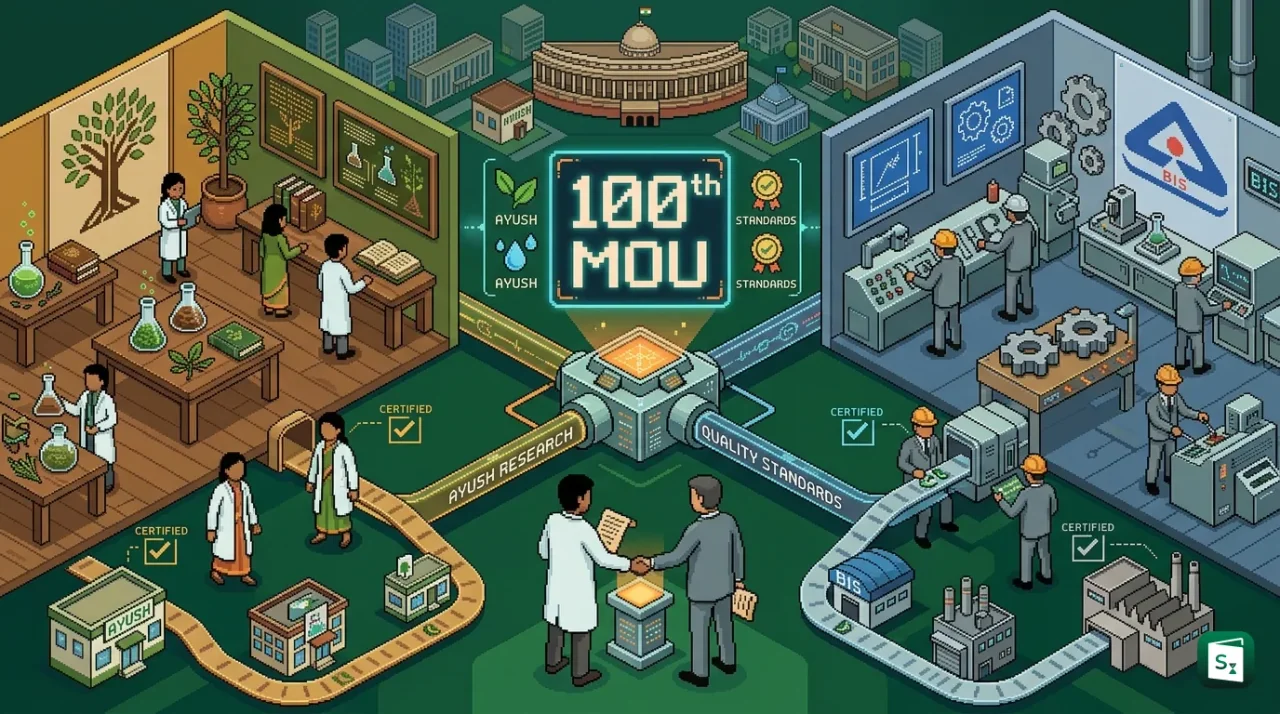
The Central Council for Research in Ayurvedic Sciences (CCRAS) and the Bureau of Indian Standards (BIS) signed a Memorandum of Understanding (MoU) in New Delhi on 7 August 2026 to jointly develop globally benchmarked quality standards for Ayurveda and other traditional medicine systems. The agreement covers quality standards, conformity assessment, scientific research, and capacity building across the AYUSH sector. This is the 100th MoU signed by BIS and its first with any organisation under the Ministry of AYUSH, marking a significant step toward bringing scientific rigour to India’s traditional healthcare systems.
What Is the CCRAS-BIS MoU About?
The MoU establishes a collaborative framework between CCRAS and BIS to develop quality standards, strengthen laboratory quality and conformity assessment mechanisms, and promote scientific validation of traditional medicine knowledge. The partnership aims to produce globally benchmarked standards for Ayurvedic products, practices, and research, making them safer, scientifically validated, and internationally accepted.
Under the agreement, CCRAS scientists will participate actively in the formulation of Indian Standards for Ayurveda. This involvement is expected to accelerate the standards development process by bringing in deep domain expertise from one of India’s foremost Ayurvedic research institutions. The collaboration also covers the use of CCRAS’s research network, which includes institutions and laboratories that hold National Accreditation Board for Testing and Calibration Laboratories (NABL) and ISO accreditation.
The MoU was signed by Prof. (Vaidya) Rabinarayan Acharya, Director General of CCRAS, and Sanjay Pant, Deputy Director General (Standardisation-II) of BIS, in the presence of Vaidya Rajesh Kotecha, Secretary of the Ministry of AYUSH.
About CCRAS and BIS
CCRAS: India’s Apex Ayurvedic Research Body
The Central Council for Research in Ayurvedic Sciences (CCRAS) is an autonomous body under the Ministry of AYUSH, Government of India. It was first conceived in 1946 and formally established as an advisory body in 1962. Over the decades, it evolved from a small advisory council into India’s apex research institution dedicated to the scientific exploration of Ayurveda.
In 1978, it was redesignated as the Central Council for Research in Ayurveda and Siddha after a reorganisation. In 2010, the Central Council for Research in Siddha (CCRS) became a separate entity, and CCRAS was given the additional mandate of research on the Sowa-Rigpa system of medicine. In 2011, it was renamed the Central Council for Research in Ayurvedic Sciences.
Today, CCRAS operates through a network of 30 peripheral research institutes and centres across the country. Its work spans clinical research, medicinal plant research, drug standardisation, pharmacological research, and literary research and documentation. It also runs flagship training programmes such as the PG-STAR (Scheme for Training in Ayurveda Research for Post-Graduate Scholars) and SPARK (Studentship Program for Ayurveda Research Ken).
BIS: India’s National Standards Body
The Bureau of Indian Standards (BIS) is India’s national standards body, established under the Bureau of Indian Standards Act, 2016 (which came into effect on 12 October 2017). It replaced the earlier Bureau of Indian Standards Act, 1986, and functions under the Department of Consumer Affairs, Ministry of Consumer Affairs, Food and Public Distribution.
BIS is responsible for the harmonious development of standardisation, marking, and quality certification of goods, processes, and services. It has 25 members drawn from central and state governments, industry, scientific and research institutions, and consumer organisations. Its headquarters are in New Delhi, with regional offices in Kolkata, Chennai, Mumbai, Chandigarh, and Delhi.
In August 2024, BIS created a dedicated AYUSH Department to fast-track standardisation in the traditional medicine sector. This department has formed seven sectional committees, each addressing a specific AYUSH system. The Ayurveda Sectional Committee alone currently manages 128 Indian Standards, while 243 standards covering different AYUSH domains have been developed over the past three years.
Significance for the AYUSH Sector
The AYUSH sector in India has grown rapidly in recent years. According to the Ministry of AYUSH, the market size of the AYUSH industry expanded from approximately $2.85 billion in 2014-15 to $23.3 billion by 2022. By 2026, the India AYUSH and alternative medicine market is estimated to be worth $26.53 billion. This explosive growth has created an urgent need for robust quality standards and regulatory frameworks.
Currently, around 6,998 registered Ayurvedic manufacturing units operate out of a total of 7,914 licensed AYUSH, Unani, and Homoeopathic pharmacies in India. However, roughly 4,200 micro and small units still do not meet the World Health Organization’s Good Manufacturing Practices (WHO-GMP) thresholds for air-handling, in-process validation, and residual solvent testing. The lack of uniform quality standards has been a persistent challenge, both for domestic consumer safety and for international market acceptance.
The CCRAS-BIS partnership directly addresses this gap. By involving CCRAS’s scientific expertise in the standards development process, the MoU aims to ensure that Indian Standards for Ayurveda are rooted in rigorous clinical evidence rather than being purely procedural. This is particularly important for categories such as herbal formulations, raw drug quality, and diagnostic terminology, where traditional knowledge and modern scientific validation must work together.
BIS Deputy Director General Sanjay Pant noted that the participation of CCRAS scientists will “strengthen and accelerate the formulation of Indian Standards for Ayurveda.” The collaboration is also expected to enhance India’s voice in international standardisation forums, particularly at the International Organization for Standardization (ISO), where BIS recently proposed the creation of a new subcommittee on Ayurveda and Yoga under ISO TC 249 (Traditional Chinese Medicine).
India’s Push for Global Ayurveda Standards
The MoU comes at a time when India is aggressively pushing for global acceptance of its traditional medicine systems. The WHO has estimated that approximately 80% of the global population across 170 countries uses some form of traditional medicine. Ayurveda, in particular, has gained recognition in over 25 countries as a legally recognised traditional medicine system.
India’s Ministry of AYUSH has been building institutional infrastructure to support this global push. The WHO Global Traditional Medicine Centre in Jamnagar, Gujarat, is being upgraded to serve as a hub for global research and training. The Ayush Export Promotion Council, registered in January 2022, is working to overcome regulatory barriers in overseas markets. The Ministry has also signed MoUs with institutions like the London School of Hygiene and Tropical Medicine and the Frankfurter Innovationszentrum Biotechnologie GmbH in Germany for clinical research on Ayurveda.
The Union Budget 2026-27 further strengthened this trajectory by proposing the establishment of three new All India Institutes of Ayurveda and five Regional Medical Hubs that will integrate AYUSH centres with modern diagnostics. The government has allocated ₹3,992.90 crore to the Ministry of AYUSH for the current fiscal year, up from the revised estimate of ₹3,497.64 crore in 2025-26.
Standardisation is the critical bridge between India’s traditional knowledge and global market access. Without internationally recognised quality benchmarks, Indian AYUSH products face regulatory barriers in markets like the European Union and the United States. The CCRAS-BIS collaboration is designed to fill precisely this gap, ensuring that Ayurvedic products and practices meet the same rigour expected of modern pharmaceutical products.
Key Takeaways
- The CCRAS-BIS MoU was signed on 7 August 2026 in New Delhi, marking the 100th MoU signed by BIS and its first with an AYUSH organisation.
- CCRAS (Central Council for Research in Ayurvedic Sciences) was formally established in 1962 as an autonomous body under the Ministry of AYUSH and operates 30 peripheral research institutes across India.
- BIS (Bureau of Indian Standards) is the national standards body established under the BIS Act, 2016, headquartered in New Delhi, with 25 members drawn from government, industry, and research institutions.
- The BIS Ayurveda Sectional Committee currently manages 128 Indian Standards, while 243 standards across all AYUSH domains have been developed in the past three years.
- India’s AYUSH industry market size grew from $2.85 billion in 2014-15 to $23.3 billion by 2022, with the country home to 6,998 registered Ayurvedic manufacturing units.
- The Ministry of AYUSH was elevated from a department to a full ministry in November 2014 and received an allocation of ₹3,992.90 crore in the Union Budget 2026-27.