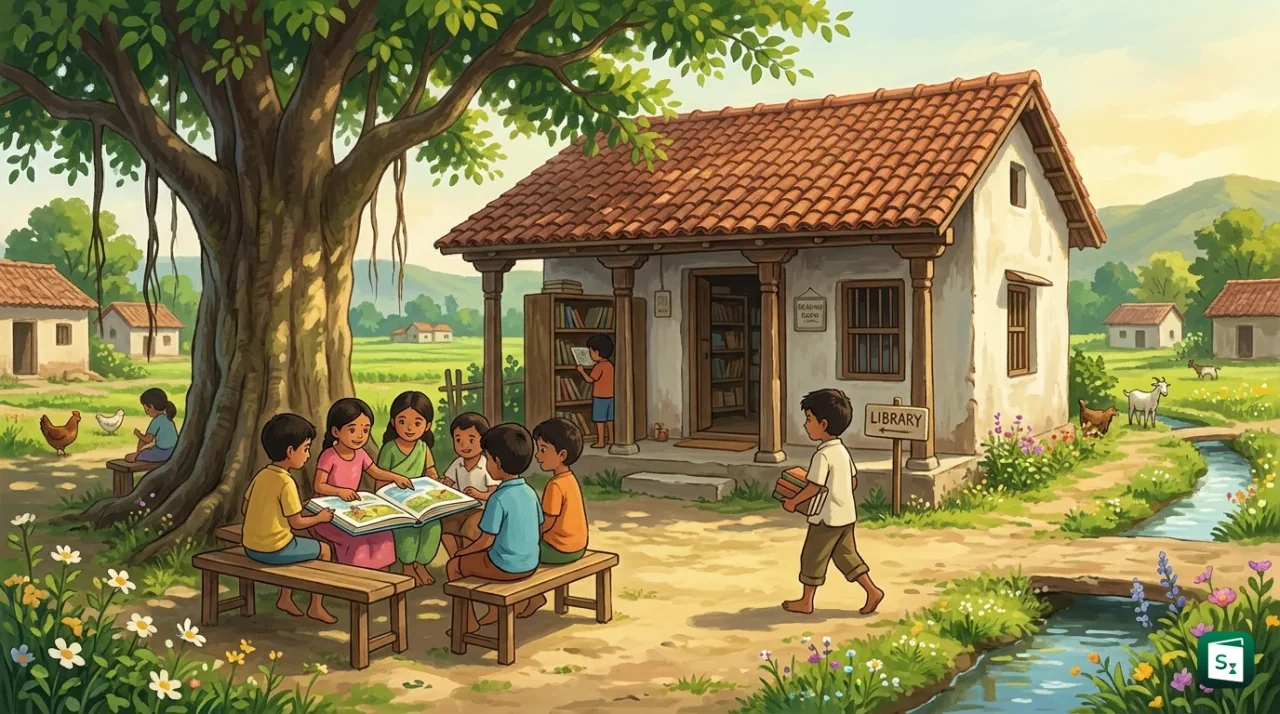
Union Home Minister Amit Shah launched the Gramin Gyan Setu mobile application on 12 August 2026, the occasion of National Library Day, through video conferencing from New Delhi. The app is designed to digitally interconnect libraries across the Gandhinagar Lok Sabha constituency in Gujarat, with the goal of establishing a library in every village and encouraging reading habits among children. The initiative links 752 libraries to a centralised digital network, giving rural readers access to a combined collection of 2.8 lakh books.
What Is Gramin Gyan Setu?
Gramin Gyan Setu, which translates to “Rural Knowledge Bridge,” is a mobile application that creates a digital network linking small village libraries with larger central libraries. The app was developed to solve a simple but widespread problem: rural villages often have small libraries with limited books, while larger towns hold far bigger collections. By connecting them digitally, a child in a remote village can now request and receive books from a central library without travelling long distances.
The initiative was proposed by Amit Shah, who represents the Gandhinagar Lok Sabha constituency in Gujarat. It was subsequently developed and implemented by the Gujarat state government under Chief Minister Bhupendra Patel, who integrated it with a more structured digital approach. Within three months of its rollout, 752 libraries across the constituency were connected to the app.
As part of the project, 63 small village libraries have been established across the Gandhinagar, Kalol, and Sanand assembly constituencies. Each of these libraries is stocked with approximately 4,500 to 6,000 books, covering children’s stories, literature on Gujarat and Indian history, material on the 1857 freedom struggle, and books useful for career development and competitive examinations.
How the Digital Network Works
The Gramin Gyan Setu system operates on a hub-and-spoke model. Four central libraries serve as hubs, holding a combined collection of 2.8 lakh books. The 63 village libraries spread across Gandhinagar, Kalol, and Sanand act as the spokes. Through the mobile app, users at any village library can browse the central catalogue, request specific titles, and receive the books at their local library.
To ensure a steady flow of books between the central hubs and village libraries, the initiative uses mobile library vans. These vehicles, funded through the Members of Parliament Local Area Development (MPLAD) scheme, visit villages on a fortnightly basis. During each visit, the vans collect books that have already been issued and deliver new titles requested through the app. This regular rotation keeps the collection fresh and prevents stagnation at any single library.
The MPLAD scheme allows each Member of Parliament to recommend development works worth ₹5 crore per year in their constituency. Amit Shah has directed a portion of his MPLAD allocation toward these mobile library vehicles, making the book circulation system financially self-sustaining within the constituency’s development framework.
What the Libraries Offer
The collections in the village libraries are curated to serve a wide range of readers. Children’s titles include stories such as Aladdin’s Magic Lamp and Sindbad’s Adventures. For older readers, the libraries stock books on the history of Gujarat, Indian history, the 1857 freedom struggle, and material for state and central competitive examinations. The aim is to provide not just entertainment but also practical knowledge that supports career development for adolescents and young people in rural areas.
Gujarat’s Broader Library Push
The Gramin Gyan Setu initiative is part of a wider push by the Gujarat government to strengthen public library infrastructure across the state. In the Gujarat Budget 2026-27, Finance Minister Kanubhai Desai announced a provision of ₹100 crore to build the country’s largest and most modern library, the Namo Central Library, in Gandhinagar. This state-of-the-art facility will offer digital and physical reading resources on a scale not yet seen in India.
In parallel, the Gujarat government has launched the Bhagwan Birsa Munda Library scheme, aimed at establishing libraries in all talukas of tribal areas across the state. For 2026-27, the government has resolved to set up these libraries in 15 tribal talukas. The initiative is named after Birsa Munda, the iconic tribal freedom fighter from Jharkhand who led the Ulgulan (Munda Rebellion) against British colonial rule in the late 19th century. An additional ₹50 crore has been allocated for setting up digital libraries in municipal corporations.
Chief Minister Bhupendra Patel also announced plans to digitally connect several major literary and cultural institutions with libraries in Gujarat. These include the Sastu Sahitya Mandal, a Gandhinagar-based publishing house with which Amit Shah has a long-standing association, the Gita Press of Gorakhpur (one of the world’s largest publishers of Hindu religious texts), the Bhupen Hazarika Institute (named after the legendary Assamese musician and poet), and the Thiruvalluvar Sansthan (an institution dedicated to the legacy of the Tamil poet-saint Thiruvalluvar). Connecting these institutions online would give rural readers in Gujarat access to literature spanning multiple languages and traditions.
Why the Launch Was Timed to National Library Day
The Gramin Gyan Setu app was deliberately launched on 12 August, which India celebrates as National Library Day. This date marks the birth anniversary of Padma Shri Dr. S.R. Ranganathan (1892 to 1972), widely regarded as the Father of Library Science in India. Born in Siyali (now Sirkazhi) in Tamil Nadu, Ranganathan began his career as a mathematics professor before turning to librarianship, a field he transformed through his pioneering work.
Ranganathan’s most enduring contribution is his Five Laws of Library Science, published in 1931. These five principles, stated simply, are:
- Books are for use (every book should be accessible, not locked away)
- Every reader his or her book (libraries should help every person find what they need)
- Every book its reader (no book should sit unread on a shelf)
- Save the time of the reader (library systems should be efficient)
- A library is a growing organism (libraries must evolve and expand continuously)
These principles remain the foundation of modern library science worldwide. Ranganathan also developed the Colon Classification system, a method of organising library materials using letters and numbers, and he championed library legislation in India. His efforts led to the passage of the Madras Public Libraries Act of 1948, the first library legislation in independent India, which facilitated the establishment of public libraries across the country.
The Government of India awarded Ranganathan the Padma Shri in 1957 for his valuable contributions to library science. His birthday has been observed as National Librarian’s Day since 1972, and the launch of Gramin Gyan Setu on this day pays tribute to his vision of making knowledge accessible to all, regardless of geography or economic status.
Key Takeaways
- The Gramin Gyan Setu app was launched on 12 August 2026 (National Library Day) by Union Home Minister Amit Shah through video conferencing.
- The app digitally interconnects 752 libraries across the Gandhinagar Lok Sabha constituency in Gujarat, with 63 village libraries established across Gandhinagar, Kalol, and Sanand.
- Each village library is stocked with 4,500 to 6,000 books, and the four central libraries together hold 2.8 lakh books.
- Mobile library vans funded through the MPLAD scheme visit villages every fortnight to collect and deliver books requested through the app.
- The Gujarat government has allocated ₹100 crore for the Namo Central Library in Gandhinagar and plans to set up Bhagwan Birsa Munda Libraries in 15 tribal talukas in 2026-27.
- 12 August is observed as National Library Day in India, marking the birth anniversary of Padma Shri Dr. S.R. Ranganathan, the Father of Library Science in India, who authored the Five Laws of Library Science in 1931.