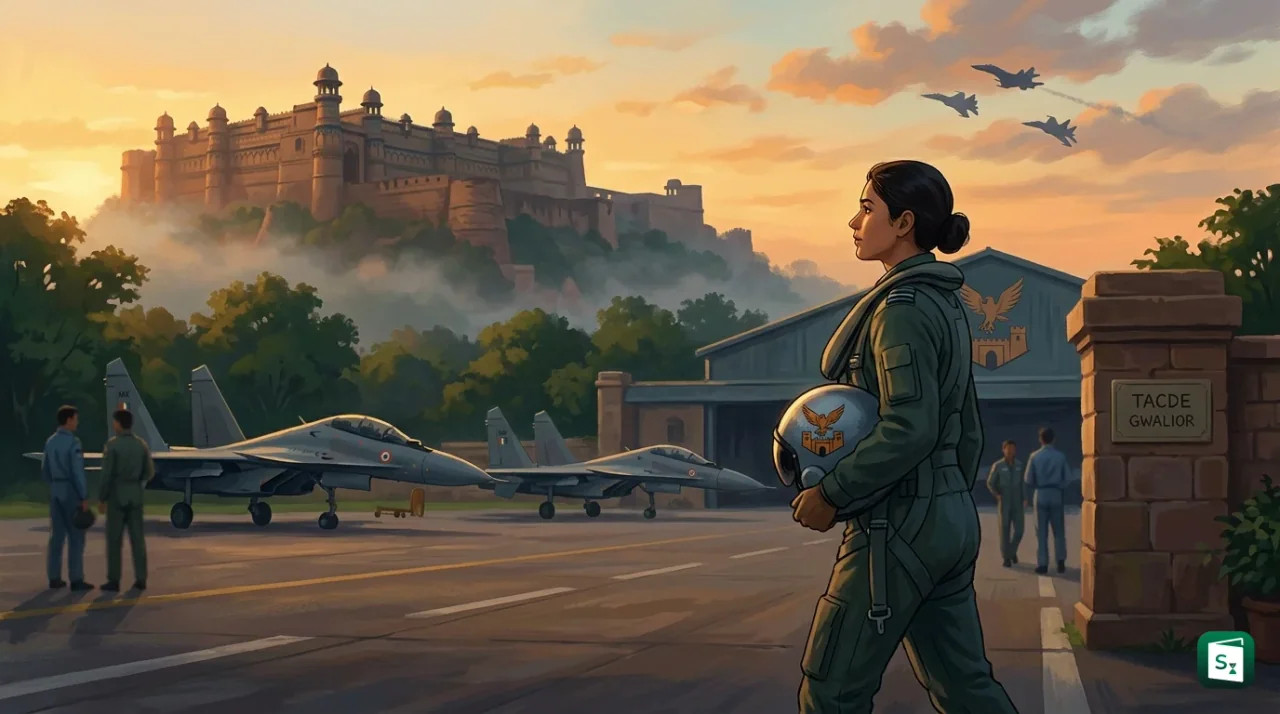
Squadron Leader Bhawana Kanth has etched her name into the history books of the Indian Air Force (IAF) by becoming the first woman fighter pilot to complete the prestigious Fighter Combat Leader (FCL) course at the Tactics and Air Combat Development Establishment (TACDE) in Gwalior, Madhya Pradesh. The gruelling 20-week programme, often compared to the United States Navy’s “Top Gun” school, accepts only about 1% of IAF pilots, making her achievement a milestone not just for gender integration but for operational excellence in combat aviation. With this accomplishment, Squadron Leader Kanth becomes the first woman graduate of India’s most elite fighter tactics institution.
Who Is Squadron Leader Bhawana Kanth?
Squadron Leader Bhawana Kanth was born on 1 December 1992 in Darbhanga, Bihar. She grew up in a refinery township in Begusarai and completed her schooling before pursuing a Bachelor of Engineering in Medical Electronics from BMS College of Engineering, Bengaluru. After briefly working at Tata Consultancy Services (TCS), she chose to follow her childhood dream of flying and joined the Indian Air Force Academy (AFA) at Dundigal, Hyderabad.
In June 2016, Bhawana Kanth was commissioned into the IAF as one of the country’s first three women fighter pilots, alongside Avani Chaturvedi and Mohana Singh Jitarwal. The trio was formally commissioned by then Defence Minister Manohar Parrikar on 18 June 2016, marking the beginning of a new chapter in India’s military aviation history. Their induction was initially sanctioned as an experimental scheme for a period of five years.
Kanth’s Trailblazing Career
After commissioning, Kanth joined a frontline fighter squadron and began flying the MiG-21 Bison, a supersonic interceptor aircraft. In March 2018, she flew her first solo sortie on the MiG-21 Bison. By May 2019, she had become the first woman fighter pilot in India to be cleared for daytime fighter combat missions on the MiG-21 Bison, a distinction that marked her as a fully operationally qualified combat pilot.
She later transitioned to the Sukhoi Su-30MKI, a twinjet multirole air-superiority fighter that serves as the backbone of the IAF’s modern fleet. In 2021, she became the first woman fighter pilot to take part in the Republic Day Parade and flypast, standing on the IAF’s tableau at Rajpath (now Kartavya Path). She participated in the Republic Day flypast again in 2024.
Squadron Leader Kanth, along with Chaturvedi and Singh, was also honoured with the Nari Shakti Puraskar, India’s highest civilian award for women, recognising their pioneering contribution to military aviation.
The Fighter Combat Leader Course: IAF’s “Top Gun” Programme
The Fighter Combat Leader (FCL) course is one of the most demanding professional programmes conducted by the Indian Air Force. It is a 20-week advanced combat training course that trains experienced fighter pilots in advanced air combat tactics, mission planning, air-to-air and air-to-ground operations, and leadership in high-intensity operational environments. Successful completion of the FCL course qualifies pilots to lead complex aerial combat missions and places them among the IAF’s elite operational tacticians.
Only about 1% of IAF pilots are selected for this programme, making it an extraordinarily selective course. The selection process identifies pilots who demonstrate exceptional flying skill, tactical acumen, and leadership potential. Graduates of the FCL course earn the title of Fighter Combat Leader and are entrusted with shaping the Air Force’s operational capabilities in complex combat scenarios.
What the FCL Course Covers
The FCL curriculum at TACDE is designed to push fighter pilots beyond standard squadron-level training. The programme includes advanced training in:
- Air-to-air combat tactics, including beyond-visual-range engagements and close combat manoeuvres
- Air-to-ground precision strike operations, including low-level penetration and weapon delivery
- Mission planning and leadership in multi-aircraft formations
- Electronic warfare and surface-to-air coordination
- Integration of unmanned systems and network-centric operations
- Lessons drawn from recent global conflicts
The course also integrates Surface to Air Guided Weapons (SAGW) crews and their combat vehicles into the final six weeks, ensuring that pilots and controllers learn to operate in a coordinated, joint environment. This integration mirrors the realities of modern warfare, where fighter aircraft, ground-based air defence, and electronic warfare assets must operate as a single system.
Graduates of the FCL course receive the coveted Fighter Combat Leader badge, one of the most prestigious professional distinctions in the IAF. TACDE also awards a diamond-studded sword and shield to the trainee officer who stands first in the overall order of merit, a tradition dating back to February 1978 when the Jamsaheb of Nawanagar presented these ceremonial items to the establishment.
TACDE: The Legacy of India’s Premier Combat Training Institution
The Tactics and Air Combat Development Establishment (TACDE) is the Indian Air Force’s premier institution for developing air combat tactics, operational doctrines, and standard operating procedures. Often compared to the United States Navy’s Strike Fighter Tactics Instructor programme (popularly known as “Top Gun”), TACDE trains the top 1% of IAF pilots in advanced aerial warfare techniques.
Founding and Historical Context
TACDE was established on 1 February 1971 as the Tactics and Combat Development and Training Squadron (T&CD&TS) at Adampur Air Force Station in Punjab, under the command of Wing Commander A.K. Mukherjee alongside Squadron Leader R.S. Chib. The institution was born out of hard lessons the IAF learned during the 1965 Indo-Pakistani War, which exposed critical shortcomings in air-ground coordination, offensive strategy, and the need for formalised combat tactics training.
During the 1971 Indo-Pakistani War, TACDE personnel, operating from Ambala Air Force Station, conducted 293 low-level night strikes on Pakistan Air Force bases despite the limitations of day-only capable aircraft like the MiG-21 and Hawker Hunter. The unit earned one Vir Chakra, 13 Mention-in-Despatches, and other honours during the conflict. In 1995, TACDE was awarded ‘Battle Honours’ by the President of India for its role in the 1971 war.
Relocation and Evolution
In December 1972, the unit was redesignated as TACDE and relocated to Jamnagar Air Force Station in Gujarat. The strong salt-laden sea breezes and occasional tornado-like storms at Jamnagar proved harmful to aircraft and equipment, prompting a move to Gwalior, Madhya Pradesh around 2000, where TACDE remains headquartered today at the Maharajpore Air Force Station.
The first Fighter Combat Leader (FCL) course commenced in May 1973 with an intake of five pilots, each already a Flight Commander and qualified Pilot Attack Instructor (PAI). In 2009, TACDE was conferred the Presidential Standard, a rare honour recognising its distinguished service and contributions to national defence. Four Air Force Chiefs (Air Chief Marshals P.V. Naik, S.K. Mehra, A.Y. Tipnis, and S. Krishnaswamy) are TACDE alumni.
Courses and Aircraft
In addition to the FCL course, TACDE conducts the Helicopter Combat Leader and Master Fighter Controller courses. Its instructors are handpicked for professional excellence from the fighter, helicopter, and radar streams. The institution currently operates a fleet that includes the MiG-29, Mirage 2000, and Sukhoi Su-30MKI, reflecting its role at the cutting edge of IAF combat capability. TACDE phased out the legacy MiG-21 from its inventory in 2022 after over 50 years of service.
Women in IAF’s Fighter Stream: A Ten-Year Journey
The story of women in the IAF’s fighter cockpit stretches back to 2015, when the government decided to open the fighter stream to women on an experimental basis. The IAF had already inducted women into transport and helicopter flying roles since 1994, but the fighter stream, considered the most demanding and combat-intensive role in military aviation, had remained exclusively male.
The Pioneering Trio of 2016
In June 2016, the IAF commissioned its first batch of three women fighter pilots: Avani Chaturvedi (from Rewa, Madhya Pradesh), Bhawana Kanth (from Darbhanga, Bihar), and Mohana Singh Jitarwal (from Jhunjhunu, Rajasthan). They were formally commissioned on 18 June 2016 at the Air Force Academy in Dundigal, Hyderabad, by then Defence Minister Manohar Parrikar.
Their induction was initially sanctioned as an experimental scheme for five years. The three officers underwent the same rigorous training as their male counterparts, progressing from basic training on the Pilatus PC-7 aircraft to the Kiran jet trainer and finally the Hawk Mk.132 advanced jet trainer, before being assigned to fighter squadrons.
A Decade of Milestones
The journey from the first batch to Squadron Leader Kanth’s TACDE graduation has been marked by a series of firsts:
| Year | Milestone | Officer |
|---|---|---|
| 2016 | First women fighter pilots commissioned into the IAF | Avani Chaturvedi, Bhawana Kanth, Mohana Singh |
| 2018 | First solo sortie on MiG-21 Bison by a woman pilot | Avani Chaturvedi |
| 2019 | First woman cleared for day combat missions on MiG-21 Bison | Bhawana Kanth |
| 2019 | First woman to attain full operational status on Hawk Mk.132 | Mohana Singh |
| 2021 | First woman fighter pilot in Republic Day Parade | Bhawana Kanth |
| 2022 | Experimental scheme regularised into a permanent IAF programme | Government of India |
| 2024 | First woman pilot to fly the indigenous Tejas fighter jet | Mohana Singh |
| 2026 | First woman graduate of TACDE FCL course | Bhawana Kanth |
In February 2022, Defence Minister Rajnath Singh announced that the experimental scheme for induction of women fighter pilots had been regularised into a permanent programme, noting that with 16 women fighter pilots already commissioned, what started as an experiment had become a permanent feature of the IAF.
Growing Presence
As of 2024, the IAF has over 1,800 women personnel serving in various capacities (excluding Medical and Dental branches). Women pilots now fly the MiG-29, Sukhoi Su-30MKI, Mirage 2000, and the latest Rafale jets. Squadron Leader Shivangi Singh became India’s first woman Rafale pilot when she joined the IAF’s Golden Arrows squadron in 2020. Earlier in 2026, Squadron Leader Saanya became the first woman officer in the IAF to earn the coveted Category-A Qualified Flying Instructor (QFI) qualification.
The Way Forward
Squadron Leader Kanth’s graduation from TACDE carries implications that go beyond personal achievement. It signals that women officers are now competing successfully for the IAF’s most rigorous professional courses, which demand exceptional flying skill, tactical acumen, and leadership under pressure. The successful completion of the FCL course by a woman officer for the first time demonstrates that gender is no barrier to reaching the highest echelons of combat aviation expertise.
What the FCL Qualification Means Operationally
Graduates of the FCL course are not merely trained pilots. They are designated as the IAF’s frontline combat tacticians, entrusted with leading complex air combat missions and mentoring future generations of fighter pilots. TACDE’s graduates shape the tactical doctrines that the entire Air Force follows, influence the development of standard operating procedures for new aircraft and weapons systems, and evaluate newly inducted platforms before they are integrated into operational service.
With Kanth’s qualification, the IAF now has a woman officer who can lead multi-aircraft strike missions, plan complex air combat operations, and contribute to the development of the Air Force’s combat doctrine. This is a significant step toward full operational integration of women in the IAF’s most demanding combat roles.
Expanding Opportunities
The regularisation of the women fighter pilot programme in 2022, combined with milestones like Kanth’s TACDE graduation, reflects a broader institutional shift. The IAF has been at the forefront of gender integration among India’s three armed forces. While the Army and Navy have also made strides, including the Supreme Court’s 2020 directive on permanent commission for women officers, the IAF’s fighter stream remains the most visible symbol of breaking gender barriers in direct combat roles.
The IAF continues to recruit women into its fighter stream through the Air Force Common Admission Test (AFCAT) and the National Defence Academy (NDA) entry, which was opened to women in 2022 following a Supreme Court order. As more women pilots join frontline squadrons and progress to advanced training programmes like the FCL course, the IAF’s operational capacity stands to benefit from a wider and more diverse talent pool.
Key Takeaways
- Squadron Leader Bhawana Kanth became the first woman fighter pilot of the Indian Air Force to complete the Fighter Combat Leader (FCL) course at TACDE in Gwalior.
- The FCL course is a 20-week advanced combat programme conducted by TACDE, and only about 1% of IAF pilots are selected for it.
- TACDE was established on 1 February 1971 at Adampur, Punjab, and was redesignated in December 1972 before relocating to Gwalior, where it received the Presidential Standard in 2009.
- Bhawana Kanth was part of the first batch of three women fighter pilots commissioned into the IAF in June 2016, alongside Avani Chaturvedi and Mohana Singh.
- The IAF’s experimental scheme for women fighter pilots was regularised into a permanent programme in February 2022 by Defence Minister Rajnath Singh.
- TACDE is often compared to the United States Navy’s “Top Gun” programme (officially the Strike Fighter Tactics Instructor programme) and trains pilots in advanced air combat tactics, electronic warfare, and precision strike operations.