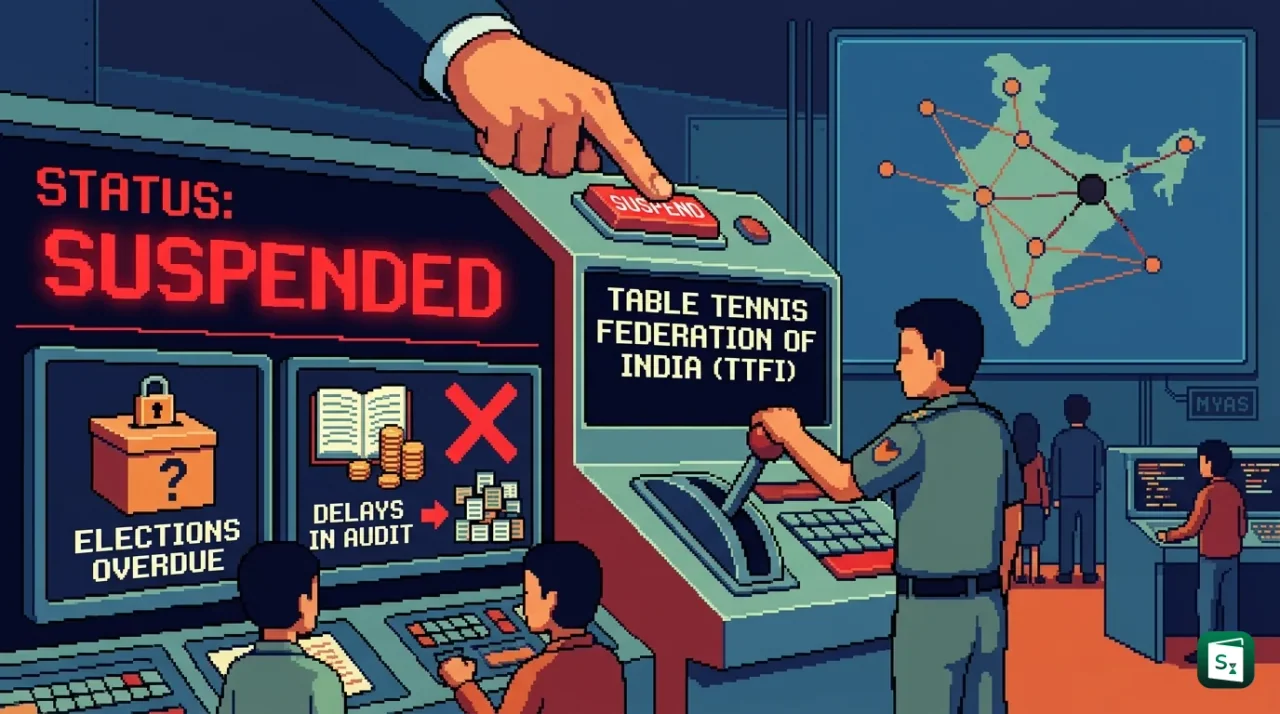
The Ministry of Youth Affairs and Sports (MYAS) suspended the recognition of the Table Tennis Federation of India (TTFI) on 12 August 2026, citing repeated governance failures, delayed elections, and severe financial irregularities. The decision was announced just five weeks before India’s table tennis squad is scheduled to compete at the Asian Games 2026 in Aichi-Nagoya, Japan. With this suspension, TTFI loses access to all government financial assistance, official patronage, and benefits tied to its status as a recognised National Sports Federation (NSF).
About the Table Tennis Federation of India
The Table Tennis Federation of India (TTFI) is the national governing body for table tennis in India. It was established in 1926 and is among the founding members of the International Table Tennis Federation (ITTF), the sport’s global governing body headquartered in Lausanne, Switzerland. The TTFI is also affiliated with the Asian Table Tennis Union (ATTU), the continental body for the sport in Asia.
The federation is headquartered in Delhi and has a membership of 32 state units and 37 institutional affiliates. It is responsible for organising national championships, selecting Indian teams for international competitions, and managing the overall development of table tennis in the country. Recognition as an NSF by the Indian government is essential for the TTFI to receive financial grants, represent India in international events, and use the word “India” in its official name.
The TTFI is currently headed by Meghna Ahlawat, who became the federation’s first woman president in December 2022. She is the wife of Dushyant Chautala, a Haryana MLA and former TTFI president. Kamlesh Mehta, a former player, serves as the Secretary General. The federation also has an Italian coach, Massimo Costantini, overseeing both the men’s and women’s national teams.
Why Was TTFI Suspended?
The Sports Ministry issued the suspension on 12 August 2026 after the TTFI failed to provide a satisfactory response to a show-cause notice served on 30 June 2026. The ministry cited multiple governance failures that had been building up over several years. The suspension was enforced under the provisions of the National Sports Development Code of India, 2011 (commonly known as the Sports Code).
Failure to Hold Elections on Time
The most immediate trigger for the suspension was the TTFI’s failure to conduct its organisational elections within the mandated timeframe. Under the Sports Code, national sports federations are required to hold periodic elections to ensure democratic functioning. The TTFI’s elections, originally due in 2026, had not been conducted, and there was no word on when the process would begin.
The ministry order stated that the TTFI had “repeatedly disregarded directions and guidelines” issued by it. The principles of accountability and democratic functioning expected of a recognised NSF had not been followed. The continued delay in holding elections meant that the federation was operating without a legitimate, democratically elected mandate.
Financial Governance Lapses
The TTFI also came under fire for serious financial irregularities. The ministry flagged severe delays in the adoption and uploading of audited financial statements for the financial years 2023-24 and 2024-25. Although the financial statements for FY 2023-24 were audited on 30 September 2024, they were placed before the General Body for adoption only on 28 January 2026, after an unexplained delay of over 15 months.
The FY 2024-25 accounts were never placed before the General Body at all. The ministry found the TTFI’s explanation for these delays “unsatisfactory”. The internal rift between the federation’s president and secretary general meant that regular Annual General Meetings (AGMs) were never held, and accounts could not be audited or passed in a timely manner.
Selection Policy and Athlete Welfare Concerns
The suspension was also linked to concerns over athlete welfare and the federation’s selection procedures. In June 2026, India’s top paddler Manika Batra was named only as a reserve for the Asian Games 2026 squad, despite being the country’s second-highest ranked women’s singles player. Batra publicly criticised the decision and alleged that the TTFI had violated its own constitution by using a nine-member selection committee instead of the mandated maximum of seven members.
The ministry noted that TTFI’s selection policies, framed in May 2023 and July 2026, were inconsistent with the ministry’s own guidelines issued on 5 March 2025. The ministry also highlighted the delay in conducting the National Championships in 2025, citing it as a failure in ensuring athlete welfare. The continuing differences between TTFI president Meghna Ahlawat and secretary general Kamlesh Mehta had, according to the ministry, adversely affected institutional decision-making and undermined confidence in the federation’s governance.
A Look Back: The 2022 Suspension
This is not the first time the TTFI has faced suspension. In February 2022, the Delhi High Court suspended the federation and appointed a Committee of Administrators (CoA) to run its affairs. That intervention came after Manika Batra filed a petition challenging the TTFI’s selection policy, which had led to her exclusion from the Asian Championships that year. Batra had also accused national coach Soumyadeep Roy of pressuring her to throw a match in favour of his private trainee during the Tokyo Olympics qualification period.
The Delhi High Court, while ordering the appointment of an administrator, stated that it was “appalled” by the “sorry state of affairs” in the TTFI. A three-member enquiry committee, comprising two former Supreme Court judges and a former athlete, was constituted to investigate the match-fixing allegations. The TTFI was eventually restored in December 2022 after fresh elections, which brought Meghna Ahlawat and Kamlesh Mehta to power. However, the internal rift between the two leaders quickly resurfaced, leading to fresh governance crises.
Consequences of the Suspension
The suspension has immediate and far-reaching consequences for the TTFI and Indian table tennis. Under the Sports Code, once an NSF’s recognition is suspended, it loses all government financial assistance, official patronage, and other benefits. This means the TTFI can no longer access funding from the Ministry of Youth Affairs and Sports or the Sports Authority of India (SAI) for training programmes, national camps, coaching salaries, or infrastructure development.
The suspension also strips the TTFI of its authority to select national teams, regulate the sport domestically, and represent India in international events. However, the ministry has moved quickly to ensure that the sport does not suffer. It has directed the Indian Olympic Association (IOA) to constitute an ad-hoc committee to administer the sport until a duly constituted governance structure is restored within the TTFI.
The ministry order stated that the “IOA, in consultation with the international body (ITTF), will take appropriate action to create an internal regulatory mechanism, including the constitution of an ad-hoc committee”. This ensures that day-to-day administration of the sport, including preparations for upcoming international events, continues without disruption.
Impact on Asian Games 2026
The timing of the suspension has raised concerns about India’s preparedness for the Asian Games 2026, scheduled to be held in Aichi-Nagoya, Japan, from 19 September to 4 October 2026. India’s table tennis squad, led by Sreeja Akula and G Sathiyan, was announced in June with a 10-member contingent (five men and five women, plus two reserves each). The squad was picked in accordance with the TTFI’s selection policy, which allocates 50 per cent weightage to national rankings, 40 per cent to world rankings, and 10 per cent to the discretion of the selection committee.
The suspension does not automatically disqualify the selected players from competing, as the IOA is expected to put temporary administrative arrangements in place. However, the uncertainty over who will formally manage the squad, handle logistics, and liaise with the Olympic Council of Asia (OCA) could create administrative complications in the final weeks before the Games.
India has historically struggled in table tennis at the Asian Games. To date, the country has won only three medals in the sport at the Games, all bronze. The most recent was a mixed doubles bronze at Jakarta 2018, won by Manika Batra and Sharath Kamal. The ongoing turmoil within the TTFI threatens to derail years of preparation and undermine the athletes’ prospects at the continental event.
The Road Ahead
The suspension places the TTFI in a critical position. The federation will need to address all the governance deficiencies flagged by the ministry, including holding timely elections, passing audited accounts, and ensuring a transparent selection process, before its recognition can be restored. The ministry has made it clear that the suspension will remain in effect “until further orders”.
An important legal dimension to this case involves the National Sports Governance Act, 2025 (NSGA), which came into effect in January 2026. This Act was meant to replace the 2011 Sports Code as the primary legal framework for governing national sports bodies. Under the NSGA, the National Sports Board (NSB) is the apex regulatory authority responsible for granting, suspending, or cancelling recognition of sports federations. However, in the case of the TTFI, the ministry was forced to invoke the older Sports Code provisions because the NSB had not yet been fully constituted to exercise its powers.
The situation highlights the transitional challenges in India’s sports governance framework. While the NSGA was intended to provide a more robust and independent regulatory mechanism, the absence of its operational infrastructure forced the ministry to fall back on the Sports Code, which itself has been criticized by the Delhi High Court for non-compliance by multiple federations over the years.
For Indian table tennis, the immediate priority is to ensure that the IOA’s ad-hoc committee steps in quickly to manage the sport, particularly with the Asian Games just weeks away. In the longer term, the TTFI must resolve its internal power struggles, restore financial transparency, and conduct proper elections to regain the government’s confidence and its status as a recognised NSF.
Key Takeaways
- The Ministry of Youth Affairs and Sports suspended the recognition of the Table Tennis Federation of India (TTFI) on 12 August 2026 under the National Sports Development Code of India, 2011.
- The suspension was triggered by TTFI’s failure to hold elections on time, severe delays in adopting audited financial statements for FY 2023-24 and FY 2024-25, and unresolved selection policy disputes.
- The TTFI was established in 1926 and is a founding member of the International Table Tennis Federation (ITTF), with 32 state units and 37 institutional affiliates as members.
- This is the second suspension of the TTFI in four years, following a Delhi High Court order in February 2022 that appointed a Committee of Administrators after Manika Batra’s match-fixing allegations.
- The Indian Olympic Association (IOA) has been directed to form an ad-hoc committee to administer the sport until a compliant governance structure is restored within the TTFI.
- The suspension comes just five weeks before the Asian Games 2026 in Aichi-Nagoya, Japan, raising concerns about India’s table tennis preparations.