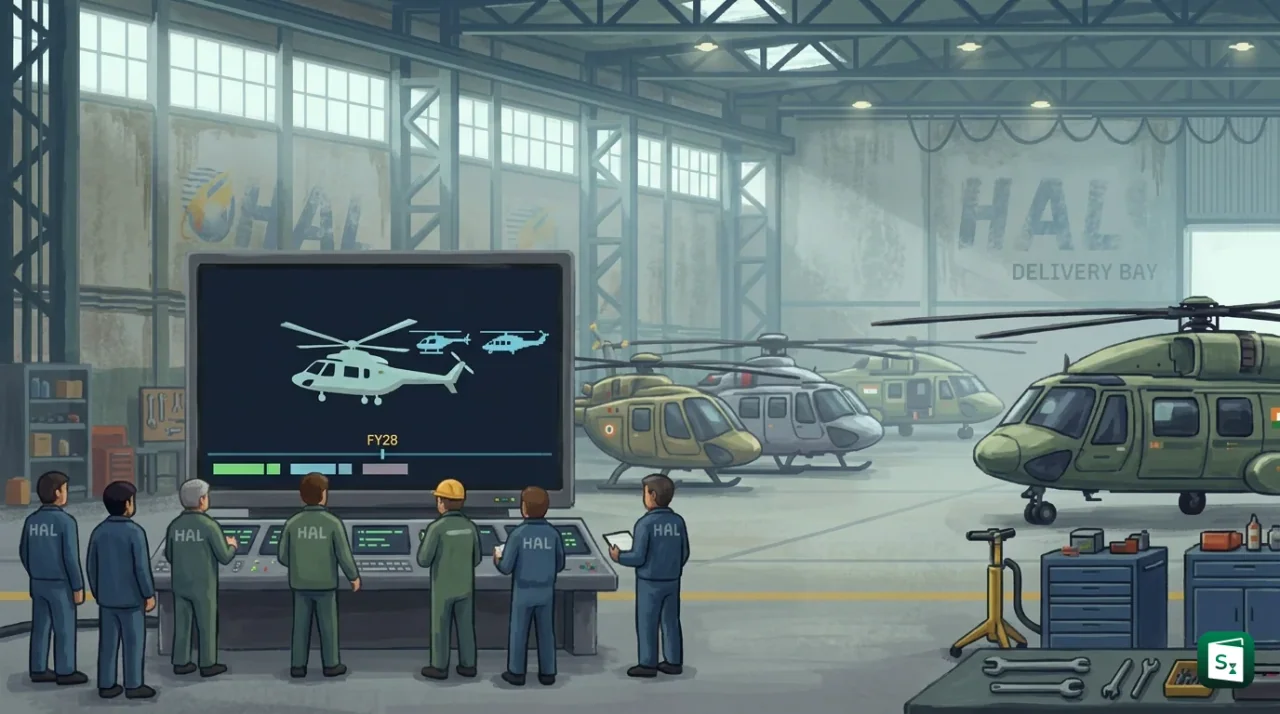
Hindustan Aeronautics Limited (HAL) has signed a Memorandum of Understanding (MoU) with SkyPulse Solutions IFSC Private Limited for a proposed programme involving 30 HAL manufactured helicopters valued at ₹2,491 crore. The framework covers acquisition, financing, leasing, deployment and lifecycle support of a mix of single engine and twin engine platforms. Initial induction is planned in FY28, with phased deliveries linked to production, financing and regulatory approvals.
What Is Hindustan Aeronautics Limited?
Hindustan Aeronautics Limited is India’s public sector aerospace and defence company under the Ministry of Defence, headquartered in Bengaluru. Founded as Hindustan Aircraft Limited in 1940 by Walchand Hirachand and reconstituted as HAL in 1964, it designs, builds and maintains aircraft, helicopters, engines and avionics.
HAL is a Maharatna Central Public Sector Enterprise under the Ministry of Defence. The company traces its origin to 23 December 1940, when it was incorporated as Hindustan Aircraft Limited in Bangalore with support from the princely state of Mysore. The Government of India took management control in 1942, placed it under the Ministry of Defence in 1951, and reconstituted it as Hindustan Aeronautics Limited on 1 October 1964 after amalgamation with Aeronautics India Limited.
HAL operates 11 research and development centres and 21 manufacturing divisions across four production units. Its helicopter work is anchored by the Helicopter Division in Bengaluru, set up in 1970, the co located Rotary Wing Research and Design Centre, the Helicopter MRO Division and the Rotary Wing Academy for pilot training. HAL started helicopter production in the 1960s with licensed manufacture of the Chetak (Alouette III) and Cheetah (Lama SA 315B) and began series production of the indigenous Dhruv in 2000-01. A large new helicopter factory at Tumakuru in Karnataka, spread over 615 acres and dedicated to the nation in 2023, is designed to produce 30 helicopters per year in the first phase, scalable to 60 and later 90 units.
What Does the HAL SkyPulse MoU Cover?
The HAL SkyPulse MoU creates a strategic framework for the acquisition, financing, leasing, deployment and lifecycle support of up to 30 HAL built helicopters. The programme is valued at about ₹2,491 crore and will use phased procurement, GIFT City based financing and long term maintenance support.
HAL signed the MoU with SkyPulse Solutions IFSC Private Limited, an aviation leasing, financing and asset management company based in GIFT City International Financial Services Centre (IFSC) in Gujarat. The signing was reported on 25 and 26 September 2026. The MoU records the present intent of both sides. Final purchase, lease, financing and maintenance deals will need separate technical evaluation, commercial negotiation, financing closure, internal approvals and definitive agreements.
The programme will be rolled out in two stages. The first stage covers 10 helicopters during 2027 to 2029, with initial induction in FY28 (2027-28). The second stage covers 20 additional helicopters from 2030 onwards. SkyPulse plans to acquire the fleet in phases as a mix of twin engine and single engine variants. The exact model mix is not yet fixed. It will be decided on operational need, technical suitability, certification status, price and customer demand.
| Programme Element | Detail Announced |
|---|---|
| Total fleet size | Up to 30 helicopters |
| Estimated value | ₹2,491 crore |
| Phase 1 | 10 helicopters, 2027 to 2029 |
| Phase 2 | 20 helicopters, from 2030 onwards |
| First induction | FY28 |
| Fleet mix | Single engine and twin engine HAL platforms, model mix to be decided |
| Scope | Acquisition, financing, leasing, deployment, spare parts, maintenance, engineering support and training |
| Conditions | Technical evaluation, commercial terms, financing, certification, regulatory and internal approvals |
The two sides may also set up a Joint Working Group to study technical, commercial, financing and implementation needs. Deliveries will depend on HAL production slots at Bengaluru and Tumakuru, closure of lease finance, customer demand from civil and government operators, certification of specific variants and mission requirements.
How Will Aircraft Leasing Through GIFT IFSC Work?
Aircraft leasing is a business where a leasing company owns an aircraft or helicopter and rents it to an operator for monthly payments. The operator flies the machine without paying the full purchase price, while the lessor handles ownership, financing and often maintenance support.
The HAL SkyPulse model will use the GIFT City IFSC framework regulated by the International Financial Services Centres Authority (IFSCA). IFSCA was established through the IFSCA Act, 2019 and is headquartered in GIFT City, Gandhinagar. In October 2020 the government notified aircraft lease, including operating and finance lease of aircraft and helicopters, as a financial product. The detailed Framework for Aircraft Lease was issued in May 2022 under the IFSCA (Finance Company) Regulations, 2021.
Under this framework a lessor can be set up as a company, limited liability partnership or trust in the IFSC and can offer operating leases, finance leases, hybrid leases, direct purchase and sale and leaseback deals. An operating lease works like rent for a fixed period, with the aircraft returning to the lessor at the end. A finance lease works like a loan to buy, with most ownership risks passing to the operator. Sale and leaseback allows an owner to sell a helicopter to the IFSC lessor and immediately lease it back to free up cash. The minimum owned fund is 200,000 dollars for operating lease business and 3 million dollars for finance lease business.
HAL and SkyPulse will explore all these options from GIFT City. This matters because India earlier depended on lessors in Ireland, Singapore and Dubai. By May 2026 GIFT IFSC hosted 40 aircraft lessors with 203 aircraft and 84 engines leased through IFSC structures, covering fixed wing aircraft, rotary wing aircraft, trainer aircraft, business jets and engines. Parliament has also passed the Protection of Interests in Aircraft Objects Act, 2025 to give full legal effect to the Cape Town Convention on repossession and security rights. The Union Budget 2026 extended the tax holiday for IFSC leasing units to 20 years within a 25 year block and set a concessional 15 percent post holiday rate, which improves long tenure helicopter financing.
HAL Helicopter Portfolio: Single and Twin Engine Variants
HAL builds both single engine light helicopters and twin engine medium helicopters. Twin engine machines offer higher safety and payload for offshore, rescue and high altitude work, while single engine machines offer lower cost for training, observation and short utility missions.
The SkyPulse programme has not named the final models. The likely pool comes from HAL civil certified or civil adaptable platforms. The table below summarises the main HAL helicopter types relevant to leasing.
| Helicopter | Class and Engine Type | Key Features and Role |
|---|---|---|
| Dhruv Advanced Light Helicopter (ALH) | 5.5 tonne, twin engine | Indigenous multi role helicopter designed by HAL. First flight in 1992, inducted in 2002, series production since 2000-01. Civil and military certified. Used for utility, rescue, offshore, police and VIP roles. More than 300 units delivered. Powered by Shakti engines. Max speed about 270 kmph, range about 660 km. |
| Rudra (ALH WSI Mk IV) | 5.8 tonne, twin engine, armed | Weapon systems integrated version of Dhruv. First flight in 2007, initial operational clearance in 2013. Carries 20 mm turret gun, 70 mm rockets, Mistral air to air missiles and Helina anti tank missiles. Primarily for Army and Air Force, with limited civil conversion scope. |
| Prachand Light Combat Helicopter (LCH) | 5.8 tonne, twin engine, combat | Dedicated attack helicopter developed after the 1999 Kargil conflict. First flight in 2010, inducted and named Prachand in 2022. Highest landing record at Siachen at 4,815 metres. Service ceiling 6.5 km. Primarily combat focused, not a core civil leasing asset. |
| Light Utility Helicopter (LUH) | 3.1 tonne, single engine | New generation helicopter to replace Chetak and Cheetah. First flight on 6 September 2016, initial operational clearance in 2020. Single Shakti 1U engine, glass cockpit, seating for two pilots plus six passengers. Service ceiling 6.5 km, range 350 km. Civil variant suited for charters, medical evacuation and pilgrimage. Production centred at Tumakuru. |
| Chetak and Cheetah and Cheetal | 2 to 2.2 tonne, single engine | Licensed versions of French Alouette III and Lama, built since the 1960s and 1970s. Proven in high altitude posts. Ageing fleet now being replaced by LUH. Still used for training, logistics and government duties. |
Single Engine Variant Details and Twin Engine Choice
A single engine helicopter like LUH has one turboshaft engine. It costs less to buy, burns less fuel and is easier to maintain. It suits short hops, tourism, aerial survey and emergency medical service in plains and hills where payload needs are modest.
A twin engine helicopter like Dhruv has two engines. If one engine fails, the other can sustain flight through most of the flight envelope. Regulators and corporate clients therefore prefer twin engine machines for night flying, over water flights, crowded city operations and high altitude rescue. The price is higher. Civil listings often place small single engine helicopters far below larger twin engine machines, which is why the SkyPulse mix will balance safety needs with lease rentals and operating cost.
Where Will the Helicopters Be Used?
HAL and SkyPulse plan to deploy Indian built helicopters across civil, governmental and mission critical roles rather than purely combat duties. Leasing makes the machines available to operators who cannot afford outright purchase or who need helicopters only for seasonal or emergency work.
The stated use cases include emergency medical services, disaster response, search and rescue, regional connectivity under schemes like UDAN, tourism and pilgrimage flights to sites like Vaishno Devi, Amarnath, Kedarnath and the Char Dham circuit, government aviation for states and police, infrastructure support for power lines, pipelines and dam projects, and charter operations for industry. This spread is important because India has a very small civil helicopter fleet compared to its size and terrain. Leased Dhruv and LUH machines can fill gaps in hill states, island territories, offshore oil fields and left wing extremism affected areas where road access is poor.
The MoU also covers an integrated support package. It includes supply of spare parts, scheduled maintenance, engineering help, pilot and technician training and handholding for Maintenance, Repair and Overhaul (MRO). HAL Rotary Wing Academy and the Helicopter MRO Division will play a central role in keeping fleet availability high, which is the key test for any lease business.
Why the Deal Matters for India
The HAL SkyPulse agreement links indigenous manufacturing, domestic aviation finance capacity and expanded practical helicopter use for public services.
It supports Make in India and self reliance in aerospace. A firm pipeline of 30 civil machines gives HAL production visibility beyond military orders and helps small suppliers of gearboxes, avionics, transmission parts and composites. Tumakuru output, Bengaluru design strength and private vendors together deepen the helicopter ecosystem.
It also tests whether GIFT City IFSC can finance rotary wing assets along with fixed wing airliners. Success would keep lease rentals, asset ownership, structuring fees and engineering jobs inside India. The Budget 2026 tax changes, the Cape Town law and the IFSCA trust and company service provider framework all aim to bring ownership and primary financing onshore instead of leaving IFSC units as sub lessors.
It creates skilled work as well. Helicopter operations need pilots, maintenance engineers, air traffic support, safety managers and MRO technicians. A 30 helicopter fleet in service generates steady demand for training and spares over a 20 to 25 year life, which is longer than the initial ₹2,491 crore acquisition value.
Key Takeaways
- HAL signed an MoU with SkyPulse Solutions IFSC Private Limited for up to 30 HAL helicopters worth ₹2,491 crore.
- The programme covers acquisition, financing, leasing, deployment and lifecycle support, with first induction in FY28.
- Phase 1 envisages 10 helicopters during 2027 to 2029, followed by 20 helicopters from 2030 onwards in single and twin engine mix.
- Leasing will be structured through GIFT City IFSC under the IFSCA Framework for Aircraft Lease, using operating, finance and sale and leaseback options.
- HAL, founded in 1940 and reconstituted in 1964 and headquartered in Bengaluru, anchors manufacture at Bengaluru and Tumakuru with the Dhruv, Rudra and LUH platforms.