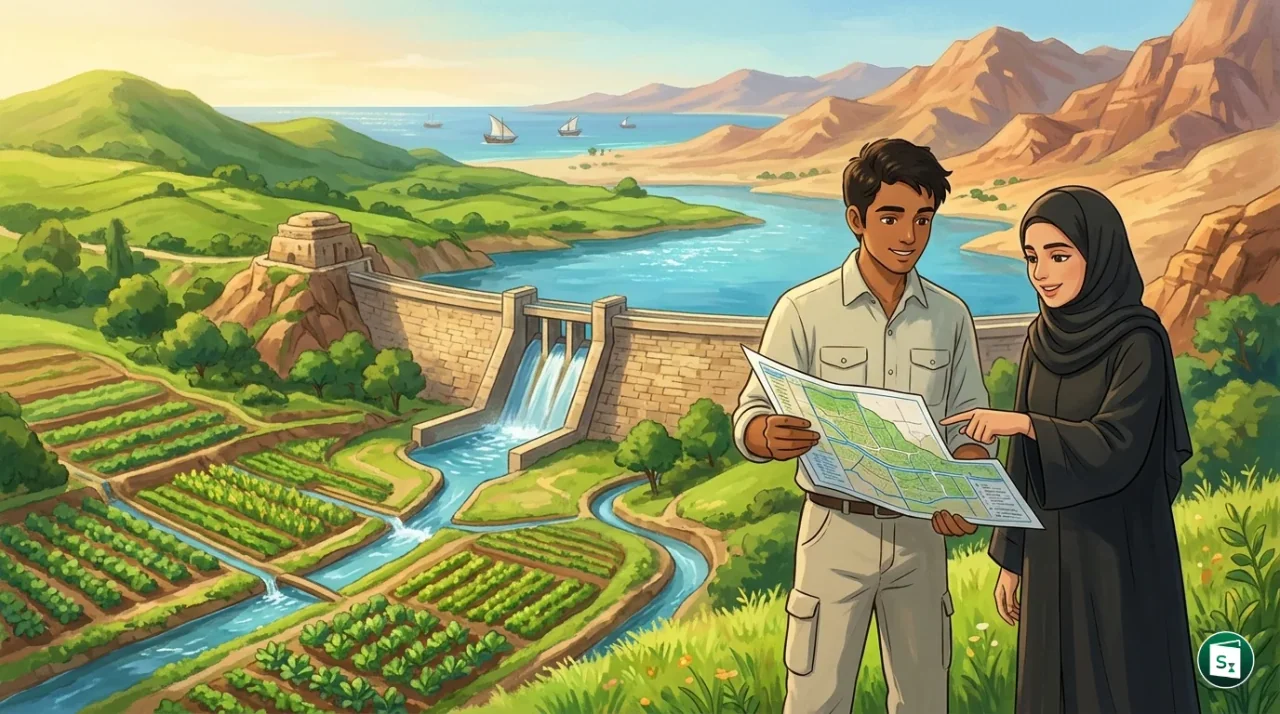
India and Saudi Arabia signed a Memorandum of Understanding on cooperation in water resources during the inaugural Saudi Water Week in Jeddah, marking a significant expansion of their strategic partnership into the water sector. The agreement was formalized by India’s Ambassador to Saudi Arabia, Dr. Suhel Khan, and Saudi Arabia’s Minister of Environment, Water and Agriculture, Eng. Abdulrahman Abdulmohsen AlFadley. The MoU aims to deepen bilateral collaboration in water resources planning, sustainable water management, and irrigation systems through capacity building and the exchange of technical expertise.
What Is Saudi Water Week?
Saudi Water Week is a landmark national platform organized by Saudi Arabia’s Ministry of Environment, Water and Agriculture (MEWA). Held from June 28 to July 2, 2026 at the Ritz Carlton in Jeddah, the inaugural edition replaced the earlier Saudi Water Forum and brought together policymakers, experts, researchers, and private sector leaders from across the world. The event featured over 97 panel discussions, technical workshops, and an accompanying exhibition showcasing advanced desalination, water reuse, and digital water management technologies. It also hosted the 7th Arab Water Forum and the Second Stakeholder Consultation Meeting for the 11th World Water Forum, which is scheduled to be held in Riyadh in 2027.
The choice of Jeddah as the venue is significant. Located on the Red Sea coast, the city is a hub for Saudi Arabia’s desalination industry, which supplies the majority of the Kingdom’s urban water needs. Aligning the event with Vision 2030, the Saudi leadership has framed water security as a strategic national priority.
What the MoU Covers
The Memorandum of Understanding establishes a broad framework for cooperation across multiple dimensions of water resource management. The key areas of engagement include:
Water resources planning - Both countries will collaborate on long-term water resource assessment, demand forecasting, and integrated water resource management strategies tailored to their respective climatic and geographic conditions.
Sustainable water management - The agreement promotes the adoption of best practices in water conservation, demand-side management, and the use of non-conventional water sources such as treated wastewater and desalinated water.
Irrigation systems - Given that agriculture accounts for nearly 84% of water consumption in Saudi Arabia and a significant share in India, improving irrigation efficiency is a shared priority. The MoU encourages cooperation on micro-irrigation, drip and sprinkler systems, and modern on-farm water management techniques.
Capacity building and technical cooperation - The partnership includes training programmes, workshops, exchange of experts, and joint research initiatives between water institutions of both countries.
Consul General Fahad Suri of the Indian Consulate in Jeddah was present at the signing ceremony, underscoring the institutional support behind the initiative.
Why Water Cooperation Matters
Saudi Arabia’s Water Challenge
Saudi Arabia is one of the most water-scarce countries on earth. It receives less than 100 millimetres of average annual rainfall, has no permanent rivers or freshwater lakes, and relies on a mix of non-renewable groundwater, desalination, and treated wastewater to meet its needs. Agriculture consumes 84% of the Kingdom’s water, with fodder alone accounting for 67% of agricultural water use.
Over the past decade, Saudi Arabia has undertaken a sweeping transformation of its water sector. Non-renewable groundwater consumption declined from approximately 21 billion cubic metres in 2016 to about 11 billion cubic metres in 2025. Desalinated water production capacity grew from 9 million cubic metres per day in 2016 to 16 million cubic metres per day by 2025, and the Kingdom now provides 100% of its population with access to safe drinking water. The National Water Strategy, part of Vision 2030, targets further gains in efficiency, wastewater reuse (from the current 25% toward a 70% target), and per-capita consumption reduction.
Despite these gains, the Kingdom’s water sector faces structural challenges. Heavy reliance on energy-intensive desalination, high transmission costs for pumping water from coastal plants to inland cities like Riyadh, and a per-capita consumption rate exceeding 250 litres per day (among the highest in water-scarce nations) all demand sustained reform and international collaboration.
India’s Growing Water Expertise
India has built considerable experience in water management through its large-scale national programmes. The Jal Jeevan Mission (JJM), launched in 2019 under the Ministry of Jal Shakti, aims to provide functional household tap connections to every rural household. From just 3 million rural households with tap connections in 2019, the mission has provided over 150 million connections by 2024, making it one of the largest rural drinking water programmes globally.
India also has deep expertise in irrigation management through the Pradhan Mantri Krishi Sinchayee Yojana (PMKSY), watershed development under the Integrated Watershed Management Programme, and groundwater management through the Atal Bhujal Yojana. The country’s experience with rainwater harvesting, greywater reuse, and community-led water management offers valuable lessons for arid and semi-arid regions.
The MoU allows both countries to leverage these complementary strengths. India can share its expertise in large-scale rural water supply, irrigation efficiency, and community participation, while Saudi Arabia brings advanced desalination technology, water recycling capabilities, and smart water management systems to the table.
The Broader Strategic Context
The water MoU is the latest addition to an expanding India-Saudi Arabia partnership that has deepened significantly over the past two decades. Diplomatic relations were established in 1947, but the relationship was elevated with the Delhi Declaration during King Abdullah’s visit to India in 2006 and the Riyadh Declaration in 2010, which established a Strategic Partnership. The formation of the Strategic Partnership Council (SPC) in 2019, with two main committees covering political, security, and socio-cultural cooperation on one side and economic and investment cooperation on the other, gave the relationship a formal institutional framework.
Bilateral trade stood at approximately USD 52 billion in 2023-24, making India Saudi Arabia’s second-largest trade partner and Saudi Arabia India’s fourth-largest. Saudi Arabia is also a key energy partner, supplying about 18% of India’s crude oil imports. In September 2023, during Crown Prince Mohammed bin Salman’s visit to India for the G20 Summit, the two sides signed eight MoUs covering energy, digitization, banking, investment, and critically, seawater desalination between India’s National Institute of Technology and the Saline Water Conversion Corporation (SWCC) of Saudi Arabia.
This new water MoU builds directly on that 2023 desalination agreement and expands the scope of water cooperation from desalination technology alone to the full spectrum of water resource management, including planning, sustainability, and irrigation.
The Way Forward
The practical impact of the MoU will depend on the speed and depth of its implementation. Both sides have expressed intent to move quickly on institutional exchanges, joint training programmes, and pilot projects. The involvement of the Ministry of Jal Shakti from the Indian side and MEWA from the Saudi side provides strong institutional anchoring.
For India, this partnership opens access to Saudi Arabia’s world-leading desalination and wastewater recycling technologies, which could be valuable for India’s own coastal cities facing water stress. For Saudi Arabia, India’s proven experience in delivering rural water supply at scale through the Jal Jeevan Mission and its low-cost irrigation solutions offer practical, field-tested models.
The MoU also aligns with India’s broader push for water diplomacy. India has been increasing its engagement on water issues internationally, including through the India International Water Week, and has expressed openness to global collaboration on water management. The Saudi Water Week platform, with its focus on innovation and partnership, provides a natural venue for this cooperation to deepen.
As both countries face growing water stress from population growth, urbanization, and climate change, the ability to share knowledge and technology will become increasingly valuable. The MoU signed at Saudi Water Week 2026 represents not just a diplomatic document, but a practical step toward building water security in two of the world’s most water-stressed nations.
Key Takeaways
- India and Saudi Arabia signed an MoU on water resources cooperation during the inaugural Saudi Water Week in Jeddah (June 28 to July 2, 2026).
- The MoU was signed by India’s Ambassador Dr. Suhel Khan and Saudi Minister of Environment, Water and Agriculture Eng. Abdulrahman Abdulmohsen AlFadley.
- The agreement covers water resources planning, sustainable water management, irrigation systems, capacity building, and exchange of technical expertise.
- Saudi Arabia is one of the most water-scarce countries, with less than 100 mm annual rainfall and reliance on desalination for over 60% of urban water supply.
- The Kingdom’s National Water Strategy, under Vision 2030, targets a 70% wastewater reuse rate and has reduced non-renewable groundwater consumption from 21 billion cubic metres (2016) to 11 billion cubic metres (2025).
- India’s Jal Jeevan Mission, launched in 2019 under the Ministry of Jal Shakti, provided over 150 million rural household tap connections by 2024.
- India and Saudi Arabia elevated their relationship to a Strategic Partnership in 2010 and established the Strategic Partnership Council in 2019.
- The 11th World Water Forum is scheduled to be held in Riyadh in 2027, underscoring Saudi Arabia’s growing global role in water governance.