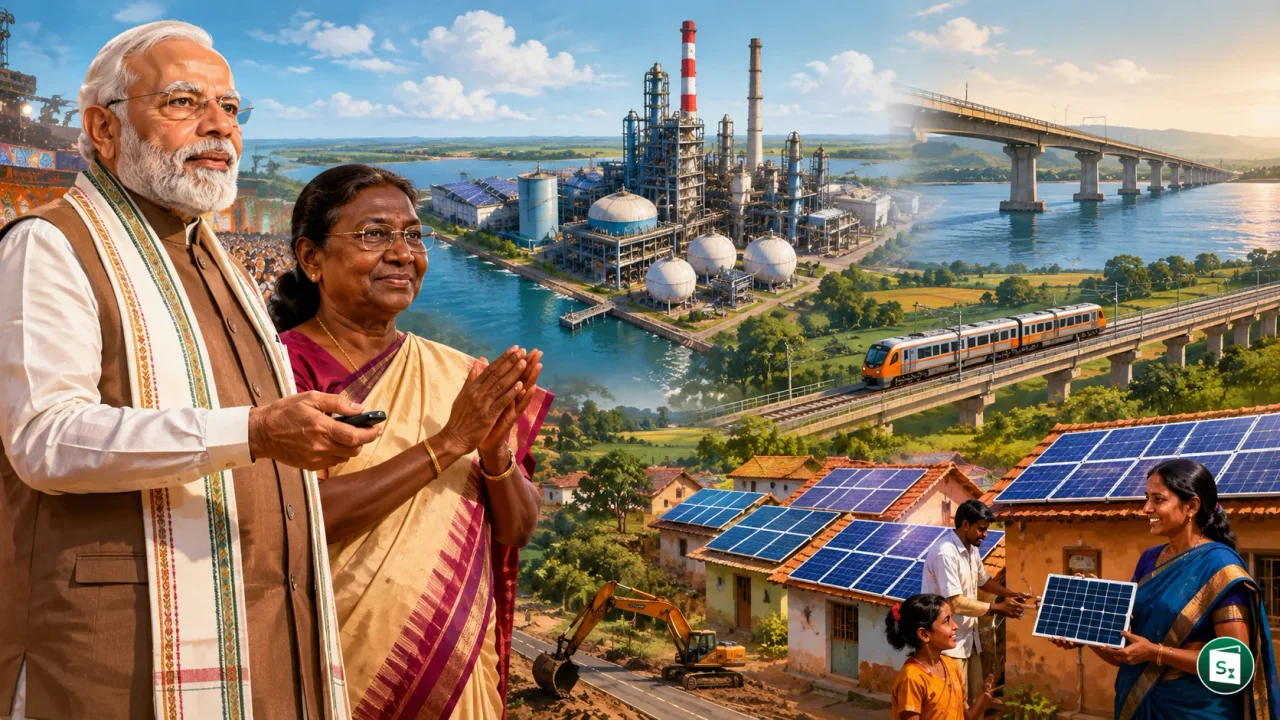
President Droupadi Murmu and Prime Minister Narendra Modi jointly inaugurated and laid the foundation stones for 72 development projects worth over ₹47,600 crore in Rairangpur, Odisha, on June 20, 2026. The event marked the completion of two years of the BJP government in Odisha under Chief Minister Mohan Charan Majhi, with the theme “Vikas ra Dhara, Odisha Sara.” Among the landmark initiatives, the foundation stone for India’s first commercial-scale coal-to-ammonium nitrate project was laid at Lakhanpur, and PM Modi announced that Pahadpur village would be developed as a model solar village.
A Rare Joint Visit to Rairangpur
The joint appearance of the President and the Prime Minister at a state-level development programme was a significant occasion, made more special by the fact that it took place in Rairangpur, the home constituency of President Murmu in Mayurbhanj district. The visit coincided with President Murmu’s 68th birthday, and PM Modi extended his greetings before a large public gathering.
Before the main event, both leaders visited Pahadpur village, the native village of President Murmu’s in-laws. They offered prayers at the sacred Santhali Jahera and Ho Jahera groves, reflecting the deep tribal cultural traditions of the region. They also visited the SLS Memorial School established by President Murmu and a skill development centre in the village. Odisha Governor Hari Babu Kambhampati and Chief Minister Mohan Charan Majhi were present at the public meeting.
Of the 72 projects, 60 were inaugurated and foundation stones were laid for 12 across sectors including energy, industrial infrastructure, road connectivity, drinking water, health, education, tourism and irrigation. These initiatives are expected to strengthen infrastructure, improve connectivity, enhance energy security and generate employment opportunities across the state, with a particular focus on tribal and rural regions.
India’s First Commercial Coal-to-Ammonium Nitrate Project
The single largest project for which a foundation stone was laid is the Bharat Coal Gasification and Chemicals Limited (BCGCL) project at Lakhanpur in Jharsuguda district, with an investment of ₹25,016 crore. This is India’s first commercial-scale coal-to-ammonium nitrate facility, marking a pivotal shift in how the country utilises its vast coal reserves.
The project is being developed by BCGCL, a joint venture between Bharat Heavy Electricals Limited (BHEL) and Coal India Limited (CIL), with CIL holding a 51% stake and BHEL holding 49%. It will deploy BHEL’s indigenously developed Pressurised Fluidised Bed Gasification (PFBG) technology to convert locally available high-ash coal into synthesis gas, which is then processed into ammonium nitrate.
How Coal Gasification Works
Coal gasification is a cleaner alternative to traditional coal combustion. Instead of burning coal directly, the process converts coal into synthesis gas (syngas), a mixture of carbon monoxide and hydrogen. This syngas can be used to manufacture a wide range of value-added products such as methanol, urea, ammonium nitrate, synthetic natural gas and other chemical feedstocks. The technology significantly reduces emissions of sulphur oxides, nitrogen oxides and particulate matter compared to conventional coal burning.
Strategic Importance
The Lakhanpur plant will produce 2,000 tonnes per day (approximately 0.66 million metric tonnes per annum) of technical-grade ammonium nitrate, a critical feedstock for fertilisers and industrial explosives used extensively in mining. Once operational, the project is expected to meet nearly 35% of India’s projected ammonium nitrate demand by 2030, reducing imports by about 0.66 million tonnes annually and generating foreign exchange savings of more than $360 million every year. Over its operating life, cumulative import substitution savings could exceed $9 billion.
India currently imports end-use and intermediate chemical products worth approximately ₹2.7 lakh crore annually. The Ministry of Coal has approved incentive schemes with a cumulative outlay of up to ₹46,000 crore to promote surface coal and lignite gasification projects across the country. The BCGCL project is receiving ₹1,350 crore in financial support under this incentive scheme. The initiative is expected to catalyse investments of ₹2.5 to 3 lakh crore and create around 50,000 direct and indirect employment opportunities across 25 projects in coal-bearing regions.
The land for the project spans approximately 350 acres under the possession of Mahanadi Coalfields Limited (MCL), a subsidiary of Coal India.
Major Energy Infrastructure Push
Two significant power sector projects also received foundation stones during the programme, together representing a major boost to Odisha’s energy security.
Upper Indravati Pumped Storage Project
The 600 MW Upper Indravati Pumped Storage Project (PSP) is being developed by the Odisha Hydro Power Corporation (OHPC) at Mukhiguda in Kalahandi district at an estimated cost of ₹3,160 crore. A pumped storage project works like a giant battery: water is pumped from a lower reservoir to an upper reservoir during periods of low electricity demand, and released back through turbines to generate power during peak demand. This technology is critical for integrating renewable energy sources like solar and wind into the grid, as it can store excess power and release it when needed.
The project will utilise the existing Indravati reservoir as the upper reservoir while a new lower reservoir will be constructed near Ranibahal village. It will consist of four reversible turbine-generating units of 150 MW each, operating under a rated head of 344 metres in generating mode. The powerhouse and penstocks will be located underground to minimise environmental impact. Once operational, the project will supply 1,040 million units of electricity annually to the Odisha grid and help stabilise the state’s power supply during peak hours.
IB Thermal Power Station Expansion
The Stage-II expansion of the IB Thermal Power Station in Jharsuguda district will add two supercritical units of 660 MW each (totalling 1,320 MW). The power plant is operated by the Odisha Power Generation Corporation (OPGC), a state-owned enterprise established in 1984. With this expansion, the total installed capacity of the IB Thermal Power Station will rise from its current 1,740 MW to 3,060 MW, significantly strengthening Odisha’s power generation capability.
Pahadpur: A Model Solar Village
In a notable announcement during his address, PM Modi declared that Pahadpur village in Mayurbhanj district, the native village of President Murmu’s in-laws, would be developed as a Surya Gram (Solar Village). Under this initiative, every household in the village will be equipped with solar power generation facilities, ensuring energy self-sufficiency.
Drawing a parallel with Odisha’s iconic Sun Temple at Konark, a UNESCO World Heritage Site built in the 13th century, PM Modi expressed confidence that Pahadpur would emerge as a model solar-powered village for the nation. The initiative aligns with the PM Surya Ghar: Muft Bijli Yojana, a central scheme launched to provide free electricity to households through rooftop solar installations.
The solar village concept extends beyond just lighting homes. It aims to create a model of energy self-sufficiency based on renewable energy, promote clean energy adoption, enhance rural infrastructure and create new livelihood opportunities at the local level. Any surplus power generated by households can be fed into the grid, potentially providing an additional source of income for residents. This announcement is particularly significant for Mayurbhanj district, which is a tribal-dominated region and one of the largest districts in Odisha.
The Purvodaya Vision
The development push in Odisha is closely tied to the Centre’s broader Purvodaya vision, a strategic initiative announced in the Union Budget 2024-25 by Finance Minister Nirmala Sitharaman. The vision aims at the all-round development of the eastern region, covering Bihar, Jharkhand, West Bengal, Odisha and Andhra Pradesh, with a focus on human resource development, infrastructure and generation of economic opportunities.
Addressing the gathering, PM Modi said eastern India, which remained backward for decades, is now emerging as a gateway to progress and development. He emphasised that the Centre’s vision is to develop the country through the development of eastern India. Odisha, with its abundant mineral resources including 80% of India’s iron ore and 100% of its coking coal, along with major ports like Paradip and strategic industrial infrastructure, is positioned as a key driver of this vision.
The Prime Minister noted that Odisha’s centenary year of formation in 2036 and India’s centenary of Independence in 2047 present shared developmental goals. He linked the state’s progress directly to the national ambition of becoming a developed nation, stating that if Odisha’s economy is strong, India will be strong.
During his address, PM Modi highlighted the achievements of the double-engine government (with the BJP in power at both the Centre and the state), noting that investment commitments worth nearly ₹20 lakh crore had been secured through the Utkarsh Odisha initiative. He also praised the state government’s delivery of welfare schemes including the Subhadra Yojana, under which more than ₹20,588 crore has been transferred directly to over 1 crore women beneficiaries, and the Ayushman Bharat-Gopabandhu Jana Arogya Yojana, which has extended health coverage to 3.46 crore people in Odisha.
Key Takeaways
- President Droupadi Murmu and PM Narendra Modi jointly inaugurated 60 projects and laid foundation stones for 12 more worth over ₹47,600 crore in Rairangpur, Odisha, on June 20, 2026.
- The Bharat Coal Gasification and Chemicals Limited (BCGCL) project at Lakhanpur, Jharsuguda, is India’s first commercial-scale coal-to-ammonium nitrate facility, with an investment of ₹25,016 crore.
- The project will produce 2,000 tonnes per day of ammonium nitrate using BHEL’s indigenously developed Pressurised Fluidised Bed Gasification (PFBG) technology, meeting 35% of India’s demand by 2030.
- The 600 MW Upper Indravati Pumped Storage Project in Kalahandi and the Stage-II expansion of IB Thermal Power Station (adding 1,320 MW) were key energy projects that received foundation stones.
- PM Modi announced that Pahadpur village in Mayurbhanj will be developed as a Surya Gram (Solar Village) under the PM Surya Ghar initiative.
- The development push is part of the Centre’s Purvodaya vision for eastern India, first announced in the Union Budget 2024-25.