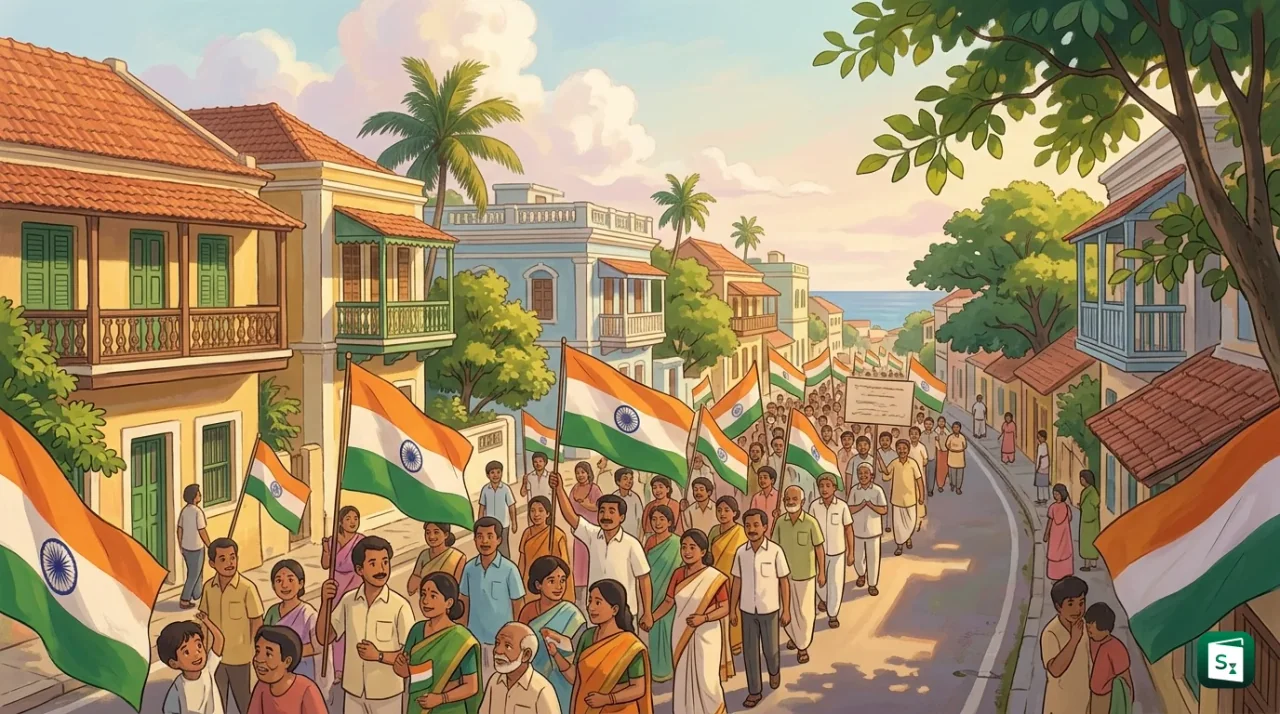
Union Home Minister Amit Shah flagged off the Har Ghar Tiranga Yatra at Murugaa Theatre Signal in Puducherry during his two-day visit to the Union Territory. The 2026 edition of the Har Ghar Tiranga campaign is dedicated to the commemoration of 150 years of Vande Mataram, India’s national song. The campaign, launched by Prime Minister Narendra Modi in 2022, urges citizens to treat the Tricolour as a living symbol of national unity, sovereignty and identity.
The Har Ghar Tiranga Yatra in Puducherry
Shah participated in the yatra on 9 August 2026, a day after arriving in Puducherry on a two-day official visit. The flagging-off at Murugaa Theatre Signal was part of the larger Har Ghar Tiranga movement, and similar rallies were held across states and Union Territories in the run-up to Independence Day.
During the same visit, Shah attended the presentation ceremony of the President’s Colour to the Puducherry Police at the Armed Police Ground in Gorimedu. The President’s Colour is the highest honour a police force can receive, and Puducherry became the 18th state or Union Territory to get it. The Union Home Minister also urged citizens to join the campaign through Tiranga Yatras, mass singing of Vande Mataram, and by uploading a selfie with the national flag on the official portal, harghartiranga.com.
What Is the Har Ghar Tiranga Campaign?
The Har Ghar Tiranga campaign was launched by Prime Minister Narendra Modi in 2022 as part of Azadi ka Amrit Mahotsav, the government’s celebration of 75 years of India’s Independence. Its core idea is simple: bring the national flag into every home and encourage ordinary citizens to hoist it, rather than seeing the Tiranga only at official buildings.
The campaign rests on a people’s participation model. Citizens hoist the flag, take part in rallies and cultural events, and upload their photographs on the campaign website. Over the years it has grown into what the government describes as the world’s biggest citizens’ movement, with crores of Indians taking part in each edition.
The Flag Code of India and Its 2022 Amendments
The display of the national flag is governed by the Flag Code of India, 2002, along with the Prevention of Insults to National Honour Act, 1971. When the Har Ghar Tiranga campaign began, the government amended the Flag Code to make it easier for citizens to participate.
Two changes were especially significant. A December 2021 amendment allowed the use of machine-made flags and polyester. A July 2022 order permitted citizens to fly the flag day and night, so households were no longer bound by the old rule that restricted flag display to daylight hours. The flag must still be rectangular, with a 3:2 length-to-width ratio, and it must never touch the ground or be used disrespectfully.
Why the 2026 Edition Focuses on Vande Mataram
This year’s Har Ghar Tiranga campaign carries the theme Spirit of Vande Mataram. It runs from 9 to 17 August 2026, wrapping around the 80th Independence Day on 15 August. The reason for the theme is a milestone: the national song is completing 150 years in 2026.
The Story of Vande Mataram
Vande Mataram, which means “Mother, I bow to thee”, was written by Bankim Chandra Chattopadhyay on 7 November 1875, on the auspicious day of Akshaya Navami. Written in Sanskritised Bengali, it first appeared in the literary journal Bangadarshan and was later included in his famous novel Anandamath, published in 1882. The song was set to music by Rabindranath Tagore and was first sung by him at the 1896 session of the Indian National Congress in Calcutta.
The song became a rallying cry of the freedom struggle. It was first used as a political slogan on 7 August 1905, during the Swadeshi Movement that followed the partition of Bengal. Freedom fighters raised it in processions, meetings and courtrooms, and it is said to have been the last word on the lips of many who were sentenced to death. The Constituent Assembly gave it the status of the national song on 24 January 1950, declaring that it would be honoured equally with the national anthem, Jana Gana Mana.
A Year-Long National Commemoration
The government began a year-long commemoration of the song’s 150th anniversary on 7 November 2025. The Prime Minister inaugurated it at the Indira Gandhi Indoor Stadium in New Delhi, where a commemorative stamp and coin were also released. The celebrations continue until 7 November 2026.
Several related decisions mark the anniversary. The Home Ministry has directed that Vande Mataram be sung before the national anthem at official events and schools, and that the full six-stanza version be used. Parliament has also amended the Prevention of Insults to National Honour Act to criminalise disrespect to the national song, giving it protection equal to that of the national anthem. For the first time, Vande Mataram is set to be sung from the ramparts of the Red Fort during the Independence Day ceremony.
Who Organises the Campaign and How Citizens Can Take Part
The Ministry of Culture is the nodal ministry for the Har Ghar Tiranga campaign. It coordinates with state governments, educational institutions, local bodies and self-help groups, some of which now make Tirangas themselves.
This year’s campaign has several signature activities:
| Activity | Detail |
|---|---|
| Flag hoisting | Citizens hoist the national flag at home from 9 to 17 August |
| Selfie with Tiranga | Photographs uploaded on harghartiranga.com earn a digital certificate |
| Tiranga rallies and concerts | Processions, bike and cycle rallies and musical events across the country |
| Band performances | Military and paramilitary bands perform nationwide until 15 August |
| Suryapath Tiranga | Indian missions abroad hoist the flag in succession from east to west, following the rising sun |
The campaign closes on 17 August with a grand musical concert in New Delhi.
Significance of the Campaign
The Har Ghar Tiranga movement connects citizens with the two most powerful symbols of the freedom struggle: the Tiranga and Vande Mataram. By turning flag hoisting into a household act, it shifts the national flag from an official emblem to a personal expression of patriotism.
The Puducherry launch also carries a symbolic message. Puducherry was a French colony until 1954, when it joined the Indian Union through a peaceful merger. Hoisting the Tricolour there reinforces the idea of unity across territories that came together to form modern India. With the country preparing to celebrate its 80th Independence Day and the government’s Viksit Bharat vision for 2047, the campaign seeks to channel collective pride into nation-building.
Key Takeaways
- Union Home Minister Amit Shah flagged off the Har Ghar Tiranga Yatra at Murugaa Theatre Signal, Puducherry on 9 August 2026.
- The Har Ghar Tiranga campaign was launched by PM Narendra Modi in 2022 under Azadi ka Amrit Mahotsav, marking 75 years of India’s Independence.
- The Ministry of Culture is the nodal ministry for the campaign, whose portal is harghartiranga.com.
- The 2026 edition is dedicated to 150 years of Vande Mataram, written by Bankim Chandra Chattopadhyay on 7 November 1875.
- Vande Mataram was adopted as the national song by the Constituent Assembly on 24 January 1950, with status equal to the national anthem.
- The Flag Code of India, 2002 governs flag display, and its 2022 amendment permits citizens to fly the national flag day and night.