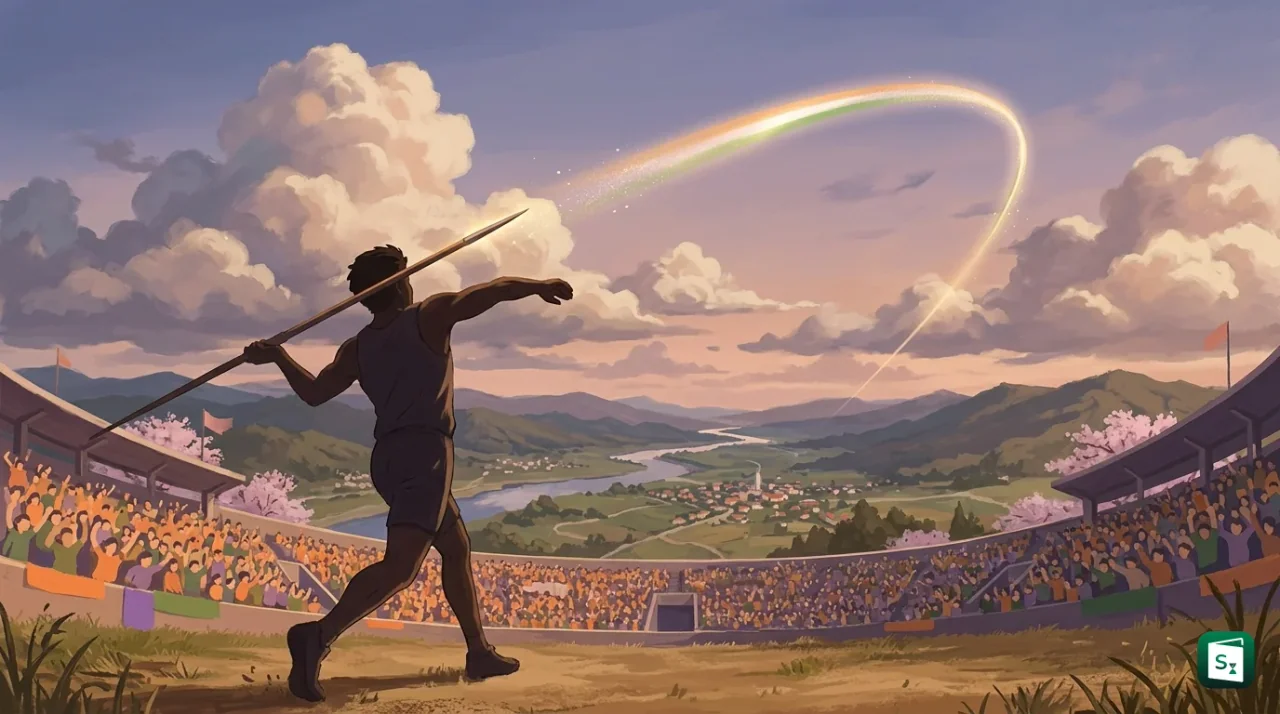
Every year on August 7, India celebrates National Javelin Day, a day dedicated to the sport that gave the nation its proudest moment in Olympic athletics. The day marks the anniversary of Neeraj Chopra’s gold medal-winning throw of 87.58 metres at the Tokyo 2020 Olympics on August 7, 2021, which made him only the second Indian after Abhinav Bindra to win an individual Olympic gold medal. Instituted by the Athletics Federation of India in 2022, the day has grown into a nationwide celebration of athletic excellence and grassroots sports development.
The Historic Throw That Started It All
On August 7, 2021, Neeraj Chopra stepped onto the track at the Japan National Stadium in Tokyo for the men’s javelin throw final. He was just 23 years old, carrying the weight of a billion expectations and the memory of a nation that had never won an Olympic medal in track and field. In his very first attempt, he launched the javelin 87.03 metres, placing him at the top of the leaderboard. Then, on his second throw, he improved to 87.58 metres, a distance that would prove insurmountable for the rest of the field.
The moment was seismic. Germany’s Johannes Vetter, the world number one and overwhelming favourite, failed to make the top eight after three rounds, crashing out in ninth place. Czech athletes Jakub Vadlejch and Vitezslav Vesely took silver and bronze respectively. But the story of the evening belonged to the 23-year-old from Khandra village in Haryana.
With that throw, Neeraj became the first Indian to win an Olympic gold medal in athletics and only the second Indian individual gold medallist in Olympic history, after shooter Abhinav Bindra won the 10m air rifle event at the 2008 Beijing Olympics. India had waited over 120 years for this moment in track and field. The only previous Olympic medal in athletics for India came in 1900, when Norman Pritchard won two silver medals in Paris, and even that attribution remains disputed.
Neeraj dedicated his win to the memory of sprinter Milkha Singh and track legend P.T. Usha, two Indian athletics icons who had come agonisingly close to Olympic glory in their respective eras but never reached the podium.
Who Is Neeraj Chopra?
Subedar Major Neeraj Chopra PVSM VSM was born on December 24, 1997, in Khandra, a small farming village in Panipat district of Haryana. His parents, Satish Kumar Chopra and Saroj Devi, are both farmers. Neeraj, the eldest of three children, struggled with obesity as a child, which prompted his father to enrol him at a local gymnasium in Madlauda. It was there, around the age of 11 to 13, that he first picked up a javelin and discovered a natural talent for the sport.
At the Sports Authority of India (SAI) centre in Panipat, javelin coach Jaiveer Singh Chaudhary recognised the young boy’s potential and began training him. Neeraj later moved to the Tau Devi Lal Sports Complex in Panchkula, where he trained under coach Naseem Ahmad. He studied videos of Czech legend Jan Zelezny, widely regarded as the greatest javelin thrower in history, to refine his technique.
Neeraj’s career trajectory accelerated rapidly. He won the gold medal at the 2016 IAAF World U20 Championships in Bydgoszcz, Poland, with a junior world record throw of 86.48 metres. This made him the first Indian track and field athlete to become a world champion at any level. He then won gold at the 2018 Commonwealth Games in Gold Coast with a throw of 86.47m, and at the 2018 Asian Games in Jakarta with an 88.06m effort.
A significant setback came in 2019 when Neeraj suffered an elbow injury that required surgery on May 3, just as the Tokyo Olympics qualification window opened. The postponement of the Games due to the COVID-19 pandemic gave him crucial time to recover and rebuild. For his Tokyo preparation, he trained under German coach Uwe Hohn, the first man to throw a javelin over 100 metres, and South African biomechanics expert Klaus Bartonietz.
Neeraj also built a career in the military. He was commissioned as a Junior Commissioned Officer in the Rajputana Rifles regiment of the Indian Army. His Olympic success earned him an out-of-turn promotion to Subedar, and in 2025, he was conferred the honorary rank of Lieutenant Colonel in the Territorial Army.
His list of national and international awards includes the Arjuna Award (2018), the Major Dhyan Chand Khel Ratna Award (2021), India’s highest sporting honour, and the Padma Shri (2022), the country’s fourth-highest civilian award. He also received the Vishisht Seva Medal (2020) and Param Vishisht Seva Medal (2022) for his service in the Indian Army.
From Ancient Weapon to Olympic Sport
The javelin throw is among the oldest athletic events in human history. Long before it became a sport, the javelin was a weapon used by hunters and soldiers across ancient civilisations. In ancient Greece, the javelin was one of the five events of the pentathlon, which also included the discus throw, long jump, sprint, and wrestling. The javelin was added to the Ancient Olympic Games in 708 BC during the 18th Olympiad.
Greek athletes used a leather strap called an ankyle (or amentum in Latin) wound around the middle of the javelin shaft. This strap provided additional leverage and axial spin during release, significantly increasing throwing distance. Experiments conducted centuries later showed that an untrained thrower who could only manage 25 metres unaided could reach 65 metres using this technique.
The javelin throw remained a part of ancient athletic competitions for centuries but disappeared from formal sport during the Middle Ages. It re-emerged in Scandinavia in the 18th and 19th centuries, where it was practised both for distance and for accuracy. Sweden conducted the first national championship in the event in 1896, and Swedish and Finnish athletes dominated the sport’s early international records.
The javelin throw made its modern Olympic debut at the 1908 London Olympics. Swedish athlete Eric Lemming won the inaugural event and went on to defend his title at the 1912 Stockholm Olympics, setting the first officially ratified javelin world record at 62.32 metres. Women’s javelin was added to the Olympic programme in 1932.
The modern javelin is a far cry from its ancient wooden ancestors. The men’s javelin must be between 260 cm and 270 cm in length and weigh at least 800 grams. The women’s version is shorter and lighter, between 220 cm and 230 cm, weighing at least 600 grams. The implement must land point first for a throw to be measured, and the athlete must not cross the foul line at the end of the runway.
The world record in men’s javelin stands at 98.48 metres, set by Czech athlete Jan Zelezny in 1996. Neeraj Chopra’s personal best of 90.23 metres, achieved at the 2025 Doha Diamond League, makes him the 25th man in history to breach the 90-metre barrier.
How National Javelin Day Came to Be
The Athletics Federation of India (AFI), the apex governing body for athletics in the country, was formed in 1946 and is affiliated to World Athletics, the Asian Athletics Association, and the Indian Olympic Association. Headquartered in New Delhi, the AFI oversees 32 affiliated state and institutional units and organises national championships, training camps, and selections for international competitions.
Recognising the magnitude of Neeraj Chopra’s achievement at Tokyo, the AFI declared August 7 as National Javelin Day. The decision was announced by AFI President Adille J. Sumariwalla, who stated that the initiative would serve a dual purpose: celebrating Neeraj’s historic feat and promoting javelin throw at the grassroots level across the country. The first official observance took place on August 7, 2022.
Since then, the day has become a platform for grassroots talent identification and development. In 2022 and 2023, over 600 districts across India hosted local javelin competitions on this date. AFI also launched the “Find the Next Neeraj” initiative, a scouting programme aimed at discovering javelin talent from rural and semi-urban areas. This programme draws from the success of government schemes like Khelo India, launched in 2018, which has built a broader talent pipeline across multiple sports disciplines.
The impact has been tangible. Before Neeraj’s Olympic gold, javelin throw was a relatively obscure sport in India with minimal participation. Today, India boasts a growing pool of competitive javelin throwers. Athletes like Kishore Kumar Jena, D.P. Manu, and Shivpal Singh have emerged as serious contenders on the world stage. Kishore Jena, in particular, won a silver medal at the 2023 Asian Games in Hangzhou, finishing behind Neeraj in a historic Indian 1-2 finish in javelin throw.
AFI’s affiliated units across states and union territories organise official javelin throw competitions every August 7, ensuring that the day serves not just as a celebration but as a concrete mechanism for discovering and nurturing the next generation of Indian throwers.
Neeraj Chopra’s Career Milestones Post-Tokyo
Neeraj Chopra did not rest on his Olympic laurels. The years following his Tokyo triumph have been marked by a relentless pursuit of excellence across every major javelin competition in the world.
In July 2022, Neeraj became the first Indian to win a medal at the World Athletics Championships. At the event in Oregon, USA, he threw 88.31 metres to claim a silver medal, finishing behind defending champion Anderson Peters of Grenada. This was only the second-ever World Championships medal for India in athletics, after long jumper Anju Bobby George won bronze at the 2003 Paris Worlds.
Later in 2022, Neeraj won the Diamond League title in Zurich with a throw of 88.44 metres, becoming the first Indian athlete ever to win a Diamond League event. He followed this with another gold at the 2022 Asian Games in Hangzhou, defending his title with a season-best throw of 88.88 metres and leading a historic Indian 1-2 finish with Kishore Jena taking silver.
The pinnacle of Neeraj’s post-Tokyo career came at the 2023 World Athletics Championships in Budapest, Hungary. He threw 88.17 metres to win the gold medal, becoming the first Asian athlete to win a World Championships gold in javelin throw. This made him the first Indian to become a senior world champion in athletics.
At the 2024 Paris Olympics, Neeraj improved his Olympic throw to 89.45 metres but had to settle for a silver medal behind Pakistan’s Arshad Nadeem, who set an Olympic record with a massive throw of 92.97 metres. Despite the disappointment, the silver made Neeraj the fifth individual multiple medallist for India at the Olympics and the first to win a gold-silver combination.
In May 2025, at the Doha Diamond League, Neeraj finally breached the elusive 90-metre barrier for the first time, recording a throw of 90.23 metres. This set a new Indian national record and made him the 25th man in history to throw beyond 90 metres.
In a unique milestone in July 2025, Neeraj became the first Indian athlete to host and compete in an international event when World Athletics named a Gold category javelin meet after him, the Neeraj Chopra Classic, held in Bengaluru. The event served as a key qualification event for the 2025 World Athletics Championships.
Key Takeaways
- National Javelin Day is observed every year on August 7 to commemorate Neeraj Chopra’s historic gold medal at the Tokyo 2020 Olympics, and was first officially celebrated in 2022.
- Neeraj Chopra threw 87.58 metres at the Tokyo 2020 Olympics on August 7, 2021, becoming the first Indian to win an Olympic gold medal in athletics and only the second Indian individual gold medallist after Abhinav Bindra.
- The Athletics Federation of India (AFI), formed in 1946 and headquartered in New Delhi, designated August 7 as National Javelin Day to promote the sport at the grassroots level.
- Neeraj Chopra holds the Indian national record of 90.23 metres, set at the 2025 Doha Diamond League, making him the 25th man in history to breach the 90-metre barrier.
- Neeraj was conferred the honorary rank of Lieutenant Colonel in the Territorial Army in 2025 and has received the Major Dhyan Chand Khel Ratna Award (2021) and Padma Shri (2022).
- The javelin throw was part of the Ancient Olympic Games since 708 BC and made its modern Olympic debut at the 1908 London Olympics.