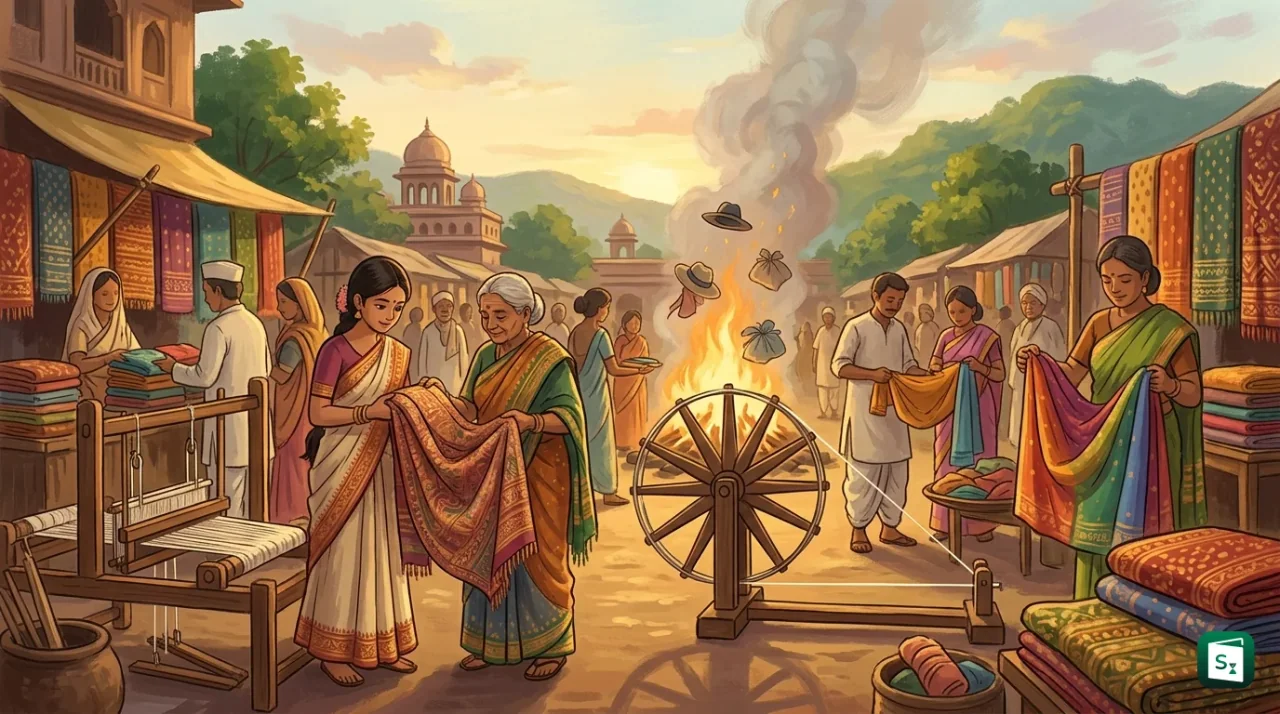
India observed the 12th National Handloom Day on 7 August 2026, celebrating the country\u2019s rich weaving heritage and the contribution of over 35 lakh handloom weavers and allied workers. The day marks the anniversary of the Swadeshi Movement, formally launched at Calcutta Town Hall on 7 August 1905, which became a defining expression of India\u2019s fight for economic self-reliance during the freedom struggle.
Why August 7 Was Chosen
The choice of 7 August as National Handloom Day is rooted in one of the most significant episodes of India\u2019s freedom struggle. On this day in 1905, a massive public meeting at Calcutta Town Hall formally proclaimed the Swadeshi Movement, calling on Indians to boycott British manufactured goods and embrace indigenous products. The movement was a direct response to the British decision to partition Bengal, which Indian leaders saw as a deliberate attempt to divide the nationalist movement.
The Swadeshi Movement of 1905
The Swadeshi Movement was not merely a political protest. It was an economic revolt that championed the idea of self-reliance, or Atma-shakti, as Mahatma Gandhi later described it. Indian leaders such as Bal Gangadhar Tilak, Bipin Chandra Pal, and Lala Lajpat Rai urged people to use locally produced textiles and support domestic industries. Handloom became the most visible symbol of this economic nationalism, as people across the country shifted from Manchester cloth to locally woven Indian fabrics.
The movement had a lasting impact on India\u2019s industrial landscape. It led to a massive revival of the domestic cottage and handloom industries, and spurred the establishment of several indigenous companies. The spirit of Swadeshi continued to influence Mahatma Gandhi\u2019s later campaigns, including the Non-Cooperation Movement and the Civil Disobedience Movement, where khadi and handloom remained central symbols of resistance.
How National Handloom Day Came Into Being
Recognising the deep historical connection between handloom weaving and India\u2019s freedom movement, the Government of India designated 7 August as National Handloom Day. The first observance took place in 2015, when Prime Minister Narendra Modi launched the initiative in Chennai, Tamil Nadu. The date was chosen specifically to honour the legacy of the Swadeshi Movement and to celebrate the continued contribution of handloom weavers to the national economy and cultural identity.
Since 2015, the day has been observed annually with exhibitions, award ceremonies, and public programmes aimed at raising awareness about India\u2019s handloom traditions. The Ministry of Textiles serves as the nodal ministry for the handloom sector, while the Development Commissioner (Handlooms) oversees the implementation of various welfare and development schemes.
India\u2019s Handloom Sector: A Living Heritage
India\u2019s handloom tradition is among the oldest documented textile traditions in the world. Archaeological evidence from the Indus Valley Civilisation shows cotton cultivation, spinning, and weaving dating back to 5000\u20133000 BCE. Ancient texts such as the Rigveda, Ramayana, Mahabharata, and Kautilya\u2019s Arthashastra reference spinning, weaving, and the quality of Indian textiles. Over centuries, different regions developed distinctive weaving techniques that became closely associated with local cultural identity.
The Fourth All India Handloom Census
India has conducted four handloom censuses, in 1987\u201388, 1995\u201396, 2009\u201310, and 2019\u201320, typically at intervals of 8 to 12 years. The Fourth All India Handloom Census (2019\u201320) provides the most recent official picture of the sector. Key findings include:
| Indicator | Figure |
|---|---|
| Total handloom households | 31.45 lakh |
| Weavers and allied workers | 35.22 lakh |
| Women in the workforce | 25.46 lakh (over 72%) |
| Total looms recorded | 28.20 lakh |
| Looms in rural areas | 25.30 lakh (nearly 90%) |
| Workers in pre-loom and post-loom activities | 8.48 lakh |
The data highlights the overwhelmingly rural character of the handloom sector, with nearly nine out of every ten looms located in rural India. It also underscores the critical role of women, who form the backbone of the handloom workforce. The sector is a significant source of livelihood for disadvantaged communities, including 4.84 lakh Scheduled Caste workers, 6.28 lakh Scheduled Tribe workers, and 12.67 lakh Other Backward Classes workers.
Government Initiatives for Handloom Weavers
Over the years, the Government of India has launched several schemes to strengthen the handloom ecosystem. These programmes focus on weaver welfare, infrastructure development, raw material access, credit support, and market linkages.
National Handloom Development Programme
The National Handloom Development Programme (NHDP), formulated for 2021\u201322 to 2025\u201326, is the flagship initiative for the integrated development of the handloom sector. It adopts a need-based approach to improving weaver welfare, infrastructure, production capacity, credit access, and marketing. The programme is implemented through government handloom organisations, state corporations, cooperative societies, federations, Handloom Producer Companies (HPCs), and participating banks. Between 2020\u201321 and 2026\u201327, around 200 HPCs were formed to help weavers organise collectively, improve bargaining power, and strengthen market access.
A key component of the NHDP is the Small Cluster Development Programme (SCDP), which provides assistance of up to \u20b92 crore per cluster for improved looms, lighting, worksheds, design development, and marketing. Between 2021\u201322 and June 2026\u201327, 357 clusters were sanctioned, and \u20b994 crore was released during 2025\u201326 alone. The impact has been significant: average daily production increased by 53%, working hours rose by 60%, and daily earnings grew by 42%, from \u20b9328 to \u20b9465. The adoption of electronic jacquards further boosted productivity, raising daily wages from \u20b9360 to \u20b9560 and average monthly income from \u20b99,600 to \u20b915,000.
Raw Material Supply Scheme and Credit Support
The Raw Material Supply Scheme (RMSS) improves access to quality yarn by reimbursing freight charges on all types of yarn and providing a 15% price subsidy on specified yarns within prescribed limits. For 2026\u201327, the NHDP and RMSS received allocations of \u20b9205 crore and \u20b9200 crore, respectively.
On the credit front, the Weaver MUDRA Scheme provides handloom-sector loans at a concessional interest rate of 6% for three years, supported by government interest subvention of up to 7%, margin-money assistance, and credit-guarantee fee coverage. Over 40,000 loans worth more than \u20b9280 crore were sanctioned between 2021\u201322 and June 2026\u201327. Handloom workers also receive social security coverage under PMJJBY (\u20b92 lakh life insurance) and PMSBY (\u20b92 lakh for accidental death or total disability).
Weaves of India Festival 2026 and Handloom Hackathon
The 2026 celebrations were marked by two notable events. The Ministry of Textiles organised the Weaves of India Festival from 24 July to 7 August at the Central Cottage Industries Emporium in Janpath, New Delhi. The festival showcased 116 heritage handloom weaves from different parts of India, providing a platform for master weavers to display traditional craftsmanship, regional textile traditions, and contemporary design innovation.
In parallel, the Handloom Hackathon 2026, themed \u201cWeaving Innovation,\u201d invited students, weavers, startups, and researchers to develop solutions in design, sustainability, digital technology, productivity, branding, and entrepreneurship. The hackathon represents a fresh approach to modernising the handloom sector while preserving its cultural roots, bridging the gap between traditional craftsmanship and contemporary market demands.
Quality Assurance and Legal Protection
To protect authentic handloom products and give buyers confidence, the government has put in place several certification and legal mechanisms.
The Handloom Mark, launched in 2006, certifies that a product is genuinely handwoven and helps consumers identify authentic handloom items. By 30 June 2026, 29,402 registrations had been issued, and 815 retail outlets were selling Handloom Mark products across the country. The India Handloom Brand, launched on 7 August 2015, certifies premium natural-fibre products based on authentic designs, assured colourfastness, skin-friendly dyes, and minimal environmental impact. By June 2026, 2,305 registrations had been issued across 184 categories.
Legal protection comes through the Handlooms (Reservation of Articles for Production) Act, 1985, which reserves 11 textile articles exclusively for handloom production, shielding weavers from competition by powerlooms and mills. Under the Geographical Indications of Goods Act, 1999, GI registration protects regional handloom traditions from unauthorised use. As of August 2026, GI registrations covered 106 handloom products, six product logos, and 227 handicraft products. India\u2019s handloom exports reached approximately \u20b91,330.96 crore in 2025\u201326, with the UAE, United States, France, United Kingdom, and Spain as the leading export destinations.
The Way Forward
The Union Budget 2026\u201327 announced several new initiatives for the handloom and textile sector. These include the National Fibre Scheme to strengthen India\u2019s raw-material base and promote self-reliance in natural, man-made, and new-age fibres, the Textile Expansion and Employment Scheme to modernise traditional clusters through capital support and technology upgrades, and the National Handloom and Handicraft Programme to integrate and coordinate existing schemes more effectively. The Mahatma Gandhi Gram Swaraj Initiative will support khadi, handloom, handicrafts, and village industries through branding, skilling, and stronger global market linkages.
The e-Pehchan portal, launched in January 2025, has streamlined the registration of handloom workers and enabled corrections and card downloads. By July 2026, around 84,000 additional workers had been approved for e-Pehchan cards. Digital platforms such as GeM (with 1.50 lakh weavers onboarded) and IndiaHandmade (with 4,186 weavers and artisans registered between 2023\u201324 and June 2026) are opening new market channels for weavers to reach consumers directly.
India\u2019s handloom sector continues to evolve, combining centuries-old craftsmanship with modern design, digital tools, and sustainable production. The challenge ahead lies in raising weaver incomes, expanding global market access, and ensuring that the sector\u2019s rich cultural heritage is preserved even as it adapts to changing consumer preferences.
Key Takeaways
- National Handloom Day is observed every year on 7 August to honour India\u2019s weaving heritage and the contribution of millions of handloom weavers.
- The date commemorates the launch of the Swadeshi Movement on 7 August 1905 at Calcutta Town Hall, which promoted indigenous goods and economic self-reliance.
- The first National Handloom Day was launched by Prime Minister Narendra Modi in Chennai on 7 August 2015.
- The Fourth All India Handloom Census (2019\u201320) recorded 35.22 lakh weavers and allied workers, with over 72% being women.
- The National Handloom Development Programme (NHDP) and the Raw Material Supply Scheme (RMSS) are the principal government schemes supporting the handloom sector.
- India\u2019s handloom exports stood at approximately \u20b91,330.96 crore in 2025\u201326, with major markets including the UAE, USA, France, UK, and Spain.