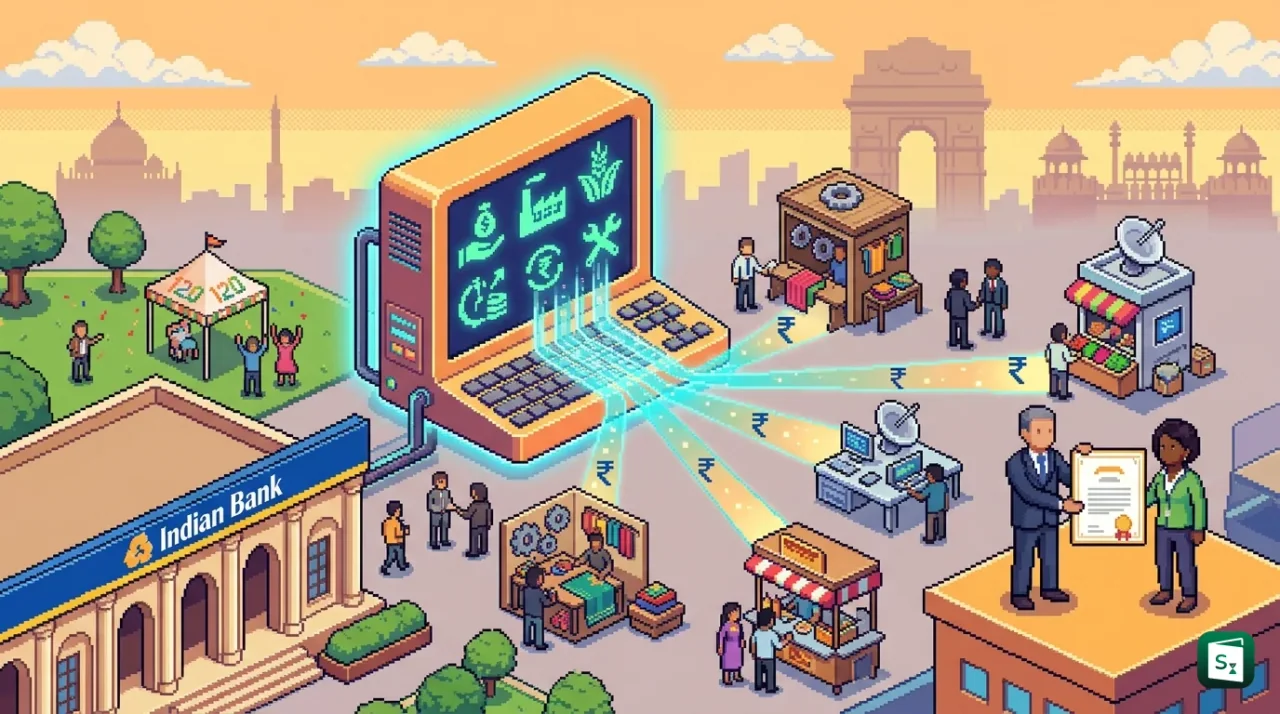
Indian Bank approved nearly ₹500 crore in Micro, Small and Medium Enterprises (MSME) loans for 128 beneficiaries at a Credit Outreach Programme in New Delhi. The event also mobilised credit proposals worth nearly ₹1,250 crore and introduced the Unified MSME Portal, a digital platform intended to bring lending services for the bank’s MSME customers onto an integrated channel.
Indian Bank’s Credit Outreach Programme
The programme formed part of Indian Bank’s 120th Foundation Day Fortnight Celebrations. It combined direct loan approvals with the mobilisation of new credit proposals, allowing eligible enterprises to move from loan applications to formal institutional finance.
The two figures represent different stages of lending. The nearly ₹500 crore amount was approved for 128 beneficiaries, while proposals worth nearly ₹1,250 crore were mobilised for consideration through the bank’s credit process. This distinction is important because mobilisation indicates demand and pipeline creation, whereas approval records the bank’s lending decision after assessment.
The outreach model takes banking services closer to business owners and can help reduce delays caused by limited awareness, fragmented documentation and repeated visits to branches. For small businesses, quicker access to working capital and term loans can support inventory purchases, wage payments, machinery acquisition and business expansion.
Unified MSME Portal and Digital Lending
The Unified MSME Portal is designed as a single digital interface for Indian Bank’s MSME customers. Its stated purpose is to provide seamless and integrated lending services, which can connect customer onboarding, document submission, credit appraisal and application tracking within a common process.
An integrated platform can improve the visibility of a loan application at each stage. It can also reduce duplication when a borrower’s business identity, banking information and financial documents are used for credit assessment. The portal’s value will ultimately depend on secure data handling, clear communication of loan terms and timely human support when an application requires clarification.
The portal fits into a wider digital credit ecosystem. The Udyam Registration Portal, launched in July 2020 by the Ministry of Micro, Small and Medium Enterprises, gives registered enterprises a formal digital identity. The Udyam Assist Platform, launched in January 2023, brings informal micro enterprises into the formal system through authorised partners such as banks and other lending institutions.
These systems matter because formal recognition can help an enterprise approach banks, access government support and benefit from Priority Sector Lending, a regulatory framework that directs credit toward sectors considered important for broad-based development. As of 28 February 2026, more than 7.83 crore enterprises had been registered on the Udyam Registration Portal and Udyam Assist Platform together.
Why MSME Credit Access Matters
The Micro, Small and Medium Enterprises Development Act, 2006 provides the legal framework for the MSME sector. The classification of an enterprise is based on a composite assessment of investment in plant and machinery or equipment and annual turnover. This approach allows a growing business to expand without immediately losing its MSME identity because of a single increase in investment or sales.
MSMEs support employment, local supply chains and industrial activity outside large urban centres. They include manufacturing units, service providers and eligible trading enterprises. Timely credit helps these businesses manage cash-flow gaps, adopt better technology and accept larger orders that may otherwise be beyond their financial capacity.
Formal lending is also linked to payment discipline. The MSMED Act requires buyers to pay Micro and Small Enterprises within the agreed period, subject to a statutory maximum of 45 days. Digital systems such as the Ministry of MSME’s SAMADHAAN Portal allow eligible enterprises to file and track delayed-payment complaints, helping protect working capital.
Institutional Context and Policy Linkages
Indian Bank is a public sector bank headquartered in Chennai, Tamil Nadu. It was established in 1907 and became a nationalised bank in 1969. Its long institutional history and branch network give it a role in extending formal credit to businesses that may not be served adequately by large corporate-focused lending channels.
The bank’s MSME lending is supported by products that combine credit with risk-sharing mechanisms. For example, its MSE-GIFT product covers eligible green projects such as renewable energy, energy efficiency, cleaner production, waste management and electric mobility. Depending on the facility and borrower category, credit guarantee cover can reduce the need for conventional collateral, although final lending remains subject to appraisal and the applicable scheme conditions.
At the national level, the Credit Guarantee Scheme for Micro and Small Enterprises is implemented through the Credit Guarantee Fund Trust for Micro and Small Enterprises, commonly called CGTMSE. The scheme helps eligible Micro and Small Enterprises obtain credit without collateral security or third-party guarantees by sharing part of the lender’s credit risk. Such mechanisms are particularly relevant for first-generation entrepreneurs whose business prospects may be sound but whose asset base is limited.
Digital lending is also developing through the Unified Lending Interface, or ULI. It is an application programming interface based framework that allows lenders and approved data providers to exchange information for faster credit assessment with customer consent. The Unified MSME Portal is an institution-specific platform, while ULI is a broader lending infrastructure. They should not be treated as the same system.
Significance of the Initiative
The programme links three parts of the MSME credit chain: outreach to potential borrowers, sanction of eligible loans and digital delivery of lending services. The nearly ₹1,250 crore proposal pipeline indicates the scale of credit demand presented at the event, while the nearly ₹500 crore in approvals shows the immediate lending outcome for 128 beneficiaries.
The new portal can make that process more transparent for borrowers if it provides clear application stages, predictable document requirements and timely updates. It can also help the bank use standardised information for appraisal and identify applications that need additional support. These gains can lower transaction costs, but they must be balanced with safeguards for privacy, consent, fraud prevention and responsible lending.
The broader policy objective is to move more enterprises from informal borrowing toward regulated financial institutions. Udyam registration, credit guarantees, digital application systems and delayed-payment protections address different barriers. Their combined effect can improve the flow of credit to productive businesses, especially micro and small units with limited collateral and incomplete formal financial histories.
Key Takeaways
- Indian Bank approved nearly ₹500 crore in MSME loans for 128 beneficiaries at a Credit Outreach Programme in New Delhi.
- The programme mobilised credit proposals worth nearly ₹1,250 crore during the bank’s 120th Foundation Day Fortnight Celebrations.
- Indian Bank launched the Unified MSME Portal to provide integrated digital lending services to its MSME customers.
- The Udyam Registration Portal was launched in July 2020, while the Udyam Assist Platform was launched in January 2023 to formalise informal micro enterprises.
- More than 7.83 crore enterprises were registered on the Udyam Registration Portal and Udyam Assist Platform together as of 28 February 2026.
- The MSMED Act, 2006 provides protection to Micro and Small Enterprises against delayed payments, with a statutory maximum payment period of 45 days.