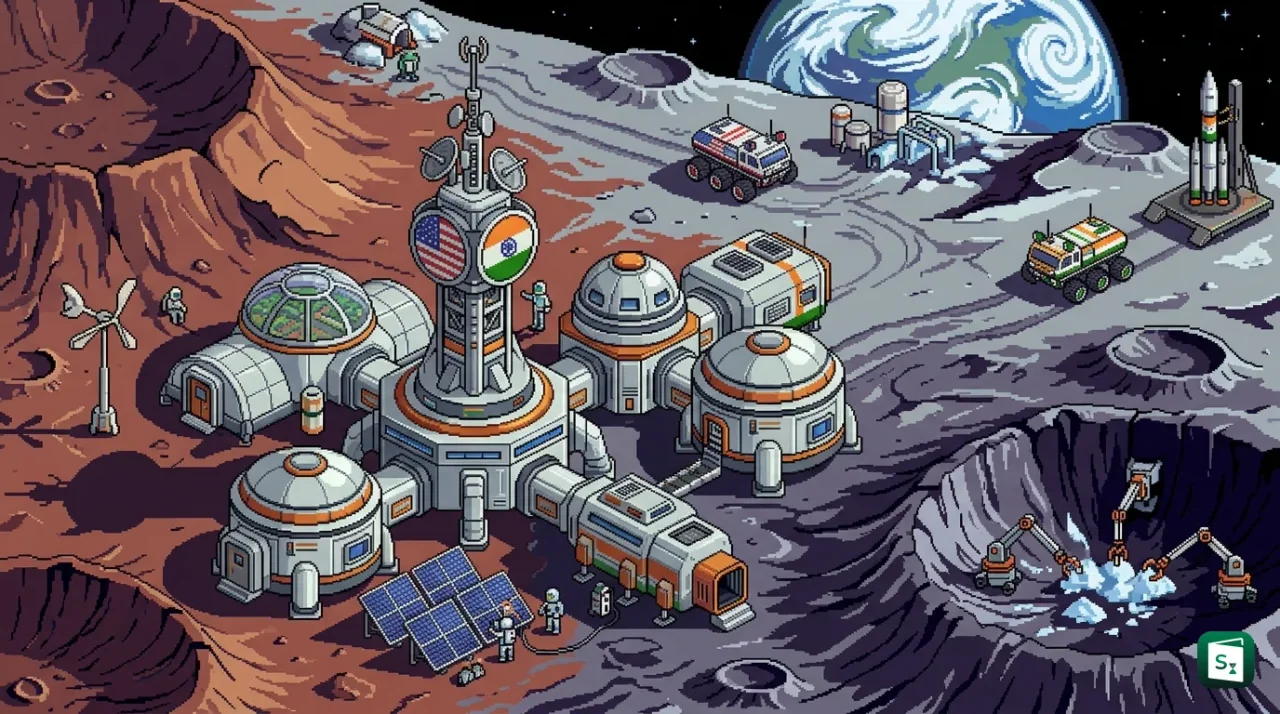
NASA has invited the Indian Space Research Organisation (ISRO) to join its Moon Base programme, a flagship initiative to establish the first permanent human outpost near the lunar South Pole. The invitation was extended during the 9th India-US Civil Space Joint Working Group (CSJWG) meeting held at ISRO Headquarters in Bengaluru on 5 and 6 August 2026. The offer deepens the strategic space partnership between the two countries under the Artemis Accords and signals a new phase where India could contribute to humanity’s first sustained presence on the Moon.
What Is NASA’s Moon Base Programme?
The Moon Base programme is NASA’s flagship initiative to build a permanent, habitable outpost where astronauts can live, work, and conduct scientific research over extended periods. Unlike the short “visit-and-return” missions of the Apollo era, this programme aims to keep humans on the lunar surface on a semi-permanent basis. NASA announced the programme during its “Ignition” event on 24 March 2026, unveiling a series of initiatives aligned with the United States’ National Space Policy.
The outpost will be located near the lunar South Pole, a region of intense scientific and strategic interest. NASA plans to develop transportation, power, communications, habitation, logistics, and cargo delivery systems needed to support this first lunar settlement. The programme is managed by NASA’s Moon Base programme executive, Carlos García-Galán, and forms part of the broader Artemis campaign.
The Three-Phase Roadmap
NASA has outlined a phased approach to building the Moon Base:
| Phase | Timeline | Key Activities |
|---|---|---|
| Phase 1 | Now through 2028 | Robotic landers, hopping drones, and survey missions to scout the South Pole and deliver scientific instruments. More than 20 robotic landings are planned through 2029. |
| Phase 2 | 2029 onwards | Repeated crewed missions to expand the site, build the first pressurized habitats, and install power generators. |
| Phase 3 | Mid-2030s | Semi-permanent habitats with astronauts living on the Moon for extended stays, with a completed operational outpost. |
Phase 1 alone is estimated to cost approximately $10 billion and involves commercial partners including Blue Origin, Firefly Aerospace, Intuitive Machines, Voyager Technologies, and Northrop Grumman. These companies are developing landers, rovers, and other systems to build a reliable supply chain before astronauts arrive.
Why the Lunar South Pole?
The choice of the lunar South Pole as the location for the Moon Base is not accidental. This region offers two critical advantages that make it the most promising site for a permanent outpost.
Water ice. Permanently shadowed craters near the South Pole, where sunlight has not reached for billions of years, are believed to contain significant deposits of water ice. This ice could be melted for drinking water, split into hydrogen and oxygen for rocket fuel, and used to produce breathable atmosphere. In situ resource utilisation (ISRU), the practice of using local resources rather than importing everything from Earth, is essential for any long-term lunar settlement. The Shackleton Crater, located at the South Pole, is one of the primary candidates for the Moon Base site precisely because of its potential ice deposits.
Near-constant sunlight. While crater floors remain in perpetual darkness, nearby mountain ridges receive sunlight for most of the lunar day. This makes solar power generation viable for extended periods. The combination of water ice and solar energy access makes the South Pole the only location on the Moon where a self-sustaining settlement is feasible.
The lunar South Pole also sits within the South Pole-Aitken Basin, the Moon’s oldest and largest impact basin, offering scientists a window into billions of years of lunar geologic history. Studying this basin could reveal fundamental information about the early Solar System.
The lunar South Pole has become a focal point of international exploration. China’s Chang’e-7 mission, targeted for around 2026, is also designed to explore this region and detect water ice. India’s own Chandrayaan-3 landed near the South Pole in August 2023, demonstrating that the region is technically accessible.
The Artemis Programme: The Bigger Framework
The Moon Base programme does not exist in isolation. It is a critical component of Artemis, NASA’s overarching lunar exploration programme established in 2017 during President Donald Trump’s first term. Artemis aims to return humans to the Moon and use it as a stepping stone for future crewed missions to Mars.
The programme has already achieved several milestones:
| Mission | Date | Description |
|---|---|---|
| Artemis I | November 2022 | Uncrewed test flight of the Space Launch System (SLS) rocket and Orion spacecraft around the Moon |
| Artemis II | April 1, 2026 | First crewed flight beyond low Earth orbit since Apollo 17 in 1972. Four astronauts flew a lunar flyby |
| Artemis III | Late 2027 (planned) | Test of the Human Landing System (HLS) lunar lander in Earth orbit |
| Artemis IV | Early 2028 (planned) | First crewed lunar landing since Apollo 17, targeting the South Pole |
| Artemis V | Late 2028 (planned) | Second lunar landing with initial efforts to begin building the permanent Moon Base |
The programme involves major international partners. The European Space Agency (ESA) is building the International Habitation Module (iHAB) for the Gateway lunar orbital station, in cooperation with the Japan Aerospace Exploration Agency (JAXA). JAXA is also developing a Pressurized Lunar Rover for surface operations. The Canadian Space Agency (CSA) is providing the Canadarm3 robotic arm. The Mohammed Bin Rashid Space Centre (MBRSC) of the UAE is building an airlock module.
The Artemis Accords
The international cooperation framework for Artemis is governed by the Artemis Accords, a non-binding set of principles established in 2020 by NASA. The Accords reinforce obligations under the 1967 Outer Space Treaty and cover areas such as peaceful exploration, transparency, registering space objects, and public release of scientific data.
Originally signed by eight nations in 2020, the Accords have grown to include 70 countries as of August 2026. India became the 27th signatory on 21 June 2023 during Prime Minister Narendra Modi’s state visit to the United States. Indian Ambassador Taranjit Singh Sandhu signed on behalf of India, with NASA Administrator Bill Nelson participating in the ceremony at the Willard InterContinental Hotel in Washington.
The 9th CSJWG Meeting: What Was Discussed
The invitation to ISRO was extended during the 9th India-US Civil Space Joint Working Group (CSJWG) meeting, hosted by India on 5 and 6 August 2026 at ISRO Headquarters in Bengaluru.
The CSJWG was established in 2005 to facilitate discussions between ISRO and NASA, along with other Indian and US government agencies, on civil and commercial space cooperation. Over the years, it has served as the primary institutional mechanism for advancing the India-US space partnership.
The meeting was co-chaired on the Indian side by M Sankaran, Director of ISRO’s UR Rao Satellite Centre (URSC), and on the US side by Dr Wesley Brooks, Assistant Secretary of State for Oceans and International Environmental and Scientific Affairs, and Kathleen Karika, NASA Associate Administrator for International and Interagency Relations. Dr V Narayanan, Chairman of ISRO and Secretary of the Department of Space, and US Ambassador to India Sergio Gor addressed the opening segment.
Several key outcomes emerged from the meeting:
- Moon Base invitation: NASA invited ISRO to participate in the Moon Base programme, building on the two countries’ partnership under the Artemis Accords.
- Scientific data sharing: Both sides agreed to advance discussions on open scientific data sharing under the Accords.
- NISAR cooperation: The agencies reviewed the successful collaboration on the NISAR (NASA-ISRO Synthetic Aperture Radar) mission, launched on 30 July 2025, and discussed expanding it.
- Human spaceflight: Future collaborations in space science and human spaceflight technology were identified as priority areas.
- Outer space sustainability: Both sides reaffirmed their commitment to advancing the United Nations Committee on the Peaceful Uses of Outer Space (COPUOS) guidelines on the long-term sustainability of outer space activities.
India’s Credentials in Lunar Exploration
NASA’s invitation to ISRO is not a ceremonial gesture. It is grounded in India’s demonstrated capabilities in lunar exploration and its growing track record of successful international space partnerships.
Chandrayaan-3: A South Pole First. On 23 August 2023, ISRO’s Chandrayaan-3 mission successfully landed the Vikram lander and Pragyan rover near the lunar South Pole, making India the fourth country to achieve a soft landing on the Moon and the first ever to land in the South Pole region. The mission cost approximately ₹615 crore (about $75 million), a fraction of what other space agencies spend on similar endeavours. The data collected by Chandrayaan-3 has since revealed a far more active electrical environment near the South Pole than previously understood, and the mission’s Laser Retroreflector Array continues to serve as a location marker for future exploration.
NISAR: Proving Ground for Joint Operations. The NISAR satellite, launched on 30 July 2025 from the Satish Dhawan Space Centre aboard an ISRO GSLV rocket, is the first Earth observation satellite to use dual-frequency synthetic aperture radar (L-band and S-band). The mission, which cost over a decade of joint development starting from an agreement signed in 2014, monitors changes in Earth’s land, ice, and water surfaces with centimetre-level precision. It scans nearly all land and ice surfaces every 12 days. NISAR demonstrated that NASA and ISRO can successfully collaborate on complex, large-scale space missions, providing the operational foundation for deeper cooperation including on the Moon Base.
Shubhanshu Shukla: India’s First ISS Astronaut. In June 2025, Group Captain Shubhanshu Shukla became the first Indian astronaut to visit the International Space Station as part of the Axiom-4 (Ax-4) mission. During the 18-day stay, Shukla and his international crewmates carried out more than 60 scientific experiments. The mission integrated with ISRO’s Gaganyaan programme, India’s independent human spaceflight initiative, and provided Indian engineers and astronauts with hands-on experience in orbital operations, rendezvous and docking procedures, and space medicine.
What This Invitation Means for India
If ISRO accepts the invitation and defines a specific role for itself, the implications for India’s space programme could be significant on multiple fronts.
Technological advancement. Participation in the Moon Base programme would expose ISRO to cutting-edge technologies in lunar habitation, power systems, in situ resource utilisation, and surface mobility. The experience gained from operating in the extreme environment of the lunar South Pole would feed directly into India’s own future lunar and deep-space missions, including the planned Chandrayaan-5 mission (a joint ISRO-JAXA venture under the LUPEX programme to study water ice at the South Pole).
Human spaceflight synergy. India’s Gaganyaan programme aims to develop the capability to send Indian astronauts into low Earth orbit. The expertise gained through Moon Base cooperation in areas such as life support systems, radiation protection, and long-duration space habitation could accelerate Gaganyaan’s objectives and prepare India for future crewed missions beyond Earth orbit.
Geopolitical positioning. India’s participation would strengthen its position as a major space power alongside the US, ESA, JAXA, and CSA. It would also align India more closely with the US-led civil space exploration framework at a time when China is advancing its own lunar ambitions through the International Lunar Research Station (ILRS) programme with Russia and other partners.
Commercial space growth. The Indian space sector has been opening to private participation since the establishment of the Indian National Space Promotion and Authorization Center (IN-SPACe) in 2020. International cooperation at this scale could attract investment, technology transfer, and commercial opportunities for India’s growing private space industry.
However, the precise nature of India’s contribution to the Moon Base programme has not been officially disclosed. ISRO’s exact role, whether it involves building specific hardware, providing scientific payloads, or contributing expertise in landing systems developed through the Chandrayaan missions, remains to be determined through further discussions.
Key Takeaways
- NASA invited ISRO to join its Moon Base programme during the 9th India-US Civil Space Joint Working Group (CSJWG) meeting held at ISRO Headquarters in Bengaluru on 5-6 August 2026.
- The Moon Base is planned as a permanent human outpost near the lunar South Pole, where permanently shadowed craters contain water ice and nearby ridges receive near-constant sunlight for solar power.
- NASA announced the Moon Base programme on 24 March 2026 during its “Ignition” event, with a three-phase roadmap targeting completion of the operational outpost by the mid-2030s.
- India signed the Artemis Accords as the 27th signatory on 21 June 2023, and the invitation builds on this framework of principles for peaceful, transparent civil space exploration.
- ISRO’s Chandrayaan-3 mission (August 2023) made India the first country to land near the lunar South Pole, while the joint NISAR satellite (launched July 2025) proved NASA-ISRO operational cooperation at scale.
- The CSJWG was established in 2005 as the primary institutional mechanism for India-US civil space cooperation, and the 9th meeting also covered scientific data sharing, human spaceflight collaboration, and outer space sustainability guidelines.