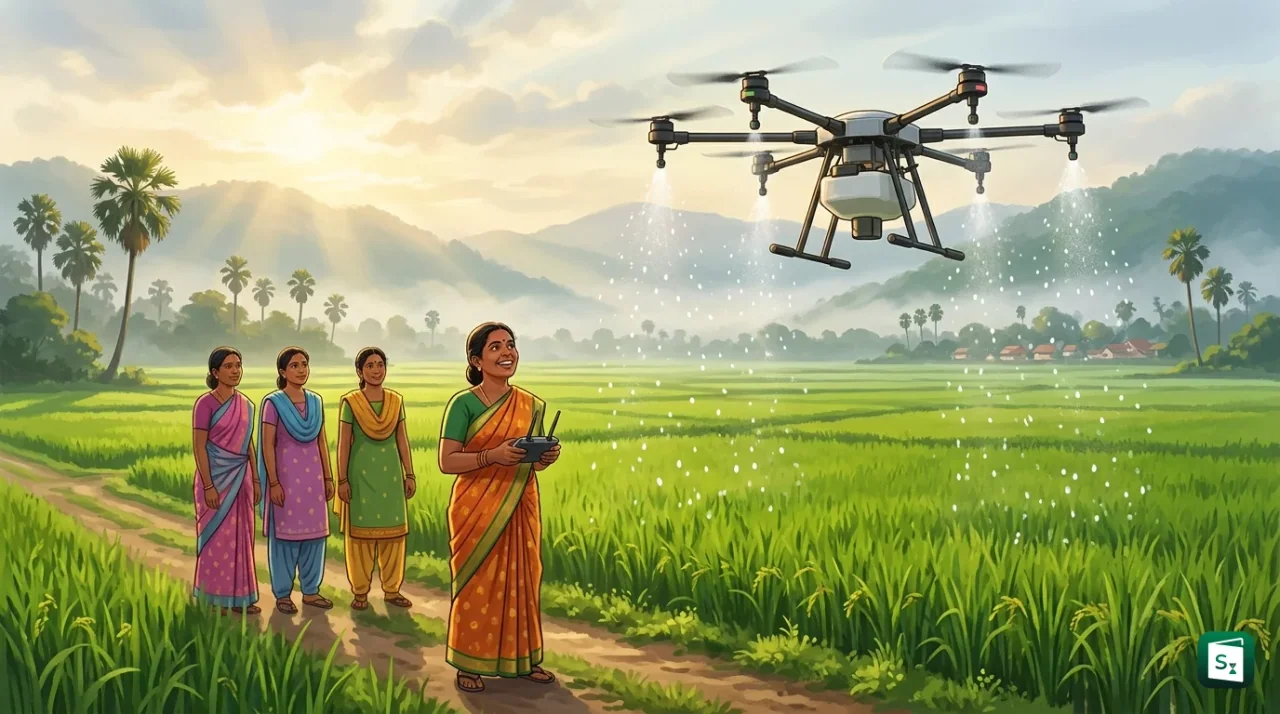
Tamil Nadu has launched the Vetri Vaanmagal scheme to train women farmers and other eligible people to operate agricultural drones. Announced in the state’s Agriculture Budget for 2026-27, the programme combines technical training, pilot licensing, and subsidised equipment to expand precision agriculture and create skilled work in rural areas.
Background to the Vetri Vaanmagal Scheme
The scheme was announced on 6 August 2026 by Tamil Nadu’s Agriculture and Farmers’ Welfare Minister R. Vinoth while presenting the state’s Agriculture Budget in the Legislative Assembly. Its focus is wider than distributing machines. It seeks to create a trained local workforce that can provide drone-based farm services and give women a stronger role in technology-led agriculture.
The initiative also comes during the International Year of the Woman Farmer, 2026, proclaimed by the United Nations. The global observance highlights women’s contribution to food production and calls for better access to land, finance, technology, training, and markets. Tamil Nadu’s scheme connects that wider focus with a practical skill and employment programme.
Training, Licences and Subsidised Drones
The programme will train 500 eligible people, including 100 women, in drone operations. The state will meet the ₹1.50 crore cost of training and help participants obtain drone pilot licences through the Remote Pilot Training Organisation of Tamil Nadu Agricultural University (TNAU). A remote pilot licence is the certification required for eligible drone operations under India’s civil aviation framework.
The equipment support is targeted at women who complete the training. Fifty trained women will receive agricultural drones with a 50% subsidy, backed by a separate state allocation of ₹2.50 crore. This design combines certification with access to equipment, which can help beneficiaries move from training into paid farm services.
| Component | Provision |
|---|---|
| People to be trained | 500, including 100 women |
| Training institution | TNAU’s Remote Pilot Training Organisation |
| Training allocation | ₹1.50 crore |
| Women receiving subsidised drones | 50 trained women |
| Equipment support | 50% subsidy |
| Drone allocation | ₹2.50 crore |
How Agricultural Drones Support Precision Farming
Precision agriculture means using data, sensors, and targeted machinery to apply farm inputs at the right place and in the right quantity. Agricultural drones, also called unmanned aircraft systems, can carry out tasks such as spraying fertilisers and pesticides, monitoring crop growth, identifying pest or disease stress, and mapping fields.
Drone-based spraying can cover fields quickly and apply inputs more evenly than some manual methods. It can reduce workers’ exposure to chemicals, save time during labour-intensive stages of cultivation, and support localised treatment instead of spraying an entire field in the same way. Crop images collected from the air can also help farmers identify problems earlier.
The technology is not a substitute for agronomic advice or safe chemical use. Operators need training in flight controls, battery and equipment maintenance, weather conditions, application rates, and safety rules. The value of the scheme will therefore depend on whether training is followed by regular service demand, technical support, and responsible use on farms.
Link with Farm Mechanisation and Women’s Livelihoods
The scheme fits within the broader movement towards farm mechanisation. The Sub Mission on Agricultural Mechanization (SMAM) has operated through states and Union Territories since 2014-15 and is now implemented under the umbrella of the Rashtriya Krishi Vikas Yojana. It promotes access to machines through individual subsidies, demonstrations, training, and Custom Hiring Centres, where farmers can rent equipment instead of purchasing it.
The Union government has reported that SMAM released ₹9,404.47 crore to states between 2014-15 and 2025-26. During this period, more than 21.61 lakh machines were distributed on subsidy, while 27,554 Custom Hiring Centres and 646 high-tech hubs were established. Vetri Vaanmagal adds a gender-focused and skill-based layer to this mechanisation approach by preparing women to operate and potentially manage agricultural technology.
The model is also related to the national NaMo Drone Didi initiative, under which selected women Self-Help Groups receive financial support and training to offer drone rental services for agriculture. Unlike a simple asset-distribution programme, the Tamil Nadu model places emphasis on local certification and individual women operators. This can create an additional income stream while making specialised services available to nearby farmers who cannot afford to buy a drone.
Implementation Significance and the Way Forward
The immediate challenge is to convert a limited number of trained operators into a reliable rural service network. Beneficiaries will need access to maintenance facilities, spare parts, charging arrangements, insurance, safe chemical handling guidance, and clear operating procedures. District-level agricultural officers and local farmer groups can help connect trained operators with crop seasons and areas facing labour shortages.
The scheme can have a wider effect if subsidised drones are used through transparent booking or rental arrangements. Small and marginal farmers could then access spraying and monitoring services without bearing the full cost of equipment. Training women as operators may also challenge the idea that advanced farm machinery is mainly a male occupation.
Tamil Nadu’s next steps will determine whether Vetri Vaanmagal remains a training initiative or develops into a sustainable rural enterprise programme. Measuring the number of women who obtain licences, operate drones, earn income, serve farmers, and adopt safer input practices will provide a clearer picture of its impact.
Key Takeaways
- Tamil Nadu announced the Vetri Vaanmagal scheme on 6 August 2026 in its Agriculture Budget for 2026-27.
- The scheme will train 500 people, including 100 women, in agricultural drone operations and pilot licensing.
- Training will be conducted through the Remote Pilot Training Organisation of Tamil Nadu Agricultural University at a state cost of ₹1.50 crore.
- Fifty trained women will receive agricultural drones with a 50% subsidy under a separate allocation of ₹2.50 crore.
- The scheme promotes precision agriculture, including drone-based spraying, crop monitoring, pest detection, and field mapping.
- The initiative complements the Sub Mission on Agricultural Mechanization, which has operated through states and Union Territories since 2014-15.