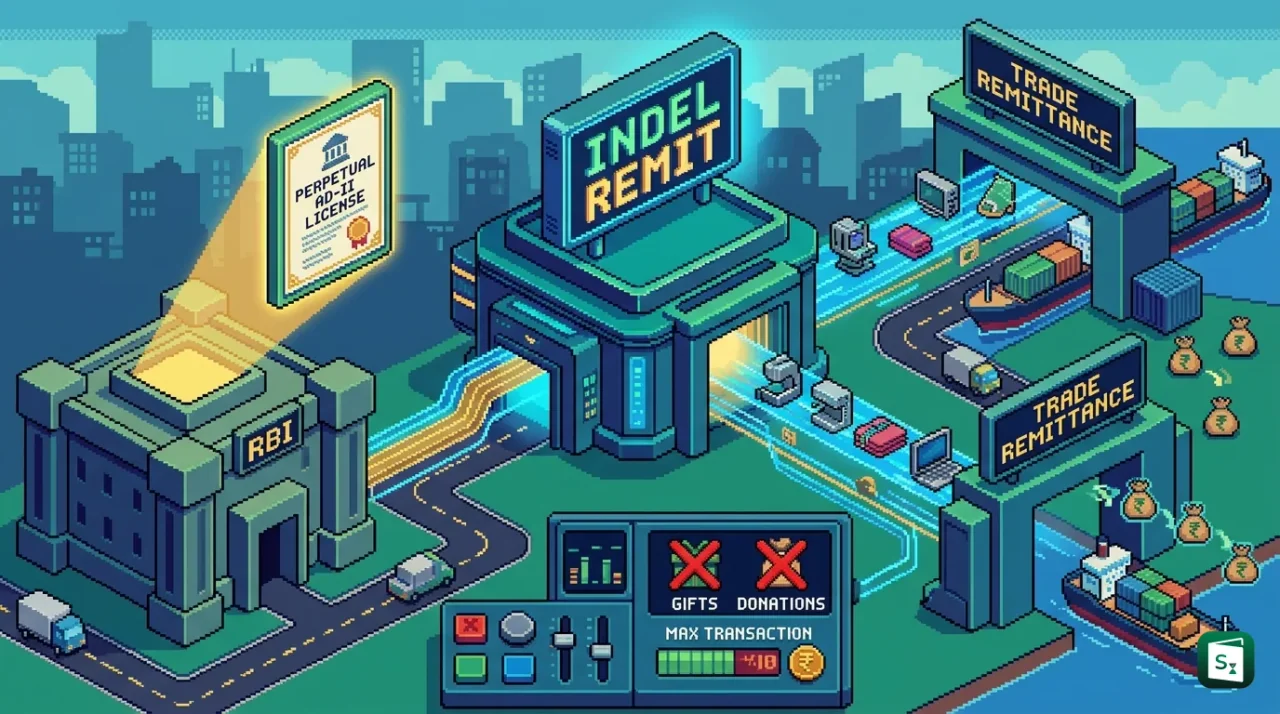
Indel Remit, the foreign exchange division of Indel Money Ltd, has received a perpetual Authorised Dealer-II (AD-II) licence from the Reserve Bank of India (RBI) to offer trade remittance services. The licence allows the Mumbai-headquartered company to handle non-trade current account transactions and foreign trade payments of up to ₹25 lakh per transaction. The RBI has barred the firm from processing gifts and donations under this authorisation.
What the New Licence Permits
The perpetual licence broadens the scope of Indel Remit’s existing AD Category-II authorisation in two ways. First, it can now undertake non-trade current account transactions that are permissible under the Foreign Exchange Management Act (FEMA), 1999, other than gifts and donations. Second, it can facilitate foreign trade transactions of up to ₹25 lakh per transaction, a power that was not part of its earlier licence.
In practice, this lets traders, micro, small and medium enterprises (MSMEs), and business executives route international payments through the company. The company has said these payments will be fast, secure and transparent, and will strengthen India’s cross-border payments mechanism. Its earlier licence, obtained in October 2023, already covered currency note conversion, travel money cards, and outward remittances for family maintenance. The new approval adds a trade settlement channel on top of those services.
Understanding Authorised Dealers in India
An Authorised Dealer (AD) is an entity authorised by the RBI under Section 10(1) of FEMA, 1999 to deal in foreign exchange or foreign securities. No person in India can legally deal in foreign exchange unless authorised by the central bank. The framework was first rationalised in 2006, when the RBI set out the different categories of licences for entities dealing in forex and undertaking money changing activities.
The term “Authorised Person” under FEMA is wider than a dealer. As per Section 2(c) of the Act, it covers an authorised dealer, a money changer, an offshore banking unit, and any other person authorised under Section 10(1). The authorised persons framework sits at the heart of India’s exchange control system, because every cross-border payment must pass through one of these licensed entities.
The Three Categories of Authorised Dealers
The RBI classifies authorised dealers into three categories based on the scope of activities permitted:
| Category | Who Can Hold It | Permitted Activities |
|---|---|---|
| AD Category-I | Banks licensed by the RBI | The widest scope, covering all current and capital account transactions permissible under FEMA |
| AD Category-II | Select banks, RBI-registered NBFCs, and eligible full fledged money changers | Specified non-trade current account transactions, all activities permitted to full fledged money changers, and now foreign trade transactions up to ₹25 lakh |
| AD Category-III | Financial and other institutions | Specific foreign exchange transactions incidental to their main business |
Under the framework, an AD Category-I entity acts as the main interface between the RBI and forex users. An AD Category-II entity is a step below, and an AD Category-III entity handles only transactions that are incidental to its own business. The new licence held by Indel Remit falls in the middle category.
AD Category-II Versus Money Changers
A Full Fledged Money Changer (FFMC), also called an Authorised Money Changer, can buy and sell foreign currency notes and travellers’ cheques, mainly for travel purposes. An AD Category-II licence is broader, because it also permits outward remittances for approved non-trade purposes, along with everything an FFMC can do. This is why companies seeking to send money abroad, such as for education, medical treatment, or now trade settlement, upgrade from FFMC licences to AD Category-II licences.
Under the new Foreign Exchange Management (Authorised Persons) Regulations, 2026, the RBI has stopped accepting fresh FFMC licence applications. Existing FFMCs can continue until their licences expire, and may seek conversion to an AD Category-II authorisation if they meet the revised eligibility conditions.
Why the Licence Is Now Perpetual: The 2026 FEMA Regulations
The word “perpetual” in the news refers to a change brought by the Foreign Exchange Management (Authorised Persons) Regulations, 2026, notified by the RBI on 30 April 2026 through Notification No. FEMA 401/2026-RB. These regulations replaced the earlier authorisation regime and introduced several major changes to how forex licences are issued.
Previously, an AD Category-II authorisation was granted initially for one year and then renewed for periods of one to five years. Under the 2026 regulations, an AD Category-II authorisation can be renewed on a perpetual basis, subject to the entity continuing to meet the eligibility conditions. This reduces the regulatory burden on existing players and improves ease of doing business.
The new framework also introduced stricter eligibility norms. An AD Category-II applicant must have a minimum net worth of ₹10 crore, and non-bank authorised persons must achieve a minimum annual forex turnover of ₹50 crore within two years of authorisation. Applications for fresh authorisations must now be filed online through the PRAVAAH portal, the RBI’s centralised platform for regulatory applications launched on 28 May 2024. The regulations also created a Forex Correspondent Scheme, under which AD Category-I and Category-II entities can appoint agents to expand their reach, and directed that the old franchisee model be wound down within two years.
Indel Money: From Gold Loans to Forex
Indel Money Limited is a non-deposit taking NBFC focused primarily on gold loans, MSME loans, consumer durable loans, and loan against property. The company traces its roots to 1986, when it was incorporated as Payal Holdings Pvt Ltd. It was acquired by its current promoters in July 2012 and rebranded as Indel Money Limited in January 2013, after converting to an RBI-regulated NBFC.
The company is headquartered in Mumbai and led by Umesh Mohanan as Executive Director and CEO, with Mohanan Gopalakrishnan as Chairman and Managing Director. When the company received its first AD Category-II licence in 2023, it described itself as the second systemically important non-deposit taking NBFC in the country to hold such a licence. Indel Remit is the dedicated foreign exchange division of this NBFC.
Diversifying into forex fits a broader trend. India’s foreign exchange reserves stood at $701.4 billion as of January 2026, providing import cover of about 11 months. With a large base of NRIs, travellers and traders moving money across borders, NBFCs and money changers are competing to offer faster and cheaper outward remittance services.
Why This Matters for Trade and Cross-Border Payments
India is the world’s largest recipient of remittances. According to the World Bank, India received $138 billion in remittances in 2024, and inflows touched a record $135.4 billion in FY25 as per official data. At the same time, cross-border trade payments are growing rapidly as Indian exporters and importers expand their global footprint.
The main beneficiaries of the new licence are MSMEs and small traders, who often struggle to access efficient cross-border payment channels. Exporters need to receive payments in foreign currency and settle invoices, while importers need to pay foreign suppliers. A ₹25 lakh per transaction ceiling covers a large share of small trade payments, which is why the RBI has allowed AD Category-II entities to handle them.
There are also safeguards built into the licence. By restricting gifts and donations, the RBI ensures that the trade remittance facility is not misused for unregulated outward money transfers. This is consistent with FEMA’s broader structure, under which a current account transaction is freely permitted unless specifically restricted, while a capital account transaction is prohibited unless specifically permitted.
The approval also signals a wider policy direction. India has been steadily liberalising its foreign exchange framework, with the 2026 authorised persons regulations, the PRAVAAH portal, and the Forex Correspondent Scheme all aimed at making forex services easier to access while keeping them tightly regulated. As more non-bank players enter the payments space, small businesses are likely to see more competition and lower costs for international transactions.
Key Takeaways
- Indel Remit, the foreign exchange division of Indel Money Ltd, received a perpetual Authorised Dealer-II (AD-II) licence from the RBI to offer trade remittance services.
- The licence permits foreign trade transactions of up to ₹25 lakh per transaction and non-trade current account transactions permissible under FEMA, but excludes gifts and donations.
- An Authorised Dealer is an entity authorised by the RBI under Section 10(1) of the Foreign Exchange Management Act (FEMA), 1999 to deal in foreign exchange.
- The Foreign Exchange Management (Authorised Persons) Regulations, 2026, notified via FEMA 401/2026-RB on 30 April 2026, allow perpetual AD Category-II authorisation and require a minimum net worth of ₹10 crore.
- Indel Money Limited is a Mumbai-based NBFC incorporated in 1986 (as Payal Holdings), rebranded in 2013, with Umesh Mohanan as Executive Director and CEO.
- India is the world’s largest recipient of remittances, receiving about $138 billion in 2024, and the RBI’s PRAVAAH portal (launched 28 May 2024) now handles forex licence applications online.