Prime Minister Narendra Modi visited Banaskantha and Ekta Nagar in Gujarat on 30 and 31 October 2026. He launched projects worth over ₹14,400 crore, attended the Rashtriya Ekta Diwas parade for the 151st birth anniversary of Sardar Vallabhbhai Patel and inaugurated the Bharat Bovine Breeding and Research Centre at Bhildi. The two day visit linked national unity celebrations with dairy science, farm income and infrastructure growth.
What Is Rashtriya Ekta Diwas and Why Is It Celebrated?
Rashtriya Ekta Diwas, or National Unity Day, is observed in India every year on 31 October. The day marks the birth anniversary of Sardar Vallabhbhai Patel and honours his role in joining more than 560 princely states into the Union of India after Independence. The central message is unity, integrity and security of the nation.
The Government of India introduced the observance in 2014. Since then, 31 October is marked by a Run for Unity, a unity pledge in government offices, schools and public institutions, and a parade by police and Central Armed Police Forces. The 2026 celebration was special because it marked the 151st birth anniversary of Patel.
Patel was born on 31 October 1875 in Nadiad, Gujarat and passed away on 15 December 1950. He became independent India’s first Deputy Prime Minister and Home Minister on 15 August 1947. He headed the States Department with V. P. Menon as Secretary and used the Instrument of Accession, under which rulers ceded defence, external affairs and communications to India, to complete accession of almost all states by 15 August 1947.
| Fact about Patel | Detail |
|---|---|
| Birth date and place | 31 October 1875, Nadiad in present day Gujarat |
| Title | Iron Man of India and Sardar for leadership in the Bardoli Satyagraha of 1928 |
| Key movements led | Kheda Satyagraha of 1918 and Bardoli Satyagraha of 1928 |
| Main contribution after 1947 | Integration of princely states and creation of All India Services as a steel frame |
| Honour linked to him | Ek Bharat Shreshtha Bharat, announced on 31 October 2015, and Statue of Unity unveiled on 31 October 2018 |
The unity pledge taken on the day commits citizens to preserve the unity, integrity and security of the nation and to spread the message among fellow citizens in the spirit of Patel’s work. In 2026, the Ekta Diwas events at Ekta Nagar carried the message of Vande Mataram and the spirit of Ek Bharat Shreshtha Bharat, with a parade, tableaux on heritage and development, and cultural shows by thousands of artists.
Where the 2026 Ekta Diwas Was Held: Ekta Nagar and the Statue of Unity
The Statue of Unity stands in Gujarat state, at Ekta Nagar in Narmada district. Ekta Nagar was earlier known as Kevadia. The statue rises on Sadhu Bet island in the Narmada river, about 3.2 km from the Sardar Sarovar Dam, with the Satpura and Vindhyachal hills in the background.
The statue is the world’s tallest statue at 182 metres. It shows Patel in a dhoti and shawl. It was designed by sculptor Ram V. Sutar, built by Larsen and Toubro and inaugurated on 31 October 2018. The height of 182 metres was chosen to match the number of seats in the Gujarat Legislative Assembly. A viewing gallery at 153 metres can hold about 200 visitors at a time and offers a view of the dam, its reservoir and the hill ranges.
| Feature | Detail |
|---|---|
| Location | Sadhu Bet island, Ekta Nagar, Narmada district, Gujarat |
| River | Narmada, facing Sardar Sarovar Dam |
| Height | 182 metres for the statue, 240 metres including the 58 metre base |
| Inauguration | 31 October 2018, the 143rd birth anniversary of Patel |
| Administration | Statue of Unity Area Development and Tourism Governance Authority |
On 31 October 2026, the Prime Minister offered floral tributes at the statue in the morning. Indian Air Force helicopters showered flower petals over the monument. In the evening, he attended the main Ekta Diwas function at the Parade Ground. A day earlier, on 30 October, he had inaugurated Bharat Parv 2026 at Ekta Nagar. The festival presents cuisines, crafts and performances from states and union territories and was scheduled to run till 15 November. Separate projects worth over ₹400 crore for Ekta Nagar, including water and sewage treatment, upgradation of Narmada Ghat, facade lighting and rainforest and eco trail facilities, were also inaugurated or started during the visit.
What PM Modi Did in Banaskantha: ₹14400 Crore Projects and PM-KISAN
The Prime Minister spent 30 October in Banaskantha district and 31 October in Ekta Nagar. In Banaskantha, he inaugurated and laid foundation stones for development projects worth over ₹14,400 crore and released the 24th instalment of the Pradhan Mantri Kisan Samman Nidhi (PM-KISAN).
PM-KISAN gives ₹6,000 per year to eligible landholding farmer families, paid as three instalments of ₹2,000 through Direct Benefit Transfer. The 24th instalment transferred more than ₹18,690 crore to over 9.34 crore farmers. With this, total transfers under the scheme crossed ₹4.65 lakh crore. In Gujarat, more than 50 lakh farmers received over ₹1,000 crore, including nearly ₹50 crore for families in Banaskantha.
Other major projects launched from Banaskantha included:
- Metro connectivity: Foundation stones for Ahmedabad Metro Phase 2A from Koteshwar Road to the airport, covering more than 6 km with five stations, and Phase 2B from GIFT City to Shahpur, covering more than 3.3 km with three stations.
- Road upgrade: Widening of Ahmedabad Mehsana Road (State Highway 41) from four lanes to eight lanes at a cost of around ₹2,600 crore.
- Farm storage and processing: Dedication of 521 projects built under the Agriculture Infrastructure Fund at a cost of around ₹4,950 crore, including cold stores, warehouses, silos and food processing units.
- Horticulture clusters: Start of work on 12 approved clusters covering about 1.46 lakh hectares for tomato, potato, chilli, grapes, banana, onion, orange, pomegranate and cocoa, expected to benefit more than 1.3 lakh farmers. Two clusters in North Gujarat focus on potato farmers of Banaskantha and Sabarkantha.
- Dairy linked food units: Inauguration of the expanded potato processing plant at Sanandar for products such as French fries and an Automated Storage and Retrieval System for ultra high temperature milk products at Palanpur.
- Child care: Foundation stones for 4,030 new child friendly Anganwadi centres and inauguration of 361 completed centres at a total investment of ₹800 crore, expected to benefit about four lakh children and pregnant mothers.
- Rail services: Flagging off of the Ahmedabad Sabarmati to Varanasi Express and the Mehsana Becharaji Sabarmati MEMU train.
- Waste to energy: Foundation stones for two Bio-CNG plants of Banas Dairy at Tharad and Radhanpur with dung processing capacities of 75 metric tonnes and 100 metric tonnes per day.
What Is the Bharat Bovine Breeding and Research Centre at Bhildi?
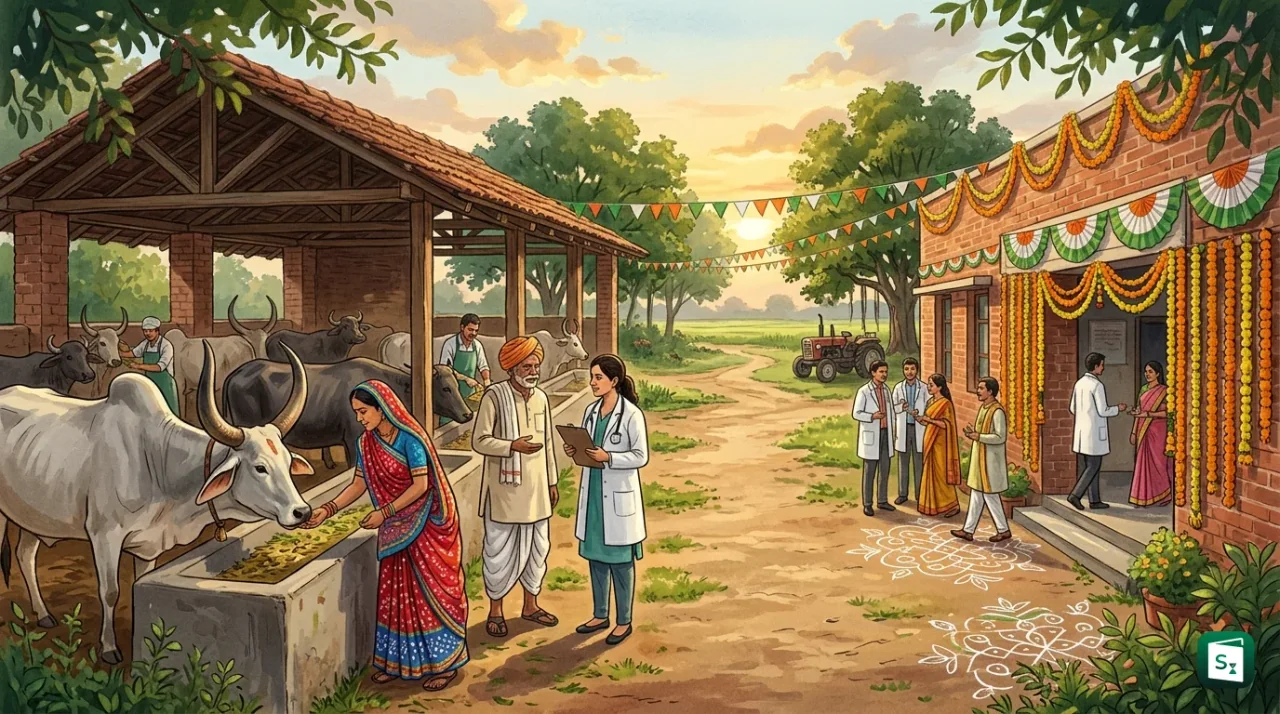
The Bharat Bovine Breeding and Research Centre (BBRC) at Bhildi in Banaskantha is a Centre of Excellence for cattle and buffalo breeding. The Prime Minister dedicated it to the nation on 30 October 2026. The centre is spread over 127 acres and was built at a cost of around ₹325 crore.
The centre was developed by Banas Dairy with technical support from the National Dairy Development Board (NDDB). It received financial support under the Rashtriya Gokul Mission, a central scheme for conservation and development of indigenous bovine breeds launched in December 2014. An amount of ₹38.83 crore was sanctioned under the mission, including funds for donor animals. The project was also approved under the Animal Husbandry Infrastructure Development Fund with support from the National Bank for Agriculture and Rural Development (NABARD).
The goal is to multiply superior indigenous germplasm and give farmers access to high quality embryos, semen and breeding services at affordable rates. The centre aims to produce 25,000 high quality embryos every year. It is described as the country’s first such facility dedicated to the Kankrej breed and is expected to speed up breed improvement by 10 to 20 times.
How Embryo Transfer and IVF Technology Works in Cattle
Embryo transfer technology is a method to get many calves from a superior female animal instead of the normal one calf in a year. In vitro fertilisation (IVF) in cattle means that fertilisation of egg and sperm takes place in a laboratory and not inside the animal.
The process used at Bhildi combines Ovum Pick Up (OPU) with IVF, also called OPU-IVEP. The steps are simple to understand. Doctors collect unfertilised eggs, called oocytes, from the ovaries of a superior donor cow or buffalo using an ultrasound guided needle through the vaginal wall. The eggs are matured in the laboratory for 20 to 22 hours. They are then mixed with processed semen for fertilisation. The fertilised eggs are grown in an incubator for seven days. Healthy embryos are then placed into surrogate mothers, called recipients, or frozen for later use.
A normal cow gives one calf per year. With Multiple Ovulation and Embryo Transfer, one elite animal can give 10 to 20 calves in a year. With OPU and IVF, the number can rise to 20 to 40 calves in a year from the same donor. The method also works well with sex sorted semen, which raises the chance of female calves and reduces the burden of maintaining unwanted male calves for small farmers.
Which Breeds the Centre Will Focus On
The centre will work on more than 15 indigenous and crossbred populations. The focus is not only on milk volume but also on traits such as feed to milk conversion, heat tolerance, disease resistance and milk fat.
| Cattle breeds | Buffalo breeds |
|---|---|
| Kankrej, Gir, Sahiwal, Red Sindhi, Tharparkar, Rathi, Punganur, Ongole | Mehsani, Banni, Murrah, Jaffarabadi |
Kankrej cattle are known for heat tolerance and tick resistance. Gir and Sahiwal are valued milch breeds with high fat and solids in milk. Tharparkar and Rathi perform well in dry and hot tracts. Among buffaloes, Murrah is known for high milk yield, while Mehsani, Banni and Jaffarabadi are important for fat rich milk in western India. Indigenous animals are naturally suited to local climate and need less costly cooling and treatment, which helps smallholders facing high feed costs. Feed and fodder account for about 70 to 75 percent of milk production cost, so an animal matched to local conditions can be more profitable than a high yielding animal that needs heavy feed and care.
Who Runs Banas Dairy and What Is the Role of NDDB?
The National Dairy Development Board (NDDB) is a statutory body and an Institution of National Importance. NDDB stands for National Dairy Development Board. It was founded on 16 July 1965 by Verghese Kurien, often called the Milkman of India. The then Prime Minister Lal Bahadur Shastri wanted to replicate the success of the Kaira Cooperative Milk Producers Union, or Amul, across India. NDDB has its headquarters at Anand in Gujarat. It became a body corporate through the NDDB Act of 1987 and works under the Ministry of Fisheries, Animal Husbandry and Dairying. NDDB planned and implemented Operation Flood from 1970 to 1996, which is known as the White Revolution and made India the world’s largest milk producer.
Banas Dairy is the short name for the Banaskantha District Cooperative Milk Producers Union Limited. It was registered on 31 January 1969 after village societies started milk collection work in 1966 under founder Galbabhai Nanjibhai Patel. Its dairy plant at Jagana near Palanpur started work in 1971. It is now described as Asia’s largest milk cooperative and the largest member union of the Gujarat Cooperative Milk Marketing Federation (GCMMF) at Anand, which markets milk and products under the Amul and Sagar brands.
This clears a common confusion about Banas Dairy and Amul. Amul is not a separate company competing with Banas Dairy. Amul is the marketing brand of GCMMF, while Banas Dairy is a district milk union that supplies milk to that federation. Banas Dairy collects on average about 57 lakh litres of milk per day, rising to 65 lakh litres and more in winter, from lakhs of pourers through more than 1,750 village societies.
NDDB gave technical guidance for the Bhildi centre, while funds came through the Rashtriya Gokul Mission. The mission was launched in December 2014 for conservation and development of indigenous bovine breeds, genetic upgradation and higher milk productivity. It covers elite breeds such as Gir, Sahiwal, Rathi, Deoni, Tharparkar and Red Sindhi and supports bull mother farms, Gokul Grams, artificial insemination services and germplasm markets. The mission continues under the Rashtriya Pashudhan Vikas Yojana from 2021 to 2026.
Key Takeaways
- Prime Minister Narendra Modi visited Banaskantha and Ekta Nagar on 30 and 31 October 2026 and launched projects worth over ₹14,400 crore.
- Rashtriya Ekta Diwas is observed every year on 31 October and the 2026 event marked the 151st birth anniversary of Sardar Vallabhbhai Patel.
- The Statue of Unity in Gujarat is the world’s tallest statue at 182 metres and stands on Sadhu Bet island in the Narmada river.
- The Bharat Bovine Breeding and Research Centre at Bhildi was built over 127 acres at a cost of ₹325 crore to produce 25,000 embryos per year.
- The National Dairy Development Board was founded in 1965 at Anand and works under the Ministry of Fisheries, Animal Husbandry and Dairying.