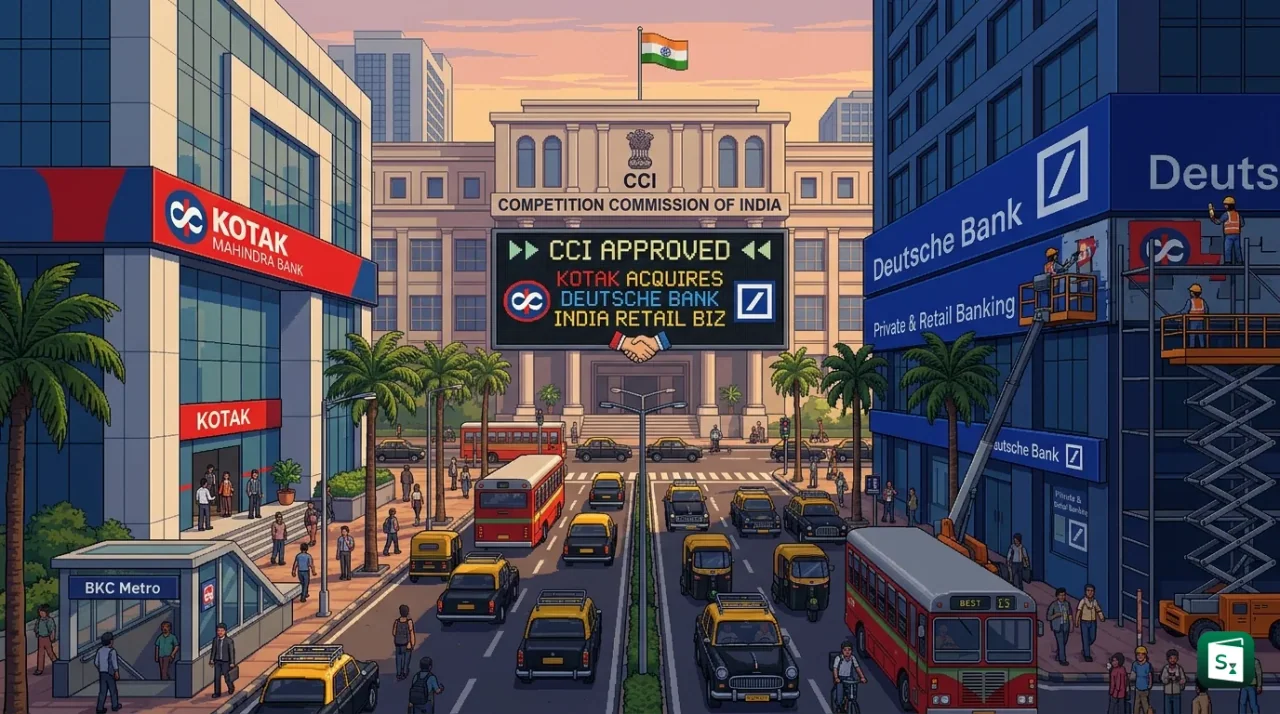
The Competition Commission of India (CCI) has approved Kotak Mahindra Bank’s acquisition of Deutsche Bank India’s retail banking, private banking and wealth management business. The deal, agreed on 30 June 2026, covers about ₹29,000 crore in loans, ₹16,000 crore in deposits and around 150,000 customers. It marks another exit by a foreign bank from Indian retail banking and a clear scale up for Kotak in affluent banking.
Is Kotak Buying Deutsche Bank? What the CCI Approval Covers
No, Kotak is not buying Deutsche Bank as a whole. Kotak Mahindra Bank Ltd (KMBL) is acquiring only the Target Business, which is Deutsche Bank Aktiengesellschaft’s retail banking, private banking and wealth management business run through its branches in India.
The Competition Commission of India (CCI) approved this proposed combination on 3 November 2026. The CCI is India’s competition regulator, set up under the Competition Act, 2002 with effect from 14 October 2003 and headquartered in New Delhi. Deals above a set asset and turnover limit must be reported to the CCI. The CCI clears them only if they do not cause an appreciable adverse effect on competition in India.
The CCI press note of 4 November 2026 describes the deal as Combination C-2026/09/1463. Kotak will take over the business as a going concern on a slump sale basis. A slump sale means the buyer takes over a whole running business unit for a lump sum price, instead of buying each asset separately. Staff, customer accounts, loans, deposits and branch operations move together, so services can continue without a break.
What Kotak Gains: Loans, Deposits, Customers and Branches
Kotak and Deutsche Bank signed the definitive business transfer agreement on 30 June 2026. The figures disclosed then, based on positions as on 31 March 2026, show the scale of the transfer.
| What moves to Kotak | Size |
|---|---|
| Loans and advances | About ₹29,000 crore (about 2.7 billion euro) |
| Deposits | About ₹16,000 crore (about 1.5 billion euro) |
| Investment assets under management | About ₹10,500 crore (about 1.0 billion euro) |
| Customers served | Around 150,000 |
| Employees moving to Kotak | About 1,000 |
| Branches moving to Kotak | 16 of 17 branches in India |
The retail and private banking book includes deposits, home loans, personal loans, loans against property, small business loans, foreign exchange services and distribution of mutual funds and insurance. More than 90 percent of the loan book is secured, which means loans backed by property or other collateral. The deposits include about ₹4,200 crore of low cost current and savings account deposits. The wealth business serves high net worth individuals, which means clients with large investible wealth who need portfolio advice and estate planning.
On branches, 16 branches will join Kotak’s network. Deutsche Bank will retain its Fort branch in Mumbai, its historic main branch. No banking licences are being transferred. Kotak will serve these customers through its own licence from the Reserve Bank of India (RBI).
How the Slump Sale and Referral Deal Will Work
Kotak will pay for the business in cash. The fixed purchase price is about ₹281.7 crore, plus the net value of assets minus liabilities on the closing date. The exact amount will be adjusted as per the business transfer agreement. Kotak has said it will write off the fixed price in the quarter in which the deal closes. At closing, Kotak expects the deal to add to its return on equity, while Deutsche Bank expects it to add to its Common Equity Tier 1 (CET1) capital ratio. CET1 is the core capital a bank holds against risks, so a higher ratio means a stronger capital position.
A second part of the deal covers investment advice. Deutsche Investments India Private Limited (DIIPL), an indirect wholly owned subsidiary of Deutsche Bank in India, runs investment advisory and portfolio management services. Portfolio management means a professional manager handles a client’s stocks, bonds and funds for a fee. DIIPL will refer such clients to two wholly owned Kotak subsidiaries, Kotak Mahindra Asset Management Company and Kotak Alternate Asset Managers. Non binding term sheets for these referrals were signed along with the main deal. Final agreements will follow.
Completion still needs other clearances. Kotak’s stock exchange filing lists approval from the National Securities Depository Limited (NSDL) and Central Depository Services (India) Limited (CDSL) for transfer of the depository business, apart from any other regulatory nods needed.
Why Deutsche Bank Is Exiting Retail Banking in India
Deutsche Bank is Germany’s largest bank, founded in 1870 in Berlin. It first opened an India branch in Calcutta in 1896, closed it during World War I, and returned in 1980 through the European Asian Bank in Mumbai. It launched private wealth management in India in 2003 and retail branch banking in 2005. Today it runs 17 branches in 16 cities, an international banking unit in GIFT City, Gujarat opened in July 2022, and large technology and service centres in Mumbai, Pune, Bengaluru and Jaipur that employ more than 25,000 people in India.
The sale fits Deutsche Bank’s Global Hausbank strategy. Under this plan, the group wants a simpler business focused on areas where it has clear scale. In India, that means corporate banking, investment banking, transaction banking and asset management through DWS. Its private bank will continue to serve global ultra high net worth clients, including non resident Indians, but from outside India.
Foreign banks face tough limits in Indian retail banking. The RBI allots only a small number of new branch licences to foreign banks each year. Competition from large domestic banks is intense. Rising costs of small branches and digital services make a small retail network hard to sustain. This is part of a wider pattern. Citibank sold its India retail and cards business to Axis Bank in 2022. Standard Chartered sold its India personal loan book of about $488 million to Kotak last year. Deutsche Bank had put its India retail business up for sale last year before choosing Kotak as buyer.
Private Banking and Wealth Management in India: Why Kotak Wants Scale
Private banking means banking and investment services for affluent clients. Wealth management means managing large portfolios, mutual funds and alternative funds for rich families and individuals. Retail banking means mass products like savings accounts, cards and home loans for ordinary customers.
Kotak sees the Deutsche Bank book as a direct fit for its affluent and small business focus. Kotak Managing Director and Chief Executive Officer Ashok Vaswani said the deal brings a high quality customer franchise and experienced teams, with added scale in segments Kotak already serves. Deutsche Bank’s customers map largely to Kotak’s affluent and private bank groups. Kotak runs a relationship led model, where one banker offers deposits, loans, broking, mutual funds and insurance from across the group.
The timing matters for market share. India’s wealthy population and demand for organised wealth advice are growing fast. A ready portfolio of 150,000 affluent customers, ₹10,500 crore of investment assets and a trained team of 1,000 bankers gives Kotak instant depth. It avoids the slow process of opening new branches and finding new customers one by one. Kotak has used this path before. It merged with ING Vysya Bank in 2015 to expand its branch base. Last year it bought Standard Chartered India’s personal loan portfolio.
Kotak Mahindra Bank and Deutsche Bank: Two Very Different Banks
Kotak Mahindra Bank, headquartered in Mumbai, started in 1985 as Kotak Capital Management Finance, a bill discounting firm founded by Uday Kotak. In February 2003, it became the first non banking finance company in India to receive an RBI banking licence. It is now India’s fourth largest private sector bank by balance sheet size. As on 31 March 2026, the group had total assets of ₹10,03,353 crore, bank deposits of ₹5.7 lakh crore and a group branch network of 5,581 branches, including bank branches, insurance, broking and microfinance outlets. Its shares are listed on the Bombay Stock Exchange (BSE) and the National Stock Exchange (NSE).
Deutsche Bank AG, headquartered in Frankfurt, Germany, is Germany’s leading bank with a strong presence in Europe, the Americas and Asia Pacific. In India it remains one of the largest foreign banks even after this sale. It will continue as the largest European bank in India, with corporate banking, investment banking, its GIFT City unit and global service centres. India operations support clients across 48 countries and form one of its 15 Asia Pacific markets.
The contrast explains the deal. Kotak wants domestic branch customers and wealth relationships to use its full Indian product suite. Deutsche Bank wants capital and management focus for cross border corporate business, where foreign banks hold a clear edge in foreign exchange, trade finance and overseas fund raising.
What Happens Next: Closing by September 2027
Both banks expect closing, including transfer of customer relationships, staff and products, by September 2027. The CCI approval was the main competition clearance. Transfers of demat accounts need NSDL and CDSL approvals. Other customary conditions in the business transfer agreement must also be met.
Until then, both banks have said they will work together to ensure continuity of service. About 1,000 Deutsche Bank employees are expected to join Kotak, which should help customers keep familiar relationship managers after the move. The detailed reasoned order of the CCI is still awaited.
Key Takeaways
- The CCI approved on 3 November 2026 Kotak Mahindra Bank’s acquisition of Deutsche Bank India’s retail, private banking and wealth management business.
- The deal was agreed on 30 June 2026 through a slump sale on a going concern basis, with cash consideration of about ₹281.7 crore plus net assets at closing.
- The transfer covers about ₹29,000 crore in loans, ₹16,000 crore in deposits, ₹10,500 crore in assets under management and around 150,000 customers.
- About 1,000 employees and 16 of 17 branches will move to Kotak, while Deutsche Bank retains its Fort Mumbai branch.
- Full closing is expected by September 2027, after NSDL, CDSL and other clearances, with referral of DIIPL advisory clients to Kotak AMC subsidiaries.