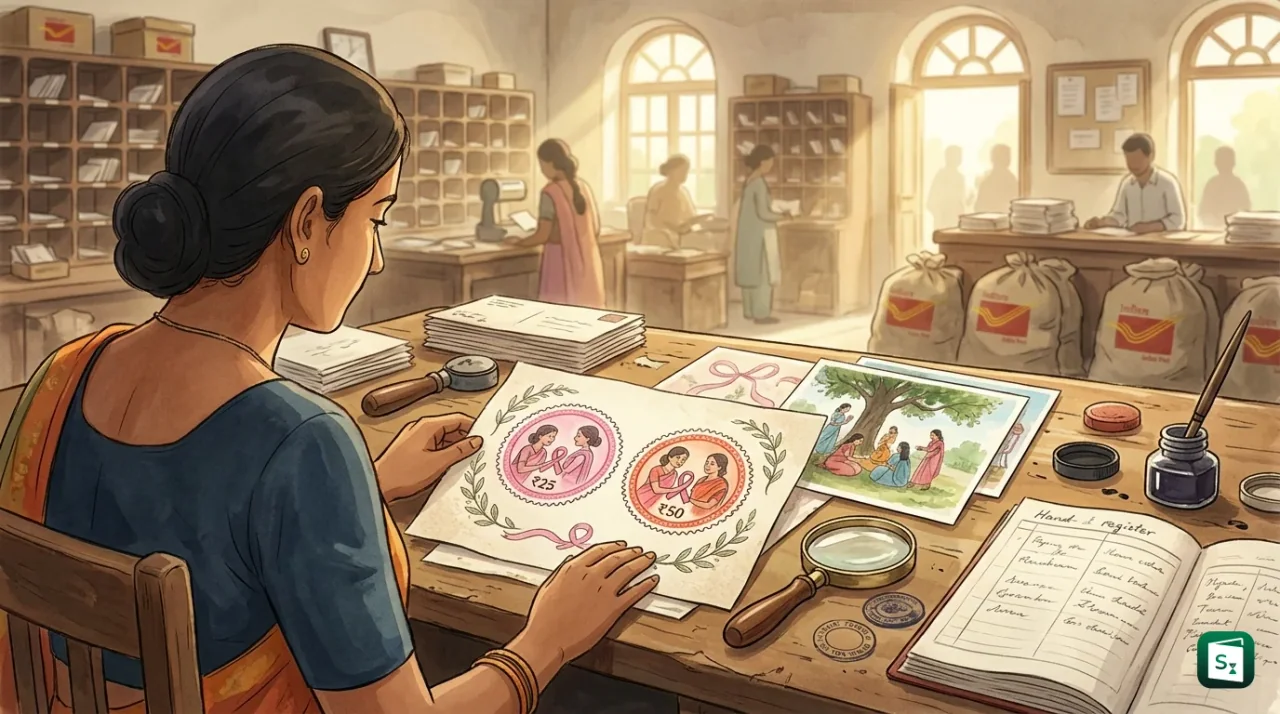
The Department of Posts released two commemorative stamps of ₹25 and ₹50 with picture postcards on breast cancer awareness at Dak Bhawan, New Delhi on 30 October 2026. The issue marks International Breast Cancer Awareness Month in October and uses the postal network to promote early detection and timely treatment.
What Is Breast Cancer and How Is It Detected?
Breast cancer is a disease in which cells in the breast grow in an uncontrolled way and form a lump or tumour. It is the most common cancer among women in India and in the world. When found early, while it is still small and has not spread, treatment works better and survival is much higher.
The exact cause of breast cancer is not single. Risk rises with increasing age, obesity, low physical activity, alcohol use and exposure to certain hormones after menopause. Only 5 to 10 percent of cases are linked to inherited gene changes passed through families. Having a close relative with breast cancer raises risk, but most cases occur in women with no strong family history.
Detection rests on screening, which means checking for cancer before clear symptoms appear. Common methods include breast self-examination, clinical breast examination and mammography. Self-examination means a woman becomes familiar with how her breasts normally look and feel and reports any new lump, change in size or shape, skin dimpling, nipple inversion or discharge to a doctor. In a clinical examination, a trained health worker checks the breast and underarm for lumps or changes. A mammogram is a low dose X-ray of the breast that can find small changes years before they can be felt. Doctors may also use ultrasound or magnetic resonance imaging (MRI) for women at high risk or to study a doubtful finding in detail.
What Did India Post Release for Breast Cancer Awareness?
The Department of Posts issued a souvenir sheet containing two commemorative postage stamps on breast cancer awareness on 30 October 2026. The Department released the issue at Dak Bhawan in New Delhi to mark International Breast Cancer Awareness Month in October. Punya Salila Srivastava, Union Health Secretary, and Manisha Sinha, Director General of Postal Services, jointly released the stamps with senior officials from both ministries present.
The issue has two round stamps with face values of ₹25 and ₹50. One stamp depicts breast self-examination. The sheet was printed at the Security Printing Press, Hyderabad by wet offset process. The Department also released a set of picture postcards carrying awareness messages prepared with technical inputs, reference material and background information from the Ministry of Health and Family Welfare.
| Item | Detail |
|---|---|
| Issue date | 30 October 2026 |
| Venue | Dak Bhawan, New Delhi |
| Format | Souvenir sheet with two commemorative stamps |
| Denominations | ₹25 and ₹50 |
| Companion item | Set of picture postcards |
| Released by | Punya Salila Srivastava and Manisha Sinha |
| Availability | Philately Bureaus across India and e-Post Office portal |
At Dak Bhawan, the Department also organised awareness sessions with Fortis Hospital on breast and cervical cancer. The sessions included interactive training in Basic Life Support (BLS) and Cardiopulmonary Resuscitation (CPR).
What Is a Commemorative Stamp and How Is It Different?
A commemorative stamp is a postage stamp issued for a limited period to honour a person, event, theme or cause. It is printed in limited numbers and is sold mainly through Philately Bureaus and philatelic deposit accounts. This breast cancer issue is a commemorative because it marks a specific health cause in October 2026.
It differs from a definitive stamp, which is printed in large numbers for everyday postal use over a long period. Definitives cover regular postal rates and stay on sale for years. Commemoratives carry a message and attract collectors, so many are never used for mail.
| Feature | Definitive stamp | Commemorative stamp |
|---|---|---|
| Purpose | Everyday postage | Marks a person, event or cause |
| Print run | Large and repeated | Limited and one time |
| Sale period | Long, often years | Short, till stocks last |
| Availability | All post offices | Mainly Philately Bureaus and e-Post Office portal |
| Example | Regular series on flora or national symbols | Breast cancer awareness stamps of ₹25 and ₹50 |
The breast cancer stamps were issued in a souvenir sheet. A souvenir sheet is a small decorative sheet in which the stamps are issued only in that sheet form. The margins carry designs that extend the theme. Collectors value such sheets because the full sheet tells the story at a glance.
Department of Posts: Backbone of the Initiative
The Department of Posts, known as India Post, functions under the Ministry of Communications. The Department was established on 1 October 1854 and is headquartered at Dak Bhawan, Sansad Marg, New Delhi. India Post runs the largest postal network in the world with more than 1.64 lakh post offices, including about 1.49 lakh rural post offices.
The idea for the breast cancer stamps came from the Department itself. Health officials provided the medical content, while postal officials turned it into stamp and postcard designs. Manisha Sinha, Director General of Postal Services, said commemorative stamps carry national priorities beyond geographical limits. The wide reach of post offices helps take health messages to remote areas where access to information is weak.
India Post regularly issues commemorative stamps with a First Day Cover and an information brochure. The philatelic network of bureaus and the e-Post Office portal makes new issues available to collectors in all states. Postcards add a personal touch. Officials noted that a postcard can serve as a message of support and encouragement for women under treatment.
Breast Cancer in India: Scale of the Challenge
Breast cancer is the most common cancer among women in India. It accounts for more than 30 percent of all new cancers diagnosed in women and about 27 percent of female cancers in registry data. India reported more than two lakh new breast cancer cases in 2024. Current estimates suggest that one in every 29 women faces the risk of developing the disease in her lifetime.
Late detection remains the main concern. A large share of patients reach hospitals at locally advanced stages, when treatment is longer and survival is lower. When the disease is found at a localised early stage, the five year survival is above 90 percent in global studies. Fear, stigma and gaps in access to screening delay care for many women, especially outside large cities.
Population studies show that breast cancer incidence has risen steadily across Indian registries over recent decades, partly linked to urbanisation and changes in lifestyle. At the same time, many cases are preventable through healthy habits, while another large share can be cured if caught early. This twin fact explains the official stress on regular screening and self-awareness.
How India Screens and Treats Breast Cancer Under NP-NCD
The National Programme for Prevention and Control of Non-Communicable Diseases (NP-NCD) anchors cancer screening in India. The programme started in 2010 to control hypertension, diabetes, cardiovascular disease, cancer, stroke and other chronic diseases. Population based screening under the programme covers all persons above 30 years of age for diabetes, hypertension and three common cancers of the oral cavity, breast and cervix.
Screening begins close to homes at Ayushman Arogya Mandirs and primary health centres. More than 1.80 lakh such mandirs are now operational. Health workers use a Community Based Assessment Checklist to list eligible persons and invite them for checks. Women in the 30 to 65 year group can access clinical breast examination and referral for mammography at higher centres.
The official data shared at the stamp release shows the scale. A total of 86.97 crore screenings have been recorded for the three cancers, including 49.02 crore for oral cancer, 22.90 crore for breast cancer and 14.05 crore for cervical cancer. About 5.50 lakh persons are currently under treatment, including 1.43 lakh breast cancer patients. Confirmed cases move from primary centres to district hospitals, District NCD Clinics, Day Care Cancer Centres, State Cancer Institutes and Tertiary Care Cancer Centres for full treatment closer to home.
Why October Is Observed as Breast Cancer Awareness Month
Breast Cancer Awareness Month is an international health campaign held every year from 1 to 31 October. It promotes education on risk factors, regular screening and support for persons affected by the disease. The period is also called Pink October because the pink ribbon is its global symbol.
The observance began in the United States in 1985 as a week long campaign by the American Cancer Society with the pharma division of Imperial Chemical Industries. It later expanded into a month long event focused on mammography and early detection. In 1991, American activist Charlotte Haley made peach coloured ribbons to demand more funds for prevention. In 1992, SELF magazine and Evelyn Lauder of Estee Lauder adopted a pink version and distributed about 15 lakh pink ribbons with self-exam cards across stores. The pink ribbon then spread worldwide.
During October, buildings are lit in pink and walks and runs raise funds for research. In India, the month is used by central and state health agencies to push population screening and to reduce stigma around breast checks.
Key Takeaways
- The Department of Posts released a souvenir sheet with two commemorative stamps of ₹25 and ₹50 and picture postcards on 30 October 2026 at Dak Bhawan, New Delhi.
- The release marked International Breast Cancer Awareness Month, observed from 1 to 31 October every year with the pink ribbon as its symbol.
- The stamps were jointly released by Union Health Secretary Punya Salila Srivastava and Director General of Postal Services Manisha Sinha.
- The Department of Posts, established on 1 October 1854 under the Ministry of Communications, is headquartered at Dak Bhawan and runs the largest postal network in the world.
- Breast cancer is the most common cancer among women in India with more than two lakh new cases in 2024, and India has recorded 22.90 crore breast cancer screenings under the NP-NCD programme.